Have you ever needed to describe something that is built into the very nature of a person, object, or system? You want to explain that a quality is essential and cannot be separated from its source, and the word “inherently” comes to mind. But is it the best fit for your audience? Choosing the right synonym for “inherently” can transform a vague description into a precise, authoritative statement. This guide explores the best synonyms of inherently, explaining exactly which word to use and when.
Quick Ans: “Inherently” means existing as a natural, essential, or permanent part of something. It is a formal adverb that indicates an inseparable quality. For formal writing, choose intrinsically or essentially. For casual conversation, use naturally or basically. In academic contexts, constitutively and fundamentally are strong choices. For a stronger, more dramatic impact, select indelibly or innately.
Meaning, Tone, and Context
Understanding the core meaning of “inherently” is the first step to using it effectively.
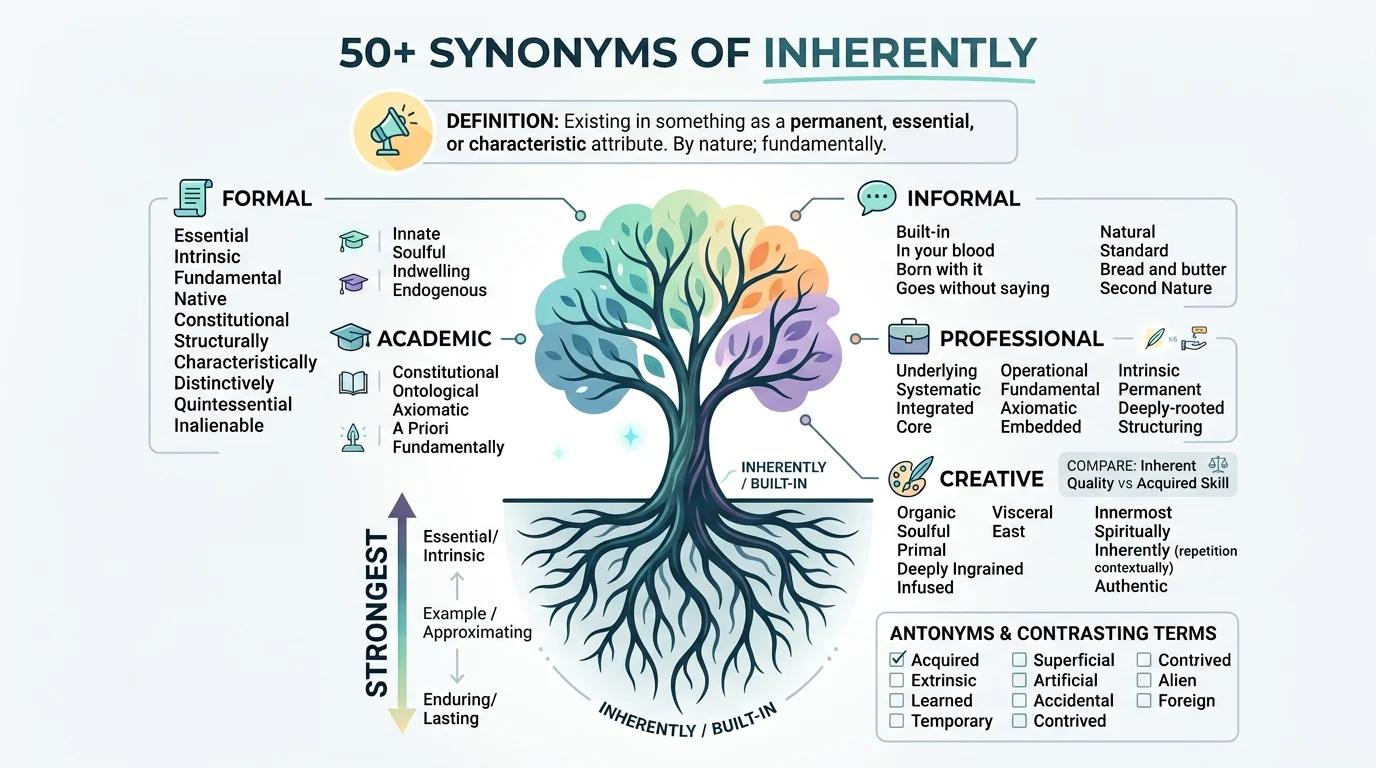
Simple Definition: In a way that is permanent and essential. Belonging to the basic nature of something.
Part of Speech: Adverb.
Overall Tone: Formal and precise. It indicates a quality that cannot be removed.
Formality Level: Formal. The word is sophisticated and suits academic, professional, and philosophical writing.
Common Uses: Native English speakers use it to describe unavoidable qualities. For example, “The system is inherently flawed,” or “She is inherently kind.”
Word Forms: Related words include the adjective inherent and the noun inherence.
When and How to Use “Inherently”
“Inherently” is the perfect choice when you want to emphasize that a quality is permanent and essential. Here are seven realistic examples.
Professional: “Remote work is not inherently less productive than office work.”
Academic: “The theory is inherently limited by its reliance on outdated data.”
Workplace: “Collaboration is inherently valuable for creative problem-solving.”
Personal: “He is inherently cautious when making financial decisions.”
Email: “The proposal is inherently risky, and we need to address those risks.”
Resume: “Developed solutions for inherently complex logistical challenges.”
Social Media: “Change is inherently uncomfortable, but it leads to growth.”
Best Synonyms of “Inherently”
No synonym is identical in every situation. Here is your guide to the best replacement for “inherently” based on your writing context.
Professional Writing: Intrinsically. It suggests a value or quality that exists within. “Customer satisfaction is intrinsically linked to product quality.”
Academic Writing: Constitutively. This is ideal when discussing essential components. “Trust is constitutively necessary for social cohesion.”
Business Communication: Fundamentally. A practical choice for describing core issues. “We need to fundamentally rethink our strategy.”
Casual Conversation: Naturally. It tones down the formality, meaning in a natural way. “She is naturally good at public speaking.”
Emotional Writing: Indelibly. This word carries weight, suggesting something is permanently marked. “The experience was indelibly etched in her memory.”
Creative Writing: Innately. It implies a quality present from birth. “He possessed an innately artistic sensibility.”
Resume Writing: Essentially. Use it to describe core competencies. “Essentially, I bridge the gap between technical and non-technical teams.”
When Not to Use “Inherently”
Using “inherently” can sound too formal or absolute in certain situations.
When It Sounds Too Formal: In casual conversation, “inherently” sounds academic.
Better Choice: Naturally or basically. “She is naturally shy” is more natural than “She is inherently shy.”
When It Is Too Absolute: “Inherently” implies something cannot change. This might be too strong.
Better Choice: Typically or often. “He is typically late” is more accurate than “He is inherently late.”
When Describing Temporary States: “Inherently” describes permanent qualities. It does not fit temporary conditions.
Better Choice: Currently or presently. “The system is currently broken” is better than “The system is inherently broken.”
When It Sounds Too Philosophical: “Inherently” can sound overly intellectual in simple contexts.
Better Choice: Simply or just. “It is simply a matter of time” is more natural.
Words Commonly Confused With “Inherently”
Several words are often mixed up with “inherently.” Here is how to keep them straight.
Word: Intrinsically
Difference: Focuses on value or worth coming from within. “Inherently” is broader.
When to Use: Use it when discussing value, motivation, or reward.
Example: “Volunteering is intrinsically rewarding.”
Word: Essentially
Difference: Means basically or fundamentally. “Inherently” emphasizes permanence.
When to Use: Use it when summarizing the core of something.
Example: “The plan is essentially the same as before.”
Word: Naturally
Difference: Means in a natural or expected way. “Inherently” is more formal.
When to Use: Use it for casual conversation or describing talents.
Example: “He naturally gravitates toward leadership roles.”
Word: Fundamentally
Difference: Means at the most basic level. “Inherently” emphasizes essential nature.
When to Use: Use it for foundational changes or core issues.
Example: “The two systems are fundamentally different.”
Word: Innately
Difference: Means present from birth. “Inherently” can apply to any permanent quality.
When to Use: Use it for traits present from the beginning.
Example: “She possesses an innately optimistic outlook.”
Word: Constitutively
Difference: Means forming a necessary part. “Inherently” is more general.
When to Use: Use it in technical or academic contexts.
Example: “Water is constitutively essential for life.”
Best Synonyms of “Inherently” by Context
| Context | Best Synonym | Why It Works | Example |
|---|---|---|---|
| Formal writing | Intrinsically | Suggests value or quality from within. | “The work is intrinsically meaningful to the community.” |
| Academic writing | Constitutively | Emphasizes essential components. | “Language is constitutively social in nature.” |
| Professional communication | Fundamentally | Conveys core, basic importance. | “We must fundamentally address the root cause.” |
| Business emails | Essentially | Clear and concise for summarizing. | “Essentially, we need to cut costs.” |
| Resume writing | Intrinsically | Highlights core motivation or value. | “I am intrinsically motivated to solve complex problems.” |
| Workplace communication | Naturally | Neutral and factual without being dramatic. | “She naturally excels in client relationships.” |
| Casual conversation | Basically | Simple, direct, and easily understood. | “He is basically a good person.” |
| Creative writing | Innately | Suggests an inborn quality. | “She possessed an innately poetic soul.” |
| Emotional writing | Indelibly | Expresses a permanent, unerasable mark. | “The tragedy was indelibly imprinted on his memory.” |
| Strong emphasis | Indelibly | The most powerful, permanent synonym. | “The lesson was indelibly burned into their minds.” |
| Mild tone | Typically | Simple and unassuming. Good for everyday observations. | “He is typically late to meetings.” |
| Social media captions | Naturally | Casual, relatable, and widely understood. | “Change is naturally uncomfortable, but it is necessary.” |
How to Choose the Best Synonym of “Inherently”
Choosing the right word is a simple decision. Answer these questions.
What is my audience? For a professor or CEO, intrinsically or fundamentally is powerful. For a friend, naturally or basically is more natural.
What is my purpose? Are you trying to be precise, persuasive, or informal? Use constitutively for precision, essentially for persuasion, and naturally for informality.
Am I describing an abstract quality or a concrete fact? For abstract qualities, intrinsically or innately are good. For concrete facts, fundamentally or basically are better.
What is the emotional strength? Indelibly is the strongest. Basically is the mildest. Pick the one that matches your message.
Real Life Examples of “Inherently”
To truly master the word, it helps to see how it behaves in the wild and how a stronger synonym can elevate the sentence.
School: Basic: “The experiment is inherently flawed.” Improved: “The experiment is fundamentally flawed in its design.”
College: Basic: “The concept is inherently difficult.” Improved: “The concept is intrinsically difficult for beginners.”
Workplace: Basic: “Teamwork is inherently important.” Improved: “Teamwork is fundamentally important for project success.”
Business: Basic: “The product is inherently valuable.” Improved: “The product is intrinsically valuable to our customers.”
Email: Basic: “The decision is inherently risky.” Improved: “The decision is inherently risky and requires careful analysis.”
Conversation: Basic: “She is inherently kind.” Improved: “She is naturally kind to everyone she meets.”
Storytelling: Basic: “The memory was inherently painful.” Improved: “The memory was indelibly painful, never fading with time.”
Top 10 Synonyms of “Inherently”
| Synonym | Simple Meaning | Best Used For | Example Sentence |
|---|---|---|---|
| Intrinsically | From within; by its very nature | Formal, professional, and value-related contexts. | “The work is intrinsically rewarding.” |
| Essentially | Basically; at its core | Business, everyday, and summarizing contexts. | “Essentially, the problem is funding.” |
| Fundamentally | At the most basic level | Professional, academic, and change-related contexts. | “We must fundamentally change our approach.” |
| Naturally | In a natural or expected way | Casual conversation and talent descriptions. | “He is naturally gifted at music.” |
| Innately | Present from birth; inborn | Creative, psychological, and trait descriptions. | “She has an innately curious mind.” |
| Constitutively | Forming a necessary part | Academic, scientific, and philosophical contexts. | “Trust is constitutively necessary for teamwork.” |
| Indelibly | Permanently; unerasably | Emotional, dramatic, and memory-related contexts. | “The moment was indelibly etched in history.” |
| Basically | Simply; at the most basic level | Casual conversation and simple explanations. | “Basically, the plan will not work.” |
| Per se | In itself; by itself | Legal, philosophical, and precise contexts. | “The policy is not harmful per se.” |
| Inherent (used as adverb) | In the essential nature | When the adjective form is preferred. | “The system is inherently flawed.” |
Synonyms of “Inherently” by Usage
Professional vs. Personal Synonyms
In the workplace (professional), choose fundamentally, essentially, or intrinsically to describe core issues or motivations. These words convey seriousness and precision. “Customer satisfaction is intrinsically linked to our success” is more impactful than “Customer satisfaction is linked to our success.”
With friends (personal), naturally, basically, or simply inherently (used sparingly) keep the tone relaxed and relatable. These alternatives sound natural in everyday conversation.
Formal vs. Conversational Synonyms
For formal writing (reports, essays, professional emails), use intrinsically, constitutively, or fundamentally. These choices maintain the sophisticated tone expected in professional documents.
For casual conversations and texting, use naturally, basically, or essentially. These options sound more natural and less pretentious.
Academic Synonyms
For research and essays, choose precise, authoritative words. Constitutively is great for essential components, intrinsically for inherent values, and fundamentally for foundational principles. These words sound considered and scholarly.
Using precise academic vocabulary demonstrates expertise and careful thinking. Professors and reviewers expect this level of precision.
Professional and Business Synonyms
For maximum impact in business writing, choose fundamentally for core changes, intrinsically for value, and essentially for summaries. These words demonstrate confidence and professional awareness.
Business leaders respond to language that conveys certainty and clarity. These synonyms project authority.
Creative and Literary Synonyms
To add emotion and imagery to your writing, choose indelibly, innately, or inherently. These words create atmosphere and drama.
Literary writers use these alternatives to build character and theme. They transform ordinary descriptions into evocative prose.
Slang or Modern Synonyms
There is no direct slang synonym for “inherently” in mainstream American English. The simplest alternative in modern texting is basically or just “just.” This straightforward approach works best for casual digital communication.
Strongest to Mildest Synonyms
Mild: basically, simply, just
Moderate: naturally, essentially, typically
Strong: fundamentally, innately, per se
Very Strong: intrinsically, constitutively, indelibly
Emotional vs. Neutral Synonyms
Emotional Synonyms: Indelibly, innately. These words often hint at permanence, depth, or dramatic significance. Use them when you want to evoke feeling.
Neutral Synonyms: Basically, essentially, fundamentally. These words simply communicate factual information. Use them when you want to inform without emotional coloring.
Antonyms of “Inherently”
Here are 15 genuine opposites of “inherently.”
| Antonym | Meaning | Example Sentence |
|---|---|---|
| Externally | From outside; not from within | “The decision was externally imposed on the team.” |
| Superficially | On the surface; not deeply | “The changes were superficially significant.” |
| Temporarily | For a limited time | “The solution is temporarily effective.” |
| Accidentally | By chance; not by design | “The error was accidentally introduced.” |
| Incidentally | As a minor or secondary matter | “The problem was incidentally related to the main issue.” |
| Peripherally | On the edge; not centrally | “The issue was peripherally relevant to the discussion.” |
| Contingently | Dependent on something else | “The plan is contingently based on funding.” |
| Extrinsically | From outside; not inherent | “The motivation was extrinsically driven.” |
| Artificially | Made by humans; not natural | “The flavor was artificially enhanced.” |
| Coincidentally | By coincidence; not intentionally | “The events were coincidentally similar.” |
| Externally | From an external source | “The change was externally driven.” |
| Secondarily | Not primarily important | “The issue was secondarily relevant.” |
| Incidentally | In a secondary way | “The point was incidentally raised.” |
| Superficially | On the surface only | “The policy was superficially appealing.” |
| Temporarily | For a short time | “The improvement was temporarily beneficial.” |
Comparison: “Inherently” vs Similar Words
Inherently vs. Intrinsically
Main Difference: Inherently describes essential nature. Intrinsically focuses on value coming from within.
Which Is Stronger? Intrinsically often carries more weight for value judgments.
Which Is More Formal? Both are formal.
When to Use Each: Use inherently for essential qualities. Use intrinsically for value and motivation.
Examples:
Inherently: “The system is inherently flawed.”
Intrinsically: “The work is intrinsically rewarding.”
Inherently vs. Essentially
Main Difference: Inherently emphasizes permanent nature. Essentially emphasizes core components.
Which Is Stronger? Inherently is stronger for permanence.
Which Is More Formal? Inherently is more formal.
When to Use Each: Use inherently for what cannot change. Use essentially for summarizing.
Examples:
Inherently: “She is inherently kind.”
Essentially: “Essentially, the plan will not work.”
Inherently vs. Fundamentally
Main Difference: Inherently focuses on essential nature. Fundamentally focuses on the most basic level.
Which Is Stronger? Fundamentally is stronger for foundational change.
Which Is More Formal? Both are very formal.
When to Use Each: Use inherently for qualities. Use fundamentally for changes or root causes.
Examples:
Inherently: “The design is inherently flawed.”
Fundamentally: “We need to fundamentally change the design.”
Inherently vs. Naturally
Main Difference: Inherently is formal and philosophical. Naturally is casual and expected.
Which Is Stronger? Inherently is more definitive.
Which Is More Formal? Inherently is far more formal.
When to Use Each: Use inherently for formal writing. Use naturally for everyday conversation.
Examples:
Inherently: “The system is inherently risky.”
Naturally: “He naturally took the lead.”
Inherently vs. Innately
Main Difference: Inherently can apply to anything. Innately specifically means from birth.
Which Is Stronger? Innately is more specific.
Which Is More Formal? Both are formal.
When to Use Each: Use inherently for general essential qualities. Use innately for inborn traits.
Examples:
Inherently: “The process is inherently complex.”
Innately: “She is innately musical.”
Inherently vs. Indelibly
Main Difference: Inherently describes essential nature. Indelibly describes something permanently marked.
Which Is Stronger? Indelibly is much more dramatic.
Which Is More Formal? Both are formal.
When to Use Each: Use inherently for qualities. Use indelibly for experiences or memories.
Examples:
Inherently: “The system is inherently insecure.”
Indelibly: “The event was indelibly etched in memory.”
Common Phrases and Expressions with “Inherently”
Phrase: Inherently flawed
Meaning: Having a fundamental weakness that cannot be fixed.
Example Sentence: “The plan was inherently flawed from the start.”
Phrase: Inherently risky
Meaning: Dangerous or uncertain by its very nature.
Example Sentence: “Investing in startups is inherently risky.”
Phrase: Inherently valuable
Meaning: Having worth that comes from within.
Example Sentence: “Education is inherently valuable to society.”
Phrase: Inherently human
Meaning: A quality that is essential to being human.
Example Sentence: “Making mistakes is inherently human.”
Phrase: Inherently difficult
Meaning: Hard by its very nature.
Example Sentence: “Learning a new language is inherently difficult.”
Common Mistakes to Avoid
Mistake 1: Using “inherently” when you mean “naturally”.
Incorrect: “He is inherently good at math.”
Better: “He is naturally good at math.”
Why: “Naturally” is more appropriate for casual conversations about talent.
Mistake 2: Using “inherently” when you mean “typically”.
Incorrect: “He is inherently late to meetings.”
Better: “He is typically late to meetings.”
Why: Being late is not an essential quality; it is a habit.
Mistake 3: Overusing “inherently” in casual conversation.
Incorrect: “This coffee is inherently cold.”
Better: “This coffee is basically cold.”
Why: “Inherently” is too formal for such a trivial observation.
Mistake 4: Using “inherently” when you mean “essentially”.
Incorrect: “The plan is inherently to raise prices.”
Better: “The plan essentially raises prices.”
Why: “Essentially” summarizes the core; “inherently” describes essential nature.
Mistake 5: Using “inherently” for temporary conditions.
Incorrect: “The system is inherently down today.”
Better: “The system is temporarily down today.”
Why: “Inherently” describes permanent states, not temporary issues.
Frequently Asked Questions
1. What are the best synonyms of “inherently”?
The best synonyms depend on your context. For formal writing, choose intrinsically or fundamentally. And for casual conversation, naturally or basically are ideal choices. For emotional writing, use indelibly or innately.
2. What are the best formal synonyms of “inherently”?
The best formal synonyms are intrinsically, constitutively, and fundamentally. These words are suitable for academic papers, professional reports, and business communications.
3. What are common informal synonyms of “inherently”?
For informal settings, use naturally, basically, or essentially. These alternatives sound more natural in everyday conversation.
4. What is another word for “inherently” in professional writing?
In professional writing, intrinsically is an excellent choice. It conveys value or quality coming from within. Fundamentally is also strong for describing core changes or issues.
5. What is the difference between “inherently” and “intrinsically”?
While both refer to essential qualities, intrinsically often emphasizes value or worth from within. Inherently is broader and simply means “in the essential nature.” Use intrinsically when discussing motivation or reward.
6. What is the opposite of “inherently”?
The most direct opposites (antonyms) of inherently are externally, superficially, and temporarily. These words describe qualities that come from outside or are not permanent.
Conclusion
“Inherently” is a powerful word for describing essential, permanent qualities. The term is formal and precise, yet it can sound stiff or absolute in casual contexts. The best choice among the synonyms of inherently depends entirely on your audience, tone, and purpose. Remember, no single synonym works perfectly in every situation. Your goal is to choose the word that communicates your message with the most clarity and impact. A practical tip for your vocabulary growth is to pay attention to how skilled writers use these words and practice substituting them in your own sentences.
Discover More:-

Amelia Brooks is a professional content writer and digital publishing specialist with a passion for creating clear, engaging, and informative content. She has extensive experience writing about technology, business, lifestyle, and online services.