Have you ever needed to describe something that is balanced, reasonable, or not excessive but felt that “average” or “medium” did not fully capture the nuance? You want to highlight temperance, restraint, or a middle position, and the word “moderate” comes to mind. But is it the best fit for your audience? Choosing the right synonym for “moderate” can transform a simple description into a precise characterization of balance, restraint, or degree. This guide explores the best synonyms of moderate, explaining exactly which word to use and when.
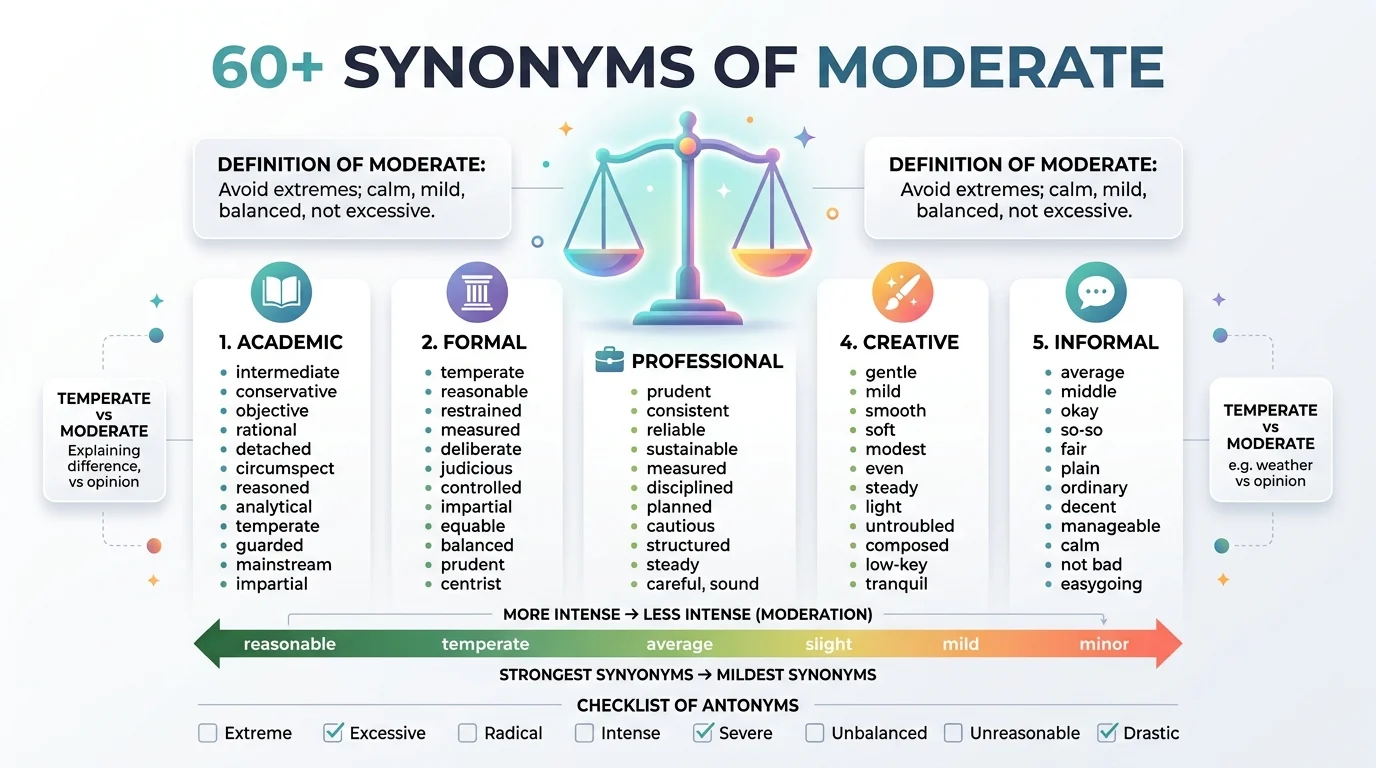
Quick Ans: “Moderate” means average in amount, intensity, or degree, or avoiding extremes. It is a neutral-to-positive adjective. For formal writing, choose temperate or measured. For casual conversation, use medium or reasonable. In academic contexts, intermediate and restrained are strong choices. For a stronger, more dramatic impact, select austere or lenient.
Meaning, Tone, and Context
Understanding the core meaning of “moderate” is the first step to using it effectively.
Simple Definition: Average in size, amount, or degree. Not extreme or excessive. Reasonable and restrained.
Part of Speech: Adjective (also a verb and noun).
Overall Tone: Neutral to positive. It indicates balance, reasonableness, and avoidance of extremes.
Formality Level: Neutral. The word works in most contexts, from casual to formal.
Common Uses: Native English speakers use it to describe amounts, opinions, weather, policies, and personal habits. For example, “The temperature is moderate today,” or “He holds moderate political views.”
Word Forms: Related words include the noun moderation, the adverb moderately, and the verb moderate (to make less extreme).
When and How to Use “Moderate”
“Moderate” is the perfect choice when you want to emphasize balance and reasonableness. Here are seven realistic examples.
Professional: “The company experienced moderate growth in the third quarter.”
Academic: “The study found a moderate correlation between the two variables.”
Workplace: “We need a moderate approach to implementing these changes.”
Personal: “She enjoys moderate exercise, like walking and yoga.”
Email: “Please provide a moderate estimate of the project timeline.”
Resume: “Managed a moderate budget of $500,000 while delivering results.”
Social Media: “Taking a moderate approach to social media has improved my productivity.”
Best Synonyms of “Moderate”
No synonym is identical in every situation. Here is your guide to the best replacement for “moderate” based on your writing context.
Professional Writing: Measured. It suggests careful, thoughtful restraint. “The measured response avoided escalating the conflict.”
Academic Writing: Intermediate. This is ideal when discussing levels or stages. “The intermediate results showed promising trends.”
Business Communication: Reasonable. A practical choice for expectations and goals. “We need a reasonable timeline for the project.”
Casual Conversation: Medium. It tones down the formality and sounds natural. “I would like a medium coffee.”
Emotional Writing: Temperate. This word carries weight, suggesting self-control. “Her temperate nature kept the peace.”
Creative Writing: Mild. It implies gentleness and lack of intensity. “The mild breeze carried the scent of flowers.”
Resume Writing: Conservative. Use it to describe careful or restrained approaches. “I took a conservative approach to risk management.”
When Not to Use “Moderate”
Using “moderate” can sound wrong or awkward in certain situations.
When It Sounds Too Vague: “Moderate” can be unclear if you need exact amounts.
Better Choice: Average or specific number. “The average temperature was 72 degrees.”
When You Mean Minimal: “Moderate” suggests a middle amount, not a small amount.
Better Choice: Minimal or slight. “There was a slight delay in the process.”
When You Mean Extreme: “Moderate” is the opposite of extreme.
Better Choice: Extreme or radical. “His extreme views were controversial.”
When It Sounds Too Formal: In casual conversation, “moderate” can sound a bit formal.
Better Choice: Okay or not too bad. “The weather is okay today.”
Words Commonly Confused With “Moderate”
Several words are often mixed up with “moderate.” Here is how to keep them straight.
Word: Average
Difference: Means the middle point of a set. “Moderate” means not extreme.
When to Use: Use it for mathematical or statistical contexts.
Example: “The average score was 75%.”
Word: Medium
Difference: Means something that is between extremes. “Moderate” is similar but often for intangible things.
When to Use: Use this for sizes, degrees, and physical things.
Example: “I would like a medium pizza.”
Word: Reasonable
Difference: Means sensible and fair. “Moderate” is about degree.
When to Use: Use this for expectations and demands.
Example: “That is a reasonable request.”
Word: Temperate
Difference: Means self-restrained or mild. “Moderate” is more general.
When to Use: Use this for climate, behavior, and character.
Example: “She has a temperate disposition.”
Word: Measured
Difference: Means careful and deliberate. “Moderate” is about amount.
When to Use: Use this for responses and actions.
Example: “He gave a measured reply.”
Word: Mild
Difference: Means gentle and not severe. “Moderate” is stronger than mild.
When to Use: Use this for weather, flavors, and conditions.
Example: “The curry was mild.”
Best Synonyms of “Moderate” by Context
| Context | Best Synonym | Why It Works | Example |
|---|---|---|---|
| Formal writing | Measured | Suggests careful restraint. | “The measured response was appreciated.” |
| Academic writing | Intermediate | Precise for levels and stages. | “The intermediate results were promising.” |
| Professional communication | Reasonable | Emphasizes fairness and logic. | “We need a reasonable solution.” |
| Business emails | Conservative | Professional and restrained. | “We took a conservative estimate.” |
| Resume writing | Balanced | Highlights stability and control. | “Brought a balanced approach to management.” |
| Workplace communication | Moderate | The standard, expected term. | “We expect moderate growth.” |
| Casual conversation | Medium | Simple, natural, and conversational. | “I will take a medium soda.” |
| Creative writing | Mild | Evokes gentleness and subtlety. | “The mild breeze was refreshing.” |
| Emotional writing | Temperate | Suggests self-control and calm. | “His temperate nature kept the peace.” |
| Strong emphasis | Austere | Suggests extreme restraint. | “The austere design was minimalist.” |
| Mild tone | Slight | Simple and unassuming. | “There was a slight change.” |
| Social media captions | Reasonable | Widely understood and relatable. | “Taking a reasonable approach to life.” |
How to Choose the Best Synonym of “Moderate”
Choosing the right word is a simple decision. Answer these questions.
What is my audience? For a professor or CEO, measured or temperate is powerful. For a friend, medium or reasonable is more natural.
What is my purpose? Are you trying to inform, persuade, or describe? Use intermediate for information, measured for persuasion, and medium for description.
Am I describing an amount, a behavior, or a response? For amounts, moderate or medium work. And for behavior, temperate or restrained are better. For responses, measured or reasonable are best.
What is the emotional strength? Austere is stronger. Slight is mild. Pick the one that matches your message.
Real Life Examples of “Moderate”
To truly master the word, it helps to see how it behaves in the wild and how a stronger synonym can elevate the sentence.
School: Basic: “The student showed moderate improvement.” Improved: “The student showed measurable improvement this semester.”
College: Basic: “They found a moderate correlation.” Improved: “They found a statistically significant correlation.”
Workplace: Basic: “We need a moderate approach.” Improved: “We need a balanced approach to satisfy everyone.”
Business: Basic: “The company had moderate success.” Improved: “The company had reasonable success given market conditions.”
Email: Basic: “Please provide a moderate estimate.” Improved: “Please provide a realistic estimate based on current data.”
Conversation: Basic: “The weather is moderate today.” Improved: “The weather is pleasant today, not too hot or cold.”
Storytelling: Basic: “She spoke with moderate volume.” Improved: “She spoke with a measured tone that commanded attention.”
Top 10 Synonyms of “Moderate”
| Synonym | Simple Meaning | Best Used For | Example Sentence |
|---|---|---|---|
| Measured | Careful and restrained | Formal, professional, and response contexts. | “The measured response avoided conflict.” |
| Temperate | Self-restrained and mild | Emotional, character, and climate contexts. | “His temperate nature kept the team calm.” |
| Intermediate | Between two levels | Academic, scientific, and stage contexts. | “The intermediate results were promising.” |
| Reasonable | Sensible and fair | Business, expectations, and demand contexts. | “That is a reasonable request.” |
| Conservative | Restrained and careful | Finance, estimates, and approach contexts. | “We took a conservative approach.” |
| Balanced | Fair and well-proportioned | Leadership, lifestyle, and opinion contexts. | “She has a balanced perspective.” |
| Medium | Between extremes | Sizes, amounts, and casual contexts. | “I would like a medium drink.” |
| Mild | Gentle and not severe | Weather, flavors, and conditions. | “The mild weather was perfect.” |
| Restrained | Held back and controlled | Behavior, responses, and art contexts. | “Her restrained manner was professional.” |
| Slight | Small in degree | Changes, differences, and casual contexts. | “There was a slight delay.” |
Synonyms of “Moderate” by Usage
Professional vs. Personal Synonyms
In the workplace (professional), choose measured, conservative, or reasonable to describe approaches and estimates. These words convey professionalism and care. “The measured response prevented escalation” is more precise than “The moderate response prevented escalation.”
With friends (personal), medium, okay, or not too much keep the tone relaxed and relatable. These alternatives sound natural in everyday conversation.
Formal vs. Conversational Synonyms
For formal writing (reports, essays, professional emails), use temperate, measured, or intermediate. These choices maintain the sophisticated tone expected in professional documents.
For casual conversations and texting, use medium, okay, or not too bad. These options sound more natural and less pretentious.
Academic Synonyms
For research and essays, choose precise, authoritative words. Intermediate is great for levels, moderate for correlations, and temperate for climate or behavior. These words sound considered and scholarly.
Using precise academic vocabulary demonstrates expertise and careful thinking. Professors and reviewers expect this level of precision.
Professional and Business Synonyms
For maximum impact in business writing, choose conservative for estimates, reasonable for expectations, and measured for approaches. These words demonstrate confidence and professional awareness.
Business leaders respond to language that conveys clarity and restraint. These synonyms project authority.
Creative and Literary Synonyms
To add emotion and imagery to your writing, choose mild, gentle, or temperate. These words create atmosphere and tone.
Literary writers use these alternatives to build mood and subtlety. They transform ordinary descriptions into evocative prose.
Slang or Modern Synonyms
In modern American slang, chill or mellow can be used to describe a moderate approach or attitude. For example, “He is pretty chill about everything,” or “She has a mellow vibe.” These are acceptable in casual, friendly contexts. Avoid them in professional or academic writing.
Strongest to Mildest Synonyms
Mild: slight, mild, modest
Moderate: moderate, medium, intermediate
Strong: measured, temperate, restrained
Very Strong: austere, severe, stringent
Emotional vs. Neutral Synonyms
Emotional Synonyms: Temperate, gentle, mild. These words often hint at calm, warmth, or subtlety. Use them when you want to evoke feeling.
Neutral Synonyms: Average, medium, moderate. These words simply communicate factual information. Use them when you want to inform without emotional coloring.
Antonyms of “Moderate”
Here are 15 genuine opposites of “moderate.”
| Antonym | Meaning | Example Sentence |
|---|---|---|
| Extreme | Far beyond the normal | “His extreme views alienated his colleagues.” |
| Excessive | More than is necessary | “The excessive spending caused problems.” |
| Intense | Very strong or extreme | “The intense heat made everyone uncomfortable.” |
| Radical | Far-reaching and extreme | “The radical proposal was rejected.” |
| Severe | Harsh and extreme | “The severe weather caused damage.” |
| Immoderate | Not moderate | “His immoderate demands were unreasonable.” |
| Unreasonable | Not sensible or fair | “The unreasonable deadline was impossible.” |
| Drastic | Having a strong effect | “The drastic changes shocked everyone.” |
| Exorbitant | Unreasonably high | “The exorbitant price was shocking.” |
| Overwhelming | Too much to handle | “The overwhelming response surprised us.” |
| Violent | Strong and forceful | “The violent storm destroyed homes.” |
| Rampant | Spreading unchecked | “The rampant corruption was exposed.” |
| Unrestrained | Not held back | “Her unrestrained laughter filled the room.” |
| Fanatical | Excessively enthusiastic | “His fanatical devotion was concerning.” |
| Outrageous | Shockingly excessive | “The outrageous claim was false.” |
Comparison: “Moderate” vs Similar Words
Moderate vs. Average
Main Difference: Average means the middle point statistically. Moderate means not extreme.
Which Is Stronger? Moderate is stronger for describing balance. Average is neutral.
Which Is More Formal? Both are formal, but average is more statistical.
When to Use Each: Use average for numbers and statistics. Use moderate for qualities and behaviors.
Examples:
Moderate: “The moderate temperature was comfortable.”
Average: “The average score was 75%.”
Moderate vs. Medium
Main Difference: Medium is for physical sizes. Moderate is for intangible qualities.
Which Is Stronger? They are similar in strength. Moderate is more abstract.
Which Is More Formal? Medium is more casual.
When to Use Each: Use medium for sizes and physical things. Use moderate for qualities and conditions.
Examples:
Moderate: “She has a moderate approach.”
Medium: “I will take a medium pizza.”
Moderate vs. Reasonable
Main Difference: Reasonable means sensible. Moderate means not extreme.
Which Is Stronger? Reasonable is stronger for fairness. Moderate is about degree.
Which Is More Formal? Both are formal.
When to Use Each: Use reasonable for expectations and demands. Use moderate for amounts and degrees.
Examples:
Moderate: “The moderate rainfall was welcome.”
Reasonable: “That is a reasonable price.”
Moderate vs. Temperate
Main Difference: Temperate suggests self-control. Moderate is about degree.
Which Is Stronger? Temperate is stronger for character.
Which Is More Formal? Both are formal.
When to Use Each: Use temperate for behavior and climate. Use moderate for general amounts.
Examples:
Moderate: “The moderate approach worked.”
Temperate: “His temperate nature kept the peace.”
Moderate vs. Measured
Main Difference: Measured suggests careful thought. Moderate is about amount.
Which Is Stronger? Measured is stronger for deliberate action.
Which Is More Formal? Both are formal.
When to Use Each: Use measured for responses and actions. Use moderate for amounts and degrees.
Examples:
Moderate: “The moderate increase was expected.”
Measured: “He gave a measured reply.”
Moderate vs. Mild
Main Difference: Mild means gentle. Moderate means in the middle.
Which Is Stronger? Moderate is stronger than mild.
Which Is More Formal? Both are formal.
When to Use Each: Use mild for weather, flavors, and conditions. Use moderate for amounts and degrees.
Examples:
Moderate: “There was a moderate risk.”
Mild: “The curry was mild.”
Common Phrases and Expressions with “Moderate”
Phrase: Moderate amount
Meaning: A reasonable, not excessive quantity.
Example Sentence: “A moderate amount of exercise is beneficial.”
Phrase: Moderate views
Meaning: Political or social opinions that are not extreme.
Example Sentence: “The candidate holds moderate views on most issues.”
Phrase: Moderate success
Meaning: Some success, but not outstanding.
Example Sentence: “The campaign had moderate success.”
Phrase: Moderate climate
Meaning: A climate that is not extreme.
Example Sentence: “The city enjoys a moderate climate year-round.”
Phrase: Moderate pace
Meaning: A speed that is not too fast or slow.
Example Sentence: “He walked at a moderate pace.”
Phrase: Moderate exercise
Meaning: Physical activity that is not too intense.
Example Sentence: “Moderate exercise like walking is recommended.”
Common Mistakes to Avoid
Mistake 1: Using “moderate” when you mean “average”.
Incorrect: “The moderate score was 70%.”
Better: “The average score was 70%.”
Why: Average is statistical. Moderate is about degree.
Mistake 2: Using “moderate” for small amounts.
Incorrect: “There was a moderate drop in sales of 1%.”
Better: “There was a slight drop in sales of 1%.”
Why: Moderate means middle, not small.
Mistake 3: Using “moderate” for extreme positions.
Incorrect: “His moderate views were very conservative.”
Better: “His conservative views were extreme.”
Why: Moderate means between extremes.
Mistake 4: Overusing “moderate” in casual conversation.
Incorrect: “I have a moderate amount of money.”
Better: “I have enough money.”
Why: Moderate sounds too formal.
Mistake 5: Confusing “temperate” with “moderate”.
Incorrect: “The temperate amount was sufficient.”
Better: “The moderate amount was sufficient.”
Why: Temperate is for behavior and climate.
Frequently Asked Questions
1. What are the best synonyms of “moderate”?
The best synonyms depend on your context. For formal writing, choose measured or temperate. And for casual conversation, medium or reasonable are ideal choices. For academic writing, use intermediate.
2. What are the best formal synonyms of “moderate”?
The best formal synonyms are measured, temperate, and conservative. These words are suitable for academic papers, professional reports, and business communications.
3. What are common informal synonyms of “moderate”?
For informal settings, use medium, reasonable, or okay. These alternatives sound more natural in everyday conversation.
4. What is another word for “moderate” in professional writing?
In professional writing, measured is an excellent choice. It conveys careful restraint and thoughtfulness. Conservative is also strong for estimates and approaches.
5. What is the difference between “moderate” and “temperate”?
While both indicate restraint, moderate is about degree. Temperate is about behavior and self-control. Use temperate for character and climate.
6. What is the opposite of “moderate”?
The most direct opposites (antonyms) of moderate are extreme, excessive, and immoderate. These words describe things that are far beyond the normal.
Conclusion
“Moderate” is a versatile and valuable word for describing balance, restraint, and middle positions. The term is neutral and widely accepted in most contexts, yet it can sound too vague or too formal in certain situations. The best choice among the synonyms of moderate depends entirely on your audience, tone, and purpose. Remember, no single synonym works perfectly in every situation. Your goal is to choose the word that communicates your message with the most clarity and impact. A practical tip for your vocabulary growth is to practice using different synonyms in your daily writing and notice how they affect the tone of your communication.
Discover More:
- 50+ Synonyms of Check: Meanings, Uses, Examples, and Best Alternatives 2026
- 50+ Synonyms of Beneficial: Meanings, Uses, Examples, and Best Alternatives 2026

Ella Parker is a professional content writer with a passion for creating clear, engaging, and well-researched articles. She focuses on delivering valuable insights and practical information across business, technology, and lifestyle topics.