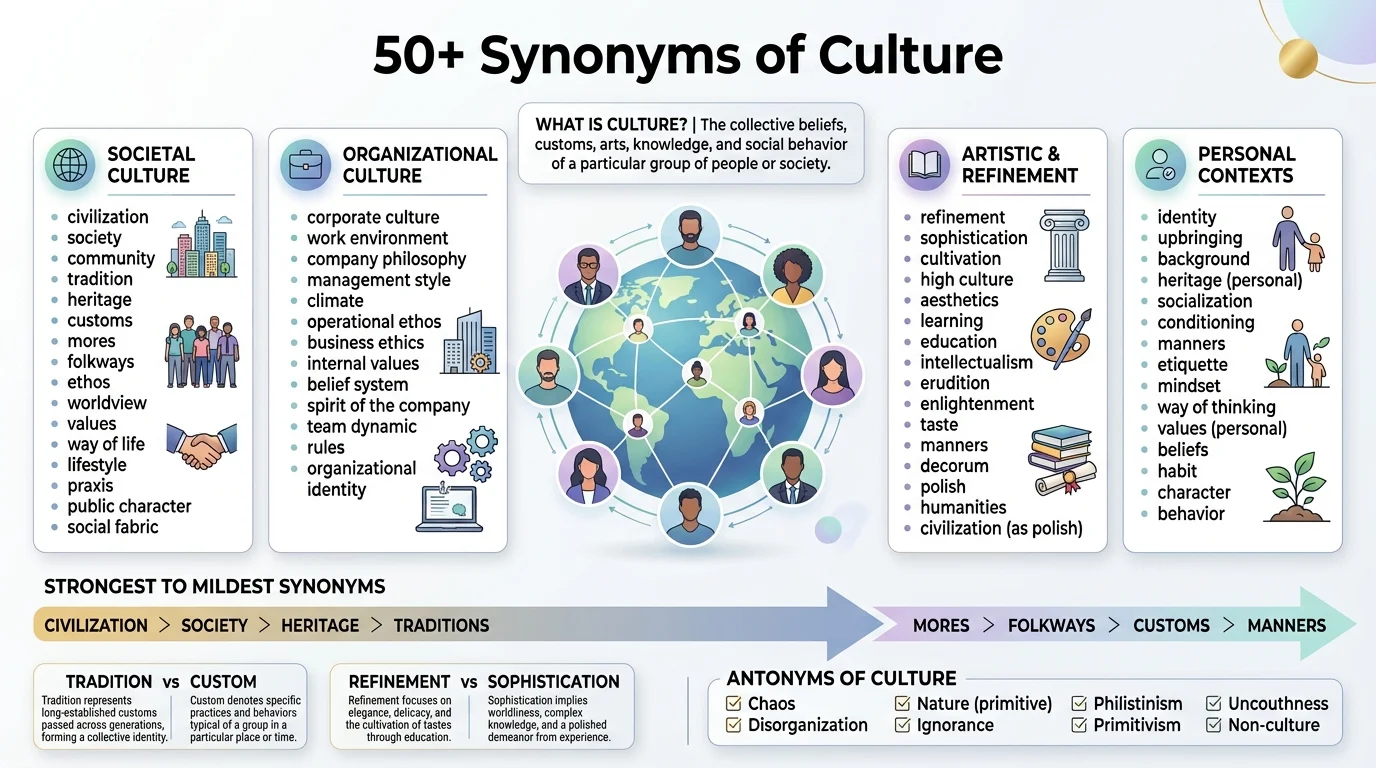
Have you ever struggled to describe the shared values, customs, or artistic achievements of a group but felt that “culture” sounded too broad or vague? You want to capture the essence of a society, organization, or way of life, and the word “culture” comes to mind. But is it the best fit for your audience? Choosing the right synonym for “culture” can transform a general statement into a precise description of civilization, refinement, or shared identity. This guide explores the best synonyms of culture, explaining exactly which word to use and when.
Quick Ans: “Culture” means the customs, arts, social institutions, and achievements of a particular nation, people, or other social group. It also refers to the development or refinement of mind, taste, and manners. For describing a society, choose civilization or society. For refinement and taste, use polish or refinement. In business contexts, ethos or values are strong choices. For the arts, use the arts or humanities.
Meaning, Tone, and Context
Understanding the core meaning of “culture” is the first step to using it effectively.
Simple Definition: The ideas, customs, and social behavior of a particular people or society . Also, the arts and other manifestations of human intellectual achievement regarded collectively.
Part of Speech: Noun (also a verb, meaning to grow microorganisms) .
Overall Tone: Neutral to positive. It indicates sophistication, shared identity, or intellectual development.
Formality Level: Neutral to formal. The word works in most contexts.
Common Uses: Native English speakers use it to describe national identity, corporate values, artistic achievements, and personal refinement. For example, “French culture is rich in history,” or “The company has a culture of innovation.”
Word Forms: Related words include the adjective cultural, the adverb culturally, and the verb cultivate.
When and How to Use “Culture”
“Culture” is the perfect choice when you want to describe shared identity or refinement. Here are seven realistic examples.
Professional: “Our corporate culture emphasizes collaboration and innovation.”
Academic: “The study examines the culture of the ancient Mayan civilization.”
Workplace: “Building a strong culture of safety is our top priority.”
Personal: “Traveling has exposed me to so many different cultures.”
Email: “We need to foster a culture of accountability within the team.”
Resume: “Developed programs to enhance company culture and employee engagement.”
Social Media: “Exploring the local culture is my favorite part of traveling.”
Best Synonyms of “Culture”
No synonym is identical in every situation. Here is your guide to the best replacement for “culture” based on your writing context.
Social Context: Civilization. It suggests an advanced state of human society. “Ancient Egyptian civilization was remarkably advanced” .
Organizational Context: Ethos. This describes the guiding beliefs of a group. “The company’s ethos emphasizes customer service.”
Refinement: Polishing. It suggests a high degree of sophistication. “He had the polish of a trained diplomat” .
Lifestyle: Way of life. A practical choice for everyday descriptions. “The traditional way of life was being eroded” .
Arts: The arts. Use it when discussing creative achievements. “France’s Minister of Culture and the Arts” .
Values Context: Beliefs. It describes the shared principles of a group.
Personal Development: Refinement. It suggests cultivated taste and manners .
When Not to Use “Culture”
Using “culture” can sound wrong or vague in certain situations.
When You Mean the Arts Specifically: “Culture” includes more than the arts. The arts is more precise.
Better Choice: The arts or humanities. “She has a deep appreciation for the arts.”
When You Mean a Specific Custom: “Culture” is broad. Custom or tradition is more specific.
Better Choice: Tradition. “The tradition of giving gifts is important here.”
When It Sounds Too Vague: “Culture” can be overused.
Better Choice: Values or norms. “The company’s values guide decision-making.”
When Describing Farming: “Culture” has a biological meaning . Cultivation or agriculture is clearer.
Better Choice: Cultivation. “The cultivation of crops is essential” .
Words Commonly Confused With “Culture”
Several words are often mixed up with “culture.” Here is how to keep them straight.
Word: Civilization
Difference: Refers to an advanced stage of human development. “Culture” can be a part of it.
When to Use: Use it for large societies with complex systems.
Example: “The Roman civilization was known for its engineering” .
Word: Society
Difference: Refers to a community of people. “Culture” is their shared behavior.
When to Use: Use this for groups of people living together.
Example: “This reflects the values in our society” .
Word: Ethos
Difference: Refers to the guiding beliefs of a group. “Culture” is broader.
When to Use: Use this for the character of an organization.
Example: “The ethos of the company is customer-first.”
Word: Refinement
Difference: Refers to cultivated taste. “Culture” can mean this also.
When to Use: Use this for personal sophistication.
Example: “She displayed refinement and good manners” .
Word: Cultivation
Difference: Refers to development or growing. “Culture” shares this meaning.
When to Use: Use this for the rearing of plants or animals .
Example: “The cultivation of oysters is a local industry” .
Word: Tradition
Difference: Refers to specific customs. “Culture” encompasses all customs.
When to Use: Use this for inherited practices.
Example: “The tradition of family dinners continues.”
Best Synonyms of “Culture” by Context
| Context | Best Synonym | Why It Works | Example |
|---|---|---|---|
| Describing a society | Civilization | Emphasizes advanced society. | “The Inca civilization was sophisticated” . |
| Organizational context | Ethos | Captures guiding beliefs. | “The ethos of the organization is clear.” |
| Personal refinement | Polish | Suggests sophistication. | “His polish and charm impressed everyone” . |
| Everyday lifestyle | Way of life | Practical and accessible. | “The traditional way of life was changing” . |
| Artistic context | The arts | Precise for creative fields. | “She was a patron of the arts.” |
| Shared values | Beliefs | Clear and direct. | “The shared beliefs unite the community.” |
| Behavioral norms | Customs | Focuses on specific practices. | “Local customs vary by region.” |
How to Choose the Best Synonym of “Culture”
Choosing the right word is a simple decision. Answer these questions.
What is my audience? For an academic, civilization or refinement is appropriate. For a general reader, way of life or customs is more accessible.
What is my purpose? Are you describing art, behavior, or values? Use the arts for creativity, customs for behavior, and beliefs for values.
Am I describing a society or an individual? For societies, civilization works. For individuals, polish or refinement is better.
What is the emotional strength? Civilization is neutral. Refinement is positive. Ethos is neutral. Pick the one that matches your message.
Real Life Examples of “Culture”
To truly master the word, it helps to see how it behaves in the wild and how a stronger synonym can elevate the sentence.
School: Basic: “We studied the culture of ancient Greece.” Improved: “We studied the civilization of ancient Greece” .
College: Basic: “The culture of the company is important.” Improved: “The ethos of the company guides all decisions.”
Workplace: Basic: “We need a better culture.” Improved: “We need to foster a values-driven environment.”
Business: Basic: “Their brand culture is strong.” Improved: “Their brand identity is strong.”
Email: Basic: “Promoting a culture of learning.” Improved: “Promoting a commitment to continuous learning.”
Conversation: Basic: “Their culture is different.” Improved: “Their way of life is different” .
Storytelling: Basic: “The village had a rich culture.” Improved: “The village preserved customs that were centuries old.”
Top 10 Synonyms of “Culture”
| Synonym | Simple Meaning | Best Used For | Example Sentence |
|---|---|---|---|
| Civilization | An advanced state of human society | Historical and societal contexts. | “The Roman civilization was powerful” . |
| Society | A community of people | General social contexts. | “The values of society are changing” . |
| Ethos | The guiding beliefs of a group | Organizational and ethical contexts. | “The ethos of the team is collaboration.” |
| Way of life | A group’s lifestyle | Everyday and practical contexts. | “The traditional way of life is valued” . |
| Refinement | Cultivated taste and manners | Personal development contexts. | “She has an air of refinement” . |
| Polish | Sophistication and elegance | Social and professional contexts. | “His polish impressed everyone” . |
| Customs | Specific practices and traditions | Anthropological and social contexts. | “Local customs vary widely.” |
| Values | Shared principles and beliefs | Business and organizational contexts. | “The company’s values are clear.” |
| The arts | Creative and intellectual achievements | Educational and cultural contexts. | “He is a patron of the arts.” |
| Cultivation | The act of developing or growing | Biological and metaphorical contexts. | “The cultivation of crops is essential” . |
Synonyms of “Culture” by Usage
Professional vs. Personal Synonyms
In the workplace (professional), choose ethos, values, or environment to describe organizational character. These words convey business awareness. “The company’s ethos promotes innovation” is more precise than “The company’s culture promotes innovation.”
With friends (personal), way of life, customs, or traditions keep the tone relaxed and relatable. These alternatives sound natural in everyday conversation.
Formal vs. Conversational Synonyms
For formal writing (reports, essays, professional emails), use civilization, refinement, or society. These choices maintain the sophisticated tone expected in professional documents .
For casual conversations and texting, use way of life, customs, or traditions. These options sound more natural and less pretentious.
Academic Synonyms
For research and essays, choose precise, authoritative words. Civilization is great for historical societies , refinement for personal development , and ethos for organizational analysis. These words sound considered and scholarly.
Using precise academic vocabulary demonstrates expertise and careful thinking. Professors and reviewers expect this level of precision.
Professional and Business Synonyms
For maximum impact in business writing, choose ethos for guiding beliefs, values for principles, and environment for workplace atmosphere. These words demonstrate confidence and professional awareness.
Business leaders respond to language that conveys clarity and purpose. These synonyms project authority.
Creative and Literary Synonyms
To add emotion and imagery to your writing, choose heritage, legacy, or tradition. These words create atmosphere and develop themes.
Literary writers use these alternatives to build setting and character. They transform ordinary descriptions into evocative prose.
Slang or Modern Synonyms
There is no direct slang synonym for “culture” in mainstream American English. In modern texting, people use vibe or scene informally. For example, “The office vibe is great,” or “I love the food scene here.” These are acceptable in casual, friendly contexts. Avoid them in professional or academic writing.
Strongest to Mildest Synonyms
Mild: customs, habits, lifestyle
Moderate: society, way of life, traditions
Strong: civilization, refinement, ethos
Very Strong: heritage, civilization, cultivation
Emotional vs. Neutral Synonyms
Emotional Synonyms: Heritage, legacy, civilization. These words often hint at pride, admiration, or respect. Use them when you want to evoke feeling.
Neutral Synonyms: Society, customs, values. These words simply communicate factual information. Use them when you want to inform without emotional coloring.
Antonyms of “Culture”
Here are 15 genuine opposites of “culture.”
| Antonym | Meaning | Example Sentence |
|---|---|---|
| Barbarism | The absence of civilization | “The barbarism of the regime was condemned” . |
| Ignorance | Lack of knowledge or education | “His ignorance of the arts was apparent” . |
| Vulgarity | Lack of refinement | “The vulgarity of the remark offended everyone” . |
| Coarseness | Lack of polish | “The coarseness of his manners was noticeable” . |
| Crudeness | The lack of sophistication | “The crudeness of the attempt was laughable” . |
| Chaos | The lack of order | “The chaos of the situation was overwhelming” . |
| Anarchy | The absence of government | “The anarchy of the period was devastating” . |
| Unsophistication | The lack of worldliness | “His unsophistication was endearing” . |
| Roughness | The lack of smoothness | “The roughness of the material was unpleasant.” |
| Inelegance | The lack of grace | “The inelegance of the design was criticized.” |
| Ignorance | The lack of knowledge | “Her ignorance of the tradition was forgiven.” |
| Disorder | The lack of organization | “The disorder of the office was chaotic” . |
| Unrefinement | The lack of cultivation | “His unrefinement was obvious.” |
| Philistinism | The hostility to culture | “The philistinism of the government was troubling.” |
| Subculture | A counter-culture within a larger one | “The punk subculture challenged mainstream values” . |
Comparison: “Culture” vs Similar Words
Culture vs. Civilization
Main Difference: Culture refers to shared customs and arts. Civilization refers to an advanced society with complex systems .
Which Is Stronger? Civilization is stronger and implies a broader scope.
Which Is More Formal? Both are formal. Civilization is more historical.
When to Use Each: Use culture for arts and customs. Use civilization for an entire advanced society.
Examples:
Culture: “The culture of the company is innovative.”
Civilization: “The Roman civilization was vast” .
Culture vs. Society
Main Difference: Society is the group of people. Culture is their shared behavior .
Which Is Stronger? They are equal. Society is more about people.
Which Is More Formal? Both are formal.
When to Use Each: Use society for groups. Use culture for shared customs.
Examples:
Culture: “French culture is diverse.”
Society: “French society values equality” .
Culture vs. Refinement
Main Difference: Culture is broad. Refinement is specifically about cultivated taste .
Which Is Stronger? Refinement is more specific and personal.
Which Is More Formal? Both are formal. Refinement is more personal.
When to Use Each: Use culture for groups. Use refinement for individuals.
Examples:
Culture: “The culture of the organization is collaborative.”
Refinement: “Her refinement made her a sought-after dinner guest” .
Culture vs. Ethos
Main Difference: Culture encompasses many things. Ethos is specifically about guiding beliefs.
Which Is Stronger? Ethos is more focused on character.
Which Is More Formal? Both are formal. Ethos is more academic.
When to Use Each: Use culture broadly. Use ethos for principles.
Examples:
Culture: “The culture of the school is welcoming.”
Ethos: “The ethos of the school emphasizes community.”
Culture vs. Tradition
Main Difference: Tradition is a specific custom. Culture is the entire system .
Which Is Stronger? Culture is broader. Tradition is more specific.
Which Is More Formal? Both are neutral.
When to Use Each: Use tradition for specific practices. Use culture for the whole.
Examples:
Culture: “The culture of the region is ancient.”
Tradition: “The tradition of the festival continues.”
Culture vs. Way of Life
Main Difference: Culture is the collective expression. Way of life is the daily reality .
Which Is Stronger? Way of life is more personal and tangible.
Which Is More Formal? Culture is more formal. Way of life is neutral.
When to Use Each: Use culture academically. Use way of life conversationally.
Examples:
Culture: “The culture of the nomads was studied.”
Way of life: “Their way of life was changing” .
Common Phrases and Expressions with “Culture”
Phrase: Corporate culture
Meaning: The shared values of a company.
Example Sentence: “The corporate culture encourages innovation.”
Phrase: Culture shock
Meaning: The disorientation of a new environment.
Example Sentence: “Moving to Japan caused culture shock.”
Phrase: Popular culture
Meaning: The mainstream culture of the masses.
Example Sentence: “Pop culture influences fashion trends.”
Phrase: Cancel culture
Meaning: The practice of withdrawing support from public figures.
Example Sentence: “The debate over cancel culture continues.”
Phrase: Culture vulture
Meaning: Someone who is overly enthusiastic about the arts .
Example Sentence: “She is a real culture vulture, always attending galleries.”
Common Mistakes to Avoid
Mistake 1: Using “culture” when you mean “the arts”.
Incorrect: “She has a deep love for culture.”
Better: “She has a deep love for the arts.”
Why: Culture is broader. The arts are specific.
Mistake 2: Using “culture” when you mean “tradition”.
Incorrect: “The culture of gift-giving is important.”
Better: “The tradition of gift-giving is important” .
Why: Tradition is specific. Culture is broad.
Mistake 3: Overusing “culture” in business.
Incorrect: “We need a better company culture.”
Better: “We need to improve our company ethos.”
Why: Ethos is more specific about guiding beliefs.
Mistake 4: Using “civilization” when you mean “culture”.
Incorrect: “The corporate civilization is innovative.”
Better: “The corporate culture is innovative” .
Why: Civilization refers to advanced societies. Culture fits organizations.
Mistake 5: Using “refinement” when you mean “sophistication”.
Incorrect: “The refinement of the team was impressive.”
Better: “The sophistication of the team was impressive” .
Why: Refinement is personal. Sophistication fits teams.
Frequently Asked Questions
1. What are the best synonyms of “culture”?
The best synonyms depend on your context. For describing society, choose civilization or society. And for refinement, choose polish or refinement. For organizations, use ethos or values.
2. What are the best formal synonyms of “culture”?
The best formal synonyms are civilization, refinement, and society . These words are suitable for academic papers, professional reports, and business communications.
3. What are common informal synonyms of “culture”?
For informal settings, use way of life, customs, or traditions. These alternatives sound more natural in everyday conversation.
4. What is another word for “culture” in professional writing?
In professional writing, ethos is an excellent choice. It conveys the guiding beliefs of an organization. Values is also strong for shared principles.
5. What is the difference between “culture” and “civilization”?
While both relate to society, culture is the shared customs and arts. Civilization refers to an advanced society with complex systems . Use culture for customs and civilization for societies.
6. What is the opposite of “culture”?
The most direct opposites (antonyms) of culture are barbarism, ignorance, and vulgarity . These words describe the absence of civilization or refinement.
Conclusion
“Culture” is a rich and versatile word for describing shared identity, refinement, and creativity. The term is widely accepted in most contexts, yet it can sound too broad for specific practices or too formal for casual conversation. The best choice among the synonyms of culture depends entirely on your audience, tone, and purpose. Remember, no single synonym works perfectly in every situation. Your goal is to choose the word that communicates your message with the most clarity and impact. A practical tip for your vocabulary growth is to pay attention to how different groups describe their shared identity and practice using different synonyms in your writing.
Discover More:
- 50+ Synonyms of Inherently: Meanings, Uses, Examples, and Best Alternatives
- 50+ Synonyms of Required: Meanings, Uses, Examples, and Best Alternatives 2026

Alexander Cole is a professional content writer and researcher who specializes in creating informative, reader-friendly, and well-researched articles. He is committed to publishing accurate, valuable, and engaging content that helps readers stay informed and make smarter decisions.
1 thought on “50+ Synonyms of Culture: Meanings, Uses, Examples, and Best Alternatives 2026”