Have you ever needed to describe the result of an action but felt that “result” did not capture the full weight of what followed? You want to explain the outcome, whether positive or negative, and the word “consequences” comes to mind. But is it the best fit for your audience? Choosing the right synonym for “consequences” can transform a simple statement into a powerful description of cause and effect. This guide explores the best synonyms of consequences, explaining exactly which word to use and when.
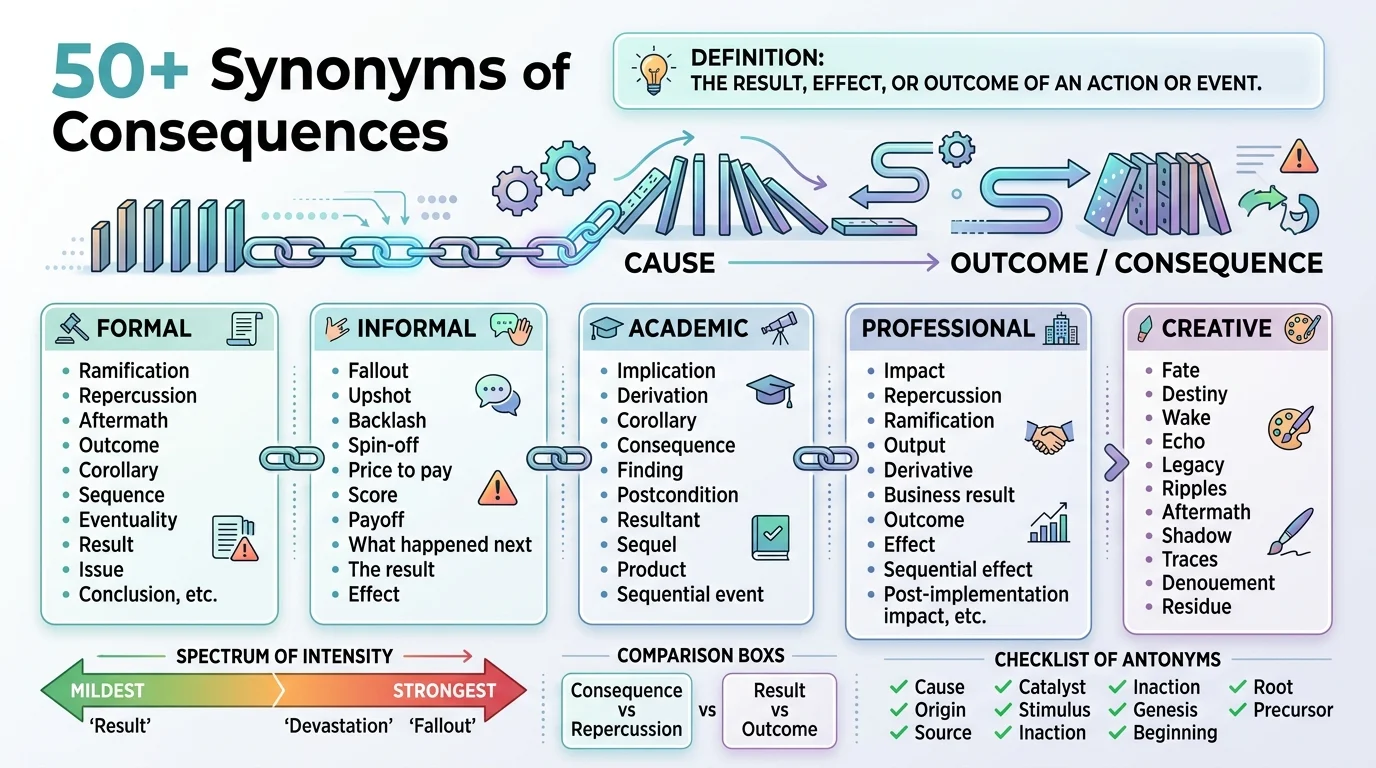
Quick Ans: “Consequences” means the results or effects of an action, condition, or event. It is a neutral-to-negative noun. For formal writing, choose ramifications or repercussions. For casual conversation, use outcome or result. In academic contexts, implications and effects are strong choices. For a neutral statement, select outcome. For a stronger, more dramatic impact, choose fallout or aftermath.
Meaning, Tone, and Context
Understanding the core meaning of “consequences” is the first step to using it effectively.
Simple Definition: Something that follows as a result of an action or condition. The outcome of a situation.
Part of Speech: Noun (usually plural).
Overall Tone: Often negative, but can be neutral. The word frequently implies a cause-and-effect relationship.
Formality Level: Formal. The word is appropriate in professional, academic, and serious contexts.
Common Uses: Native English speakers use it to describe results, often with a negative connotation. For example, “He faced the consequences of his actions,” or “The consequences of climate change are severe.”
Word Forms: Related words include the adjective consequent, the adverb consequently, and the verb consequentialize.
When and How to Use “Consequences”
“Consequences” is the perfect choice when you want to emphasize the results of an action, especially negative ones. Here are seven realistic examples.
Professional: “The company faced serious consequences for the data breach.”
Academic: “The study examines the consequences of social media on mental health.”
Workplace: “Any violation of the policy will have immediate consequences.”
Personal: “He finally understood the consequences of his reckless behavior.”
Email: “Please consider the consequences before making a final decision.”
Resume: “Developed a risk assessment framework that evaluated the consequences of potential failures.”
Social Media: “Every action has consequences. Choose wisely.”
Best Synonyms of “Consequences”
No synonym is identical in every situation. Here is your guide to the best replacement for “consequences” based on your writing context.
Professional Writing: Ramifications. It suggests branching effects that unfold over time. “The ramifications of the merger will be felt for years.”
Academic Writing: Implications. This is ideal when discussing the broader significance or meaning. “The implications of this study are profound.”
Business Communication: Repercussions. A practical choice for discussing negative outcomes. “There will be severe repercussions for missed deadlines.”
Casual Conversation: Outcome. It tones down the negativity and sounds neutral. “We are waiting to see the outcome of the decision.”
Emotional Writing: Aftermath. This word carries weight, suggesting the destructive consequences following a disaster. “The aftermath of the storm was devastating.”
Creative Writing: Fallout. It implies scattered, often unexpected negative effects. “The political fallout from the scandal was widespread.”
Resume Writing: Outcome. Use it to describe positive results. “Achieved a favorable outcome for the client.”
When Not to Use “Consequences”
Using “consequences” can sound wrong or awkward in certain situations.
When It Sounds Too Negative: If the result is positive, “consequences” sounds too ominous.
Better Choice: Outcome or benefits. “The outcome of the project was a significant increase in sales.”
When It Sounds Too Formal: In casual conversation, “consequences” sounds stiff.
Better Choice: Result or what happened. “What happened after you made the decision?”
When You Mean Immediate Impact: “Consequences” often implies long-term effects.
Better Choice: Effect or immediate result. “The immediate effect of the policy was a reduction in costs.”
When It Sounds Too Vague: “Consequences” can be general. You might need a more specific word.
Better Choice: Ramifications or repercussions (for branching effects) or aftermath (for post-disaster effects).
Words Commonly Confused With “Consequences”
Several words are often mixed up with “consequences.” Here is how to keep them straight.
Word: Effects
Difference: Means a change produced by an action. “Consequences” often implies a cause-and-effect relationship.
When to Use: Use it when describing the direct impact.
Example: “The effects of the medication were immediate.”
Word: Ramifications
Difference: Refers to complex, branching outcomes. “Consequences” is more general.
When to Use: Use it for long-term, widespread effects.
Example: “The ramifications of the decision impacted the whole industry.”
Word: Repercussions
Difference: Suggests negative outcomes that echo back. “Consequences” can be neutral or negative.
When to Use: Use it for negative, often delayed effects.
Example: “The repercussions of the scandal were felt for years.”
Word: Outcome
Difference: A neutral term for the end result. “Consequences” often implies seriousness.
When to Use: Use it when you want a neutral, non-judgmental term.
Example: “The outcome of the election was a surprise.”
Word: Aftermath
Difference: Refers to the period after a destructive event. “Consequences” can be any result.
When to Use: Use it for post-disaster or post-war situations.
Example: “In the aftermath of the hurricane, relief efforts began.”
Word: Implications
Difference: Refers to the broader significance or meaning. “Consequences” is about direct results.
When to Use: Use it when discussing what something means.
Example: “The implications of the research are far-reaching.”
Best Synonyms of “Consequences” by Context
| Context | Best Synonym | Why It Works | Example |
|---|---|---|---|
| Formal writing | Ramifications | Suggests branching, complex effects. | “The ramifications of the policy were widespread.” |
| Academic writing | Implications | Emphasizes broader significance. | “The implications for future research are significant.” |
| Professional communication | Repercussions | Highlights negative outcomes. | “The repercussions of the error were severe.” |
| Business emails | Impact | Clear and professional. | “We need to assess the impact of this change.” |
| Resume writing | Outcome | Neutral and positive-sounding. | “Achieved a positive outcome for the project.” |
| Workplace communication | Results | Direct and practical. | “The results of our efforts were visible.” |
| Casual conversation | Outcome | Simple and natural. | “We are waiting for the outcome of the game.” |
| Creative writing | Fallout | Evokes scattered, negative effects. | “The political fallout from the scandal was immense.” |
| Emotional writing | Aftermath | Suggests destruction and recovery. | “In the aftermath of the war, the city rebuilt.” |
| Strong emphasis | Repercussions | Suggests unavoidable negative effects. | “There will be serious repercussions for this action.” |
| Mild tone | Results | Simple and unassuming. | “The results of the test were encouraging.” |
| Social media captions | Consequences | Direct and impactful. | “Think before you act. Consequences matter.” |
How to Choose the Best Synonym of “Consequences”
Choosing the right word is a simple decision. Answer these questions.
What is my audience? For a professor or CEO, ramifications or implications is powerful. For a friend, outcome or result is more natural.
What is my purpose? Are you trying to warn, inform, or describe? Use repercussions for warnings, implications for informing, and outcome for describing.
Is the result positive or negative? For negative results, repercussions, fallout, or aftermath work well. For positive results, outcome or results are better.
What is the emotional strength? Aftermath and repercussions are stronger. Outcome and results are mild. Pick the one that matches your message.
Real Life Examples of “Consequences”
To truly master the word, it helps to see how it behaves in the wild and how a stronger synonym can elevate the sentence.
School: Basic: “The consequences of cheating are severe.” Improved: “The ramifications of cheating can affect your academic career.”
College: Basic: “They studied the consequences of pollution.” Improved: “They studied the implications of pollution on public health.”
Workplace: Basic: “The mistake had consequences.” Improved: “The mistake had repercussions that impacted the entire team.”
Business: Basic: “The strategy had positive consequences.” Improved: “The strategy produced a favorable outcome for the company.”
Email: Basic: “Please consider the consequences of your decision.” Improved: “Please consider the ramifications of your decision before proceeding.”
Conversation: Basic: “What were the consequences?” Improved: “What was the outcome of your decision?”
Storytelling: Basic: “The consequences of the fire were terrible.” Improved: “In the aftermath of the fire, the community came together to rebuild.”
Top 10 Synonyms of “Consequences”
| Synonym | Simple Meaning | Best Used For | Example Sentence |
|---|---|---|---|
| Ramifications | Complex, branching effects | Formal, academic, and business contexts. | “The ramifications of the merger will be felt for years.” |
| Repercussions | Negative, echoing outcomes | Warnings, business, and serious contexts. | “There will be serious repercussions for this action.” |
| Implications | Broader significance or meaning | Academic, research, and intellectual contexts. | “The implications of this discovery are enormous.” |
| Aftermath | The period after a destructive event | Disaster, war, and recovery contexts. | “In the aftermath of the hurricane, relief efforts began.” |
| Fallout | Scattered, negative effects | Political, social, and dramatic contexts. | “The political fallout from the scandal was widespread.” |
| Outcome | The final result | Neutral, positive, and everyday contexts. | “We are waiting to see the outcome of the election.” |
| Results | The direct output of an action | Scientific, professional, and practical contexts. | “The results of the test were promising.” |
| Impact | A strong effect or influence | Business, environmental, and social contexts. | “The impact of climate change is undeniable.” |
| Effects | Changes produced by an action | General, scientific, and descriptive contexts. | “The effects of the medication were immediate.” |
| Upshot | The final, main point | Informal, practical, and summary contexts. | “The upshot of the discussion is that we need more funding.” |
Synonyms of “Consequences” by Usage
Professional vs. Personal Synonyms
In the workplace (professional), choose ramifications, repercussions, or impact to describe serious outcomes. These words convey depth and seriousness. “The ramifications of the data breach were significant” is more precise than “There were consequences.”
With friends (personal), outcome, results, or what happened keep the tone relaxed and relatable. These alternatives sound natural in everyday conversation.
Formal vs. Conversational Synonyms
For formal writing (reports, essays, professional emails), use ramifications, implications, or repercussions. These choices maintain the sophisticated tone expected in professional documents.
For casual conversations and texting, use outcome, results, or upshot. These options sound more natural and less pretentious.
Academic Synonyms
For research and essays, choose precise, authoritative words. Implications is great for broader significance, ramifications for complex outcomes, and effects for direct changes. These words sound considered and scholarly.
Using precise academic vocabulary demonstrates expertise and careful thinking. Professors and reviewers expect this level of precision.
Professional and Business Synonyms
For maximum impact in business writing, choose ramifications for complex outcomes, repercussions for negative effects, and impact for overall influence. These words demonstrate confidence and professional awareness.
Business leaders respond to language that conveys depth and seriousness. These synonyms project authority.
Creative and Literary Synonyms
To add emotion and imagery to your writing, choose aftermath, fallout, or repercussions. These words create atmosphere and drama.
Literary writers use these alternatives to build tension and consequence. They transform ordinary descriptions into evocative prose.
Slang or Modern Synonyms
There is no direct slang synonym for “consequences” in mainstream American English. In modern texting, people use what happened, the result, or simply the fallout.
Strongest to Mildest Synonyms
Mild: results, outcomes, upshot
Moderate: effects, implications, impact
Strong: ramifications, repercussions, consequences
Very Strong: aftermath, fallout, devastation
Emotional vs. Neutral Synonyms
Emotional Synonyms: Aftermath, fallout, repercussions. These words often hint at danger, disaster, or drama. Use them when you want to evoke feeling.
Neutral Synonyms: Outcome, results, effects. These words simply communicate factual information. Use them when you want to inform without emotional coloring.
Antonyms of “Consequences”
Here are 15 genuine opposites of “consequences.”
| Antonym | Meaning | Example Sentence |
|---|---|---|
| Causes | The reasons for an action | “The causes of the accident were investigated.” |
| Antecedents | Things that come before | “The antecedents of the conflict were examined.” |
| Precursors | Things that precede another | “The precursors to the crisis were ignored.” |
| Reasons | The explanations for something | “The reasons for his decision were clear.” |
| Origins | The starting points | “The origins of the tradition are ancient.” |
| Sources | The origins or beginnings | “The sources of the problem were identified.” |
| Triggers | Things that initiate an action | “The triggers for the reaction were studied.” |
| Grounds | The basis for an action | “The grounds for the complaint were valid.” |
| Motivations | Reasons for behaving a certain way | “His motivations for the act were unclear.” |
| Incentives | Rewards that encourage action | “The incentives for participation were attractive.” |
| Beginnings | The starting points | “The beginnings of the movement were humble.” |
| Starts | The initial phases | “The starts of the projects were chaotic.” |
| Initiatives | The first steps | “The initiatives for change were welcomed.” |
| Roots | The underlying causes | “The roots of the problem were deep.” |
| Fundamentals | The basic elements | “The fundamentals of the theory were sound.” |
Comparison: “Consequences” vs Similar Words
Consequences vs. Ramifications
Main Difference: Consequences are general results. Ramifications are complex, branching effects.
Which Is Stronger? Ramifications is stronger and more detailed.
Which Is More Formal? Both are formal, but ramifications is more academic.
When to Use Each: Use consequences for simple results. Use ramifications for complex, unfolding effects.
Examples:
Consequences: “The consequences of the delay were minimal.”
Ramifications: “The ramifications of the policy will take years to understand.”
Consequences vs. Repercussions
Main Difference: Consequences can be neutral or negative. Repercussions are almost always negative.
Which Is Stronger? Repercussions is stronger and more ominous.
Which Is More Formal? Both are formal, but repercussions has a stronger tone.
When to Use Each: Use consequences for neutral results. Use repercussions for negative outcomes.
Examples:
Consequences: “The consequences of the decision were unexpected.”
Repercussions: “The repercussions of the scandal were devastating.”
Consequences vs. Implications
Main Difference: Consequences are direct results. Implications are broader meanings or significance.
Which Is Stronger? Implications is more intellectual and far-reaching.
Which Is More Formal? Both are formal, but implications is more academic.
When to Use Each: Use consequences for direct results. Use implications for broader significance.
Examples:
Consequences: “The consequences of the policy were immediate.”
Implications: “The implications of the research are profound.”
Consequences vs. Aftermath
Main Difference: Consequences can be any result. Aftermath specifically refers to the period after a destructive event.
Which Is Stronger? Aftermath is much stronger and more dramatic.
Which Is More Formal? Both are formal, but aftermath is more literary.
When to Use Each: Use consequences for general results. Use aftermath for post-disaster situations.
Examples:
Consequences: “The consequences of the storm were flooding.”
Aftermath: “In the aftermath of the storm, relief efforts began.”
Consequences vs. Fallout
Main Difference: Consequences are general. Fallout refers to scattered, often unexpected negative effects.
Which Is Stronger? Fallout is stronger and more dramatic.
Which Is More Formal? Both are formal, but fallout is more metaphorical.
When to Use Each: Use consequences for direct effects. Use fallout for widespread, negative effects.
Examples:
Consequences: “The consequences of the speech were protests.”
Fallout: “The political fallout from the speech was widespread.”
Consequences vs. Outcomes
Main Difference: Outcome is neutral. Consequences often implies seriousness or negativity.
Which Is Stronger? They are equal in weight, but outcome is more neutral.
Which Is More Formal? Both are formal, but outcome is more balanced.
When to Use Each: Use outcome for neutral or positive results. Use consequences for serious results.
Examples:
Consequences: “The consequences of the failure were severe.”
Outcome: “The outcome of the election was historic.”
Common Phrases and Expressions with “Consequences”
Phrase: Face the consequences
Meaning: To accept the results of one’s actions.
Example Sentence: “He had to face the consequences of his dishonesty.”
Phrase: Negative consequences
Meaning: Unfavorable results.
Example Sentence: “The negative consequences of the decision were immediate.”
Phrase: Unintended consequences
Meaning: Results that were not expected.
Example Sentence: “The policy had several unintended consequences.”
Phrase: Serious consequences
Meaning: Results of great importance or danger.
Example Sentence: “There will be serious consequences for this violation.”
Phrase: Consequences of one’s actions
Meaning: The results of what someone does.
Example Sentence: “She thought carefully about the consequences of her actions.”
Phrase: Long-term consequences
Meaning: Results that persist over time.
Example Sentence: “The long-term consequences of pollution are alarming.”
Common Mistakes to Avoid
Mistake 1: Using “consequences” for positive results.
Incorrect: “The consequences of the project were amazing.”
Better: “The outcome of the project was amazing.”
Why: Consequences often carries a negative tone.
Mistake 2: Using “consequences” when you mean “causes”.
Incorrect: “The consequences of the accident were speeding.”
Better: “The cause of the accident was speeding.”
Why: Consequences are the results. Causes are the reasons.
Mistake 3: Overusing “consequences” in academic writing.
Incorrect: “The consequences of the study were important.”
Better: “The implications of the study are significant.”
Why: Implications is more precise for academic findings.
Mistake 4: Using “aftermath” for everyday situations.
Incorrect: “In the aftermath of the meeting, we went to lunch.”
Better: “After the meeting, we went to lunch.”
Why: Aftermath is for destructive events.
Mistake 5: Using “repercussions” for neutral results.
Incorrect: “The repercussions of the decision were positive.”
Better: “The results of the decision were positive.”
Why: Repercussions are almost always negative.
Frequently Asked Questions
1. What are the best synonyms of “consequences”?
The best synonyms depend on your context. For formal writing, choose ramifications or implications. And for negative outcomes, use repercussions or fallout. For neutral results, outcome or results are ideal choices.
2. What are the best formal synonyms of “consequences”?
The best formal synonyms are ramifications, implications, and repercussions. These words are suitable for academic papers, professional reports, and business communications.
3. What are common informal synonyms of “consequences”?
For informal settings, use outcome, results, or what happened. These alternatives sound more natural in everyday conversation.
4. What is another word for “consequences” in professional writing?
In professional writing, ramifications is an excellent choice. It conveys complex, branching effects. Repercussions is also strong for negative outcomes.
5. What is the difference between “consequences” and “repercussions”?
While both indicate outcomes, consequences can be neutral or negative. Repercussions are almost always negative. Use consequences for general results and repercussions for negative outcomes.
6. What is the opposite of “consequences”?
The most direct opposites (antonyms) of consequences are causes, antecedents, and origins. These words describe what comes before rather than what follows.
Conclusion
“Consequences” is a powerful word for describing the results of actions and events. The term is formal and widely used in serious contexts, yet it can sound overly negative in everyday conversation. The best choice among the synonyms of consequences depends entirely on your audience, tone, and purpose. Remember, no single synonym works perfectly in every situation. Your goal is to choose the word that communicates your message with the most clarity and impact. A practical tip for your vocabulary growth is to pay attention to how writers describe results and practice using different synonyms in your daily writing.
Discover More:
- 50+ Synonyms of Unfair: Meanings, Uses, Examples, and Best Alternatives
- 50+ Synonyms of Ubiquitous: Meanings, Uses, Examples, and Best Alternatives

Ella Parker is a professional content writer with a passion for creating clear, engaging, and well-researched articles. She focuses on delivering valuable insights and practical information across business, technology, and lifestyle topics.