Have you ever needed to describe something without any flaws, something that meets every expectation, but felt that “good” or “great” did not capture its true quality? You want to highlight excellence and completeness, and the word “perfect” comes to mind. But is it the best fit for your audience? Choosing the right synonym for “perfect” can transform a general compliment into a precise and powerful statement. This guide explores the best synonyms of perfect, explaining exactly which word to use and when.
Quick Ans: “Perfect” means having no flaws or defects, being completely correct or accurate, or being the best possible example of something . It is a positive, versatile adjective. For describing something without flaws, choose flawless or impeccable. For describing something ideal, use ideal or supreme. For describing accuracy, select exact or precise. For describing completeness, choose absolute or utter .
Meaning, Tone, and Context
Understanding the core meaning of “perfect” is the first step to using it effectively.
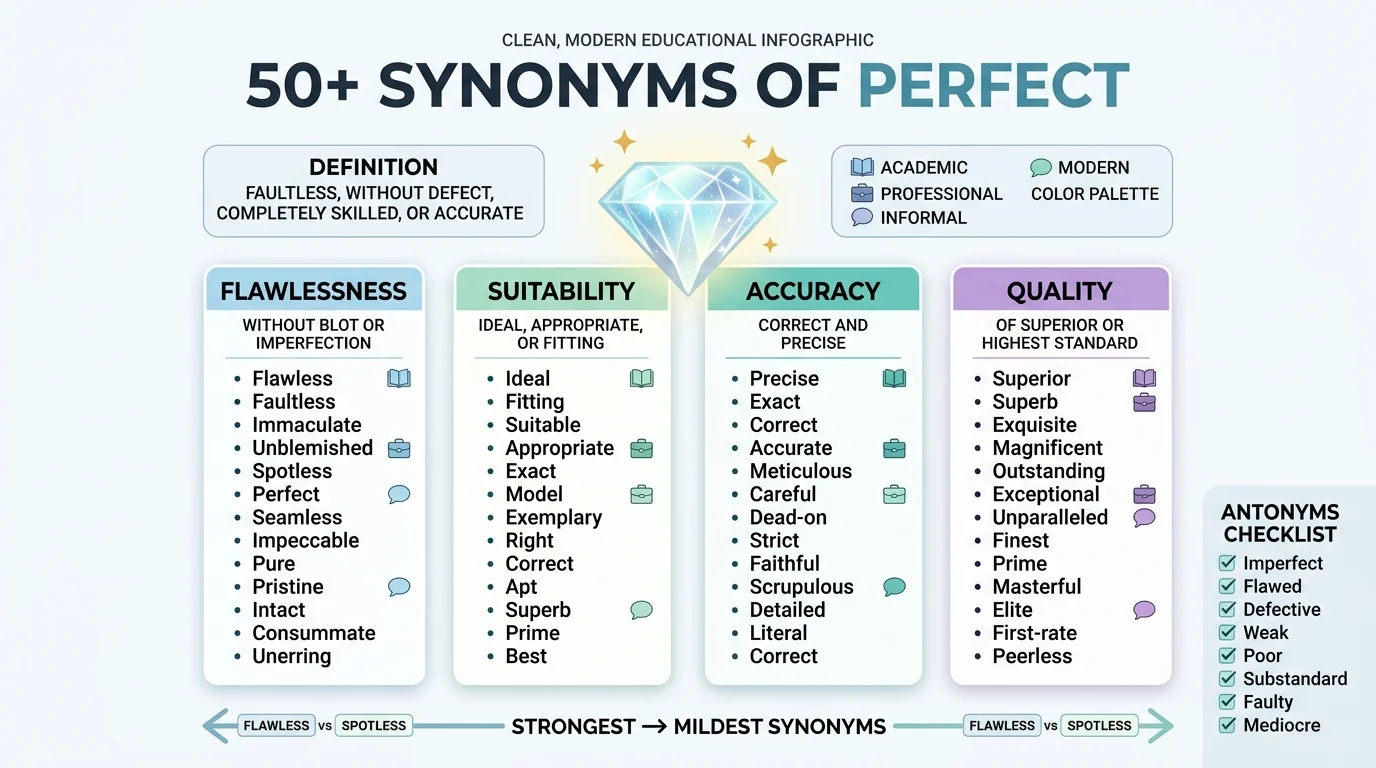
Simple Definition: Having no mistakes, flaws, or defects. Completely correct or accurate. Exactly right for a particular purpose.
Part of Speech: Adjective. The verb form means to make perfect.
Overall Tone: Positive and definitive. It indicates the highest degree of quality, accuracy, or suitability.
Formality Level: Neutral. The word works in almost any context, from casual conversation to formal academic writing.
Common Uses: Native English speakers use it constantly to describe quality, suitability, accuracy, and completeness. For example, “Her English is perfect,” or “This is the perfect day for a picnic,” or “He made a perfect fool of himself” .
Word Forms: Related words include the noun perfection, the adverb perfectly, and the verb to perfect (to make something perfect) .
When and How to Use “Perfect”
“Perfect” is the most common and versatile word in its category. Here are seven realistic examples.
Professional: “This presentation is a perfect example of how to communicate complex data.”
Academic: “The study provides a perfect case study for testing the new hypothesis.”
Workplace: “The board gave him a perfect score for his performance.”
Personal: “The weather was absolutely perfect for a day at the beach.”
Email: “Thank you for the perfect timing; your email arrived just as I needed it.”
Resume: “Led a team that delivered a perfect record of on-time project completions.”
Social Media: “A perfect sunset to end a perfect day.”
Best Synonyms of “Perfect”
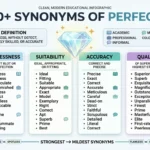
No synonym is identical in every situation. Here is your guide to the best replacement for “perfect” based on your writing context.
Describing Flawlessness: Flawless or Impeccable. These suggest the absolute absence of any defects . “She gave a flawless performance.” “His English is impeccable.”
Describing Completeness: Absolute or Utter. These suggest something is total and without qualification . “He made an absolute fool of himself.” “The project was an utter disaster.”
Describing Accuracy: Exact or Precise. These suggest correctness and attention to detail . “I can’t remember the exact words.” “The precise details are unknown.”
Describing Quality or Excellence: Superb or Ideal. These suggest the highest standard or suitability . “She did a superb job.” “The book is ideal for children.”
Describing a Perfect Example: Quintessential or Archetypal. These suggest something that is the most perfect representation of its kind . “The building is a quintessential example of the style.”
When Not to Use “Perfect”
Using “perfect” can sound wrong or awkward in certain situations.
When It Is Too Absolute: “Perfect” means no flaws at all. It may be too strong for describing something that is simply good.
Better Choice: Excellent or Superb. “The team did an excellent job.”
When You Mean “Appropriate”: “Perfect” can be too dramatic for describing something that is simply suitable .
Better Choice: Suitable or Apt. “The description was apt.”
When It Sounds Too Boastful: Using “perfect” to describe your own work can sound arrogant.
Better Choice: Solid or Reliable. “We delivered a solid performance.”
When You Mean “Ideal”: “Perfect” and “ideal” are often interchangeable, but “ideal” sometimes suggests an imagined, theoretical standard, while “perfect” suggests a reality without flaws .
Better Choice: Ideal. “The conditions were ideal.”
Words Commonly Confused With “Perfect”
Several words are often mixed up with “perfect.” Here is how to keep them straight .
Word: Flawless
Difference: Suggests the absolute absence of defects, blemishes, or imperfections. “Perfect” is a broader term.
When to Use: Use it for things that are without any physical or metaphorical imperfections.
Example: “The diamond was flawless.”
Word: Ideal
Difference: Suggests an optimum standard of excellence suitable for a specific purpose. It often embodies an imagined state of perfection .
When to Use: Use it for things that are exactly right for a particular situation.
Example: “The weather conditions were ideal for sailing.”
Word: Impeccable
Difference: Means free from faults, errors, or blemishes, often in a way that is beyond reproach .
When to Use: Use it for behavior, manners, and taste.
Example: “His English is impeccable.”
Word: Absolute
Difference: Means complete and total. It is often used to describe something without qualification or limit .
When to Use: Use it for emphasis and for describing complete failures or successes.
Example: “She was an absolute genius.”
Word: Consummate
Difference: Means showing complete skill or quality; perfectly skilled .
When to Use: Use it for people who display a high degree of skill or a perfect quality.
Example: “He was a consummate professional.”
Word: Faultless
Difference: Similar to flawless, meaning without any mistakes or defects .
When to Use: Use it for performances, works of art, and meticulous work.
Example: “They gave a faultless performance.”
Best Synonyms of “Perfect” by Context
| Context | Best Synonym | Why It Works | Example |
|---|---|---|---|
| Describing a flawless object | Flawless | Suggests no imperfections | “She has a flawless complexion.” |
| Describing ideal conditions | Ideal | Suggests optimum suitability | “The book is ideal for children.” |
| Describing a total failure | Absolute/utter | Emphasizes completeness | “It was an utter disaster.” |
| Describing a precise detail | Exact/Precise | Suggests accuracy | “I need the exact measurements.” |
| Describing a high-quality job | Superb/Excellent | Suggests extremely good quality | “He did a superb job.” |
| Describing a perfect example | Quintessential | Suggests a classic representation | “He is the quintessential hero.” |
| Describing a skilled person | Accomplished/Adept | Suggests high skill | “She is an adept guitar player.” |
How to Choose the Best Synonym of “Perfect”
Choosing the right word is a simple decision. Answer these questions.
What is my audience? For a professor or CEO, flawless or impeccable is powerful. For a friend, great or awesome is more natural.
What is my purpose? Are you trying to describe quality, suitability, or accuracy? Use superb for quality, ideal for suitability, and exact for accuracy.
What is the emotional strength? Flawless and immaculate are stronger. Good and fine are mild. Pick the one that matches your message.
Am I describing a person, an object, or a situation? For a person, accomplished or consummate is good. And for an object, flawless or pristine works. For a situation, ideal or perfect are best.
Real Life Examples of “Perfect”
To truly master the word, it helps to see how it behaves in the wild and how a stronger synonym can elevate the sentence.
School: Basic: “The student got a perfect score.” Improved: “The student achieved a flawless score.”
College: Basic: “This is a perfect example.” Improved: “This is a quintessential example.”
Workplace: Basic: “She did a perfect job.” Improved: “She did an impeccable job.”
Business: Basic: “The conditions are perfect.” Improved: “The conditions are ideal for growth.”
Email: Basic: “Thank you for the perfect timing.” Improved: “Thank you for the precise timing.”
Conversation: Basic: “The meal was perfect.” Improved: “The meal was superb.”
Storytelling: Basic: “She was a perfect mother.” Improved: “She was the consummate mother.”
Top 10 Synonyms of “Perfect”
| Synonym | Simple Meaning | Best Used For | Example Sentence |
|---|---|---|---|
| Flawless | Without any defects or errors | Objects, performances, and complexions | “They gave a flawless performance.” |
| Impeccable | Free from faults or mistakes | Behavior, manners, taste, and language | “His English is impeccable.” |
| Ideal | The best possible for a specific purpose | Conditions, situations, and suitability | “The book is ideal for children.” |
| Supreme | The highest in quality or degree | Quality, authority, and skill | “He is a supreme craftsman.” |
| Superb | Extremely good or impressive | Quality of work, achievements, and food | “The meal was superb.” |
| Exact | Completely correct and precise | Measurements, quotes, and details | “Those are my exact words.” |
| Absolute | Complete and total | Emphasis, qualifications, and extremes | “She is an absolute genius.” |
| Consummate | Showing complete skill or quality | Professionals, liars, and performers | “He is a consummate professional.” |
| Quintessential | The purest and most perfect example | Examples, representations, and ideals | “He is the quintessential gentleman.” |
| Pristine | In its original, pure, and perfect condition | Environments, condition, and cleanliness | “The beach was pristine.” |
Synonyms of “Perfect” by Usage
Professional vs. Personal Synonyms
In the workplace, choose flawless, impeccable, or superb to describe work. These words convey professionalism and high standards. “She gave a flawless presentation” is more impactful than “She gave a perfect presentation.”
With friends, great, awesome, or spot on keep the tone relaxed.
Formal vs. Conversational Synonyms
For formal writing, use flawless, impeccable, consummate, or quintessential. These choices maintain a sophisticated tone.
For casual conversations, use great, awesome, spot on, or on the money .
Academic Synonyms
For research and essays, choose precise, authoritative words. Quintessential is great for perfect examples. Definitive is best for authoritative sources .
Professional and Business Synonyms
For maximum impact, choose consummate for professionals, flawless for products, and superb for achievements. These words demonstrate confidence and high standards.
Creative and Literary Synonyms
To add emotion and imagery, choose sublime for spiritual beauty , radiant for light, or exquisite for delicate detail.
Slang or Modern Synonyms
In modern American slang, on point, on fleek, or simply perfect are used. Spot on (UK) is also common .
Strongest to Mildest Synonyms
Mild: good, fine, nice
Moderate: great, excellent, superb
Strong: flawless, impeccable, ideal
Very Strong: absolute, consummate, quintessential
Emotional vs. Neutral Synonyms
Emotional Synonyms: Sublime, radiant, exquisite. These words evoke beauty and strong feelings.
Neutral Synonyms: Perfect, correct, accurate. These words simply communicate factual information.
Antonyms of “Perfect”
Here are 15 genuine opposites of “perfect” .
| Antonym | Meaning | Example Sentence |
|---|---|---|
| Imperfect | Not perfect, with flaws | “The imperfect ceramic had a unique beauty.” |
| Flawed | Containing a fault or weakness | “The flawed logic of the argument was exposed.” |
| Faulty | Having a defect or failure | “The faulty equipment led to the accident.” |
| Defective | Having a defect or imperfection | “The defective product was recalled.” |
| Inaccurate | Not precise or correct | “The inaccurate weather report was wrong.” |
| Incorrect | Not correct or true | “The answer was incorrect.” |
| Wrong | Not right or just | “He gave the wrong answer.” |
| Unsuitable | Not appropriate | “The venue was unsuitable for the event.” |
| Inappropriate | Not suitable in the situation | “The inappropriate comment ruined the mood.” |
| Inferior | Lower in quality | “The inferior product failed quickly.” |
| Second-rate | Of poor quality | “The second-rate performance did not impress.” |
| Bad | Not good | “The bad weather ruined our plans.” |
| Poor | Lacking in quality | “The poor conditions made it difficult to work.” |
| Incomplete | Missing parts | “The incomplete data led to a faulty conclusion.” |
| Insufficient | Not enough | “The insufficient resources caused delays.” |
Comparison: “Perfect” vs Similar Words
Perfect vs. Flawless
Main Difference: Perfect implies something meets all necessary criteria. Flawless suggests the absolute absence of defects .
Which Is Stronger? They are similar. Flawless emphasizes “no defects.”
Which Is More Formal? Both are formal.
When to Use Each: Use perfect for general excellence. Use flawless for things without blemishes.
Examples:
Perfect: “Our team executed a perfect strategy.”
Flawless: “The diamond was flawless.”
Perfect vs. Ideal
Main Difference: Perfect means something fulfills all requirements. Ideal suggests an optimum standard for a specific purpose .
Which Is Stronger? They are similar. Ideal emphasizes suitability.
Which Is More Formal? Both are formal.
When to Use Each: Use perfect for general situations. Use ideal for specific purposes.
Examples:
Perfect: “She gave a perfect presentation.”
Ideal: “The weather conditions were ideal for sailing.”
Perfect vs. Impeccable
Main Difference: Perfect is broad. Impeccable is often used for things done in a way that is beyond reproach .
Which Is Stronger? They are similar. Impeccable suggests high standards.
Which Is More Formal? Both are formal.
When to Use Each: Use perfect for general things. Use impeccable for behavior, manners, and taste.
Examples:
Perfect: “The perfect plan succeeded.”
Impeccable: “His impeccable taste was admired.”
Perfect vs. Absolute
Main Difference: Perfect means without flaws. Absolute means complete and total .
Which Is Stronger? Absolute is stronger for emphasis.
Which Is More Formal? Both are formal.
When to Use Each: Use perfect for quality. Use absolute for emphasis and totality.
Examples:
Perfect: “The performance was perfect.”
Absolute: “She was an absolute genius.”
Common Phrases and Expressions with “Perfect”
Phrase: Perfect example
Meaning: A classic or excellent example.
Example Sentence: “This building is a perfect example of neoclassical style.”
Phrase: Perfect timing
Meaning: Something happening at exactly the right moment.
Example Sentence: “Thank you for the perfect timing.”
Phrase: Perfect fit
Meaning: Something that is exactly suitable.
Example Sentence: “This is the perfect fit for our requirements.”
Phrase: Perfect day
Meaning: A day when everything goes well.
Example Sentence: “It was a perfect day for a picnic.”
Phrase: Make perfect
Meaning: To improve to one’s satisfaction.
Example Sentence: “He worked hard to perfect his technique.”
Common Mistakes to Avoid
Mistake 1: Using “perfect” for things that are simply good.
Incorrect: “The meal was perfect.”
Better: “The meal was superb.”
Why: Perfect is absolute and should be reserved for the highest standard.
Mistake 2: Using “perfect” when you mean “suitable”.
Incorrect: “He is the perfect person for the job.”
Better: “He is the ideal person for the job.”
Why: Ideal suggests suitability for a specific purpose.
Mistake 3: Using “perfect” too often in writing.
Incorrect: “The perfect plan, the perfect team, the perfect results.”
Better: “The flawless plan, the ideal team, the superb results.”
Why: Variation makes writing more interesting.
Mistake 4: Using “perfect” when you mean “absolute”.
Incorrect: “He was a perfect fool.”
Better: “He was an absolute fool.”
Why: Absolute is better for emphatic statements.
Mistake 5: Using “perfect” to describe your own work.
Incorrect: “I did a perfect job.”
Better: “I am proud of the superb job I did.”
Why: It is better to let others call your work perfect.
Frequently Asked Questions
1. What are the best synonyms of “perfect”?
The best synonyms depend on your context. For describing flawlessness, choose flawless or impeccable. And for describing suitability, use ideal. For describing accuracy, use exact or precise.
2. What are the best formal synonyms of “perfect”?
The best formal synonyms are flawless, impeccable, consummate, and quintessential.
3. What are common informal synonyms of “perfect”?
For informal settings, use awesome, great, spot on, or on the money.
4. What is another word for “perfect” in professional writing?
In professional writing, superb, flawless, or consummate are excellent choices.
5. What is the difference between “perfect” and “flawless”?
While both indicate a high standard, perfect means something meets all necessary criteria . Flawless suggests the absolute absence of defects .
6. What is the opposite of “perfect”?
The most direct opposite (antonym) of perfect is imperfect. Other opposites include flawed, faulty, and incorrect .
Conclusion
“Perfect” is a powerful and versatile word for describing excellence, accuracy, and suitability. It is widely understood but can sound too absolute or dramatic for everyday use. The best choice among the synonyms of perfect depends entirely on your audience, tone, and purpose. Remember, no single synonym works perfectly in every situation. Your goal is to choose the word that communicates your message with the most clarity and impact. A practical tip for your vocabulary growth is to notice how authors and speakers praise things and practice using different synonyms.
Discover More:
- 50+ Synonyms of Futile: Meanings, Uses, Examples, and Best Alternatives 2026
- 50+ Synonyms of Ubiquitous: Meanings, Uses, Examples, and Best Alternatives

Ella Parker is a professional content writer with a passion for creating clear, engaging, and well-researched articles. She focuses on delivering valuable insights and practical information across business, technology, and lifestyle topics.