Have you ever needed to describe where something originates, when a journey starts, or what something is made of but felt that using “from” repeatedly made your writing sound repetitive? You want to express origin, starting point, or source, and the word “from” comes to mind. But is it the best fit for your audience? Choosing the right synonym for “from” can transform a repetitive phrase into a more varied and precise description of relationships, origins, and positions. This guide explores the best synonyms of from, explaining exactly which word or phrase to use and when.
Quick Ans: “From” is a preposition indicating origin, starting point, or source . It is a neutral, essential word. For formal writing, choose originating in or derived from. For casual conversation, use out of or coming from. In professional contexts, by means of and based on are strong choices. For a more dramatic or descriptive impact, select emerging from or away from .
Meaning, Tone, and Context
Understanding the core uses of “from” is the first step to finding effective synonyms .
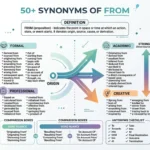
Simple Definition: Indicating the point in space or time at which a journey, motion, or action starts; indicating the source or origin of something; indicating a range; indicating separation or removal .
Part of Speech: Preposition.
Overall Tone: Neutral. It is a functional word used in countless contexts.
Formality Level: Neutral. “From” works in all settings, but alternatives may be more formal or informal.
Common Uses: Native English speakers use it constantly. For example, “I walked from the store,” “She is from New York,” “The price ranges from ten to twenty dollars,” and “He is suffering from a cold” .
Word Forms: “From” has no grammatical inflections. Related words include hence, away, and out of .
When and How to Use “From”
“From” is the most common and versatile preposition in its category. Here are seven realistic examples .
Professional: “The new policy was developed from extensive research.”
Academic: “The data collected from the study support this theory.”
Workplace: “We need the report from the marketing department by noon.”
Personal: “I received a gift from my sister.”
Email: “Please note the changes starting from next Monday.”
Resume: “Managed a team of five from project inception to completion.”
Social Media: “This view from the mountain top is incredible.”
Best Synonyms of “From”
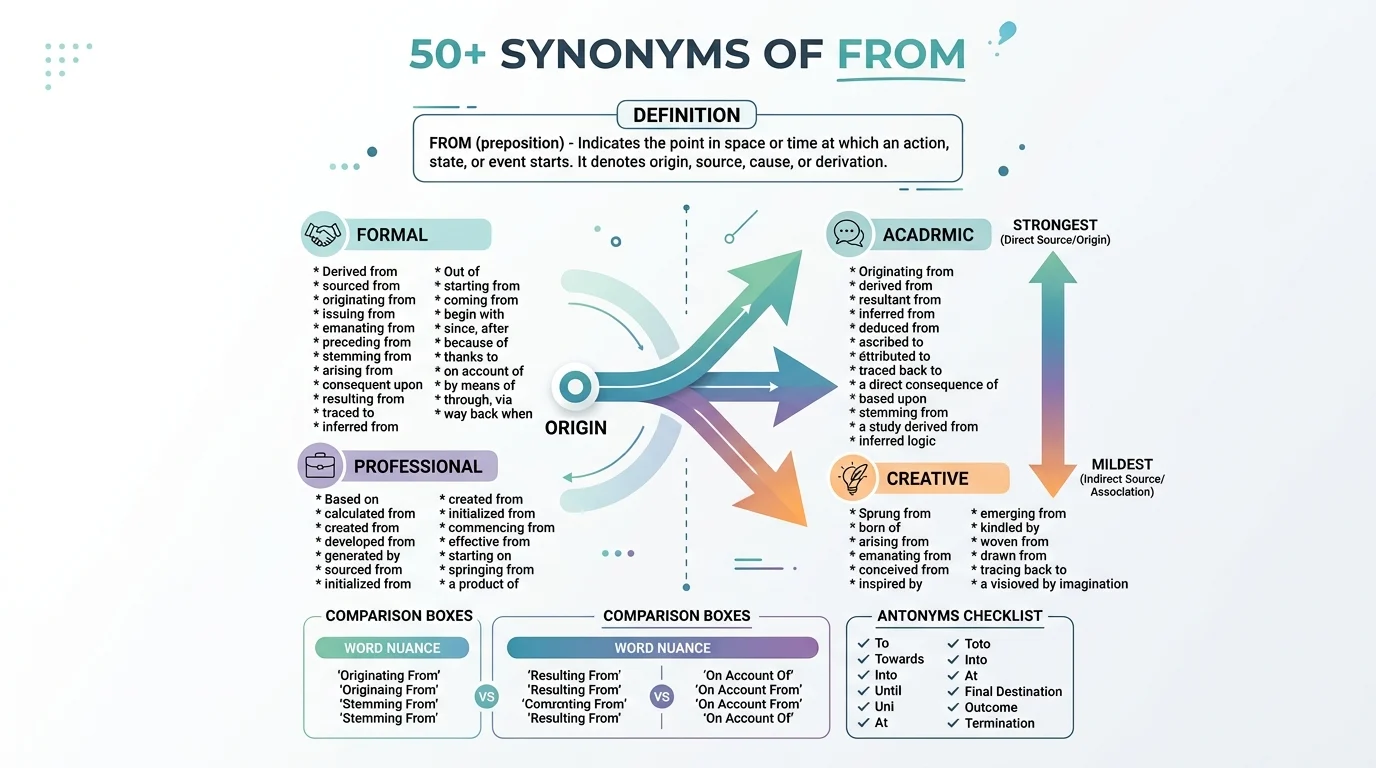
No synonym is identical in every situation. Here is your guide to the best replacement for “from” based on your writing context .
Professional Writing: Based on. It suggests deriving information or decisions from a source. “The conclusion is based on the data provided.”
Academic Writing: Derived from. This is ideal for discussing origins of words, ideas, or substances. “The term is derived from Latin” .
Business Communication: By means of. A formal way to indicate the agent or instrument. “We achieved this by means of a strategic partnership.”
Casual Conversation: Out of. It can indicate physical origin or extraction. “I made this out of recycled materials” .
Creative Writing: Emerging from. This is descriptive and evocative. “Emerging from the shadows, he spoke.”
Describing Distance or Separation: Away from. This clarifies the point of departure . “She walked away from the argument.”
Describing Starting Points: Beginning with or Starting from. This is clear for sequences . “Beginning with the first chapter, the story unfolds.”
When Not to Use “From”
Using “from” might not be the best choice in certain stylistic situations .
When You Want to Emphasize Position, Not Origin: “From” indicates movement. At or in indicates position.
Better Choice: At or in. “The view from here” is about position; you might say “The view at this point is breathtaking.”
When You Want to Express a Reason: “From” can indicate a cause, but because of or due to is often better.
Better Choice: Due to or because of. “He is suffering from a cold,” but you can say “He is suffering because of a viral infection” .
When You Want to Avoid Repetition: Overusing “from” in a list sounds repetitive.
Better Choice: Via, through, or out of. Vary your prepositions to improve flow.
Words Commonly Confused With “From”
Several words are often related to “from.” Here is how to understand their distinctions .
Word: Out of
Difference: Suggests physical extraction or exclusion .
When to Use: Use it when something comes out of something else.
Example: “The genie came out of the bottle.”
Word: Since
Difference: Specifically refers to a point in time .
When to Use: Use this for time-based origins.
Example: “I have not seen her since Tuesday.”
Word: By
Difference: Indicates agency, proximity, or means .
When to Use: Use it for how something is done or who did it.
Example: “The book was written by her.”
Word: Away
Difference: Indicates distance or motion .
When to Use: Use this for movement away.
Example: “He walked away.”
Word: Hence
Difference: Archaic word meaning “from this place” or “therefore” .
When to Use: Use this for formal or literary contexts.
Example: “The town is five miles hence.”
Word: Through
Difference: Indicates passage or cause .
When to Use: Use this for passing from one side to another.
Example: “The train passed through the tunnel.”
Best Synonyms of “From” by Context
| Context | Best Synonym | Why It Works | Example |
|---|---|---|---|
| Formal writing | Derived from | Precise for origins. | “The word derives from Latin.” |
| Academic writing | Based on | Accurate for evidence. | “The theory is based on data.” |
| Professional communication | By means of | Formal for methods. | “We achieved this by means of research.” |
| Business emails | Out of | Practical and clear. | “The product is made out of recycled material.” |
| Resume writing | Beginning with | Highlighting sequence. | “Beginning with the prototype, I led development.” |
| Workplace communication | Via | Clear for methods. | “He sent the file via email.” |
| Casual conversation | Out of | Simple and direct. | “I made it out of wood.” |
| Creative writing | Emerging from | Evocative imagery. | “Emerging from the fog, he appeared.” |
| Strong emphasis | Away from | Clear for separation. | “Stay away from the edge.” |
| Mild tone | From | The standard option. | “It is from my brother.” |
| Describing time | Since | Precise for time. | “I have been here since dawn.” |
How to Choose the Best Synonym of “From”
Choosing the right word is a simple decision. Answer these questions .
What is my audience? For a professor or CEO, derived from or based on is powerful. For a friend, out of or from is more natural.
Am I describing physical origin, time, reason, or position? For physical origin, out of works. And for time, since is clearer. For reason, due to is better. For position, away from is useful.
What is my purpose? Are you trying to sound sophisticated, clear, or descriptive? Derived from is sophisticated. Since is clear. Emerging from is descriptive.
Real Life Examples of “From”
To truly master the word, it helps to see how synonyms can vary the expression .
School: Basic: “The test is from chapter 3.” Improved: “The test covers material starting from chapter 3.”
College: Basic: “This theory comes from Freud.” Improved: “This theory derives from the work of Freud.”
Workplace: Basic: “The data from the report is critical.” Improved: “The data contained in the report is critical.”
Business: Basic: “We learned from our mistakes.” Improved: “We learned through our mistakes.”
Email: Basic: “This is from the CEO.” Improved: “This has been issued by the CEO.”
Conversation: Basic: “I am from Texas.” Improved: “I come from Texas.”
Storytelling: Basic: “He came from the dark.” Improved: “He emerged from the dark.”
Top 10 Synonyms of “From”
| Synonym | Simple Meaning | Best Used For | Example Sentence |
|---|---|---|---|
| Out of | Physical or abstract extraction. | Casual and physical contexts. | “I made the sculpture out of clay.” |
| Since | Starting at a time. | Time references . | “I have worked here since 2010.” |
| Derived from | Obtained or developed out of . | Academic and scientific contexts. | “The word is derived from Greek.” |
| Away from | At a distance from . | Distance and separation. | “He walked away from the building.” |
| Based on | Founded upon. | Professional and logical contexts. | “The decision was based on facts.” |
| By | Indicating means or agent . | Agency and method. | “She sent it by mail.” |
| Via | Through; by means of. | Route and method. | “He traveled via Paris.” |
| Through | From one side to the other . | Passage and cause. | “We succeeded through hard work.” |
| Hence | From this place . | Literary and formal contexts. | “The train departs hence.” |
| Coming from | Originating in. | Casual conversation. | “She is coming from the store.” |
Synonyms of “From” by Usage
Professional vs. Personal Synonyms
In the workplace (professional), choose based on, by means of, or via to describe methods and sources. These words convey professionalism and precision. “The conclusion is based on the data” is more detailed than “The conclusion is from the data.”
With friends (personal), out of, since, or from keep the tone relaxed and relatable.
Formal vs. Conversational Synonyms
For formal writing (reports, essays, professional emails), use derived from, based on, or by means of. These choices maintain the sophisticated tone expected in professional documents .
For casual conversations and texting, use out of, since, or from. These options sound more natural and less pretentious.
Academic Synonyms
For research and essays, choose precise, authoritative words. Derived from is great for linguistic origins, based on for evidence, and via for methodology. These words sound considered and scholarly.
Professional and Business Synonyms
For maximum impact in business writing, choose based on for decisions, via for communication channels, and by means of for strategies. These words demonstrate confidence and professional awareness.
Creative and Literary Synonyms
To add emotion and imagery to your writing, choose emerging from, away from, or hence. These words create atmosphere and evoke movement.
Strongest to Mildest Synonyms
Mild: from, of, at
Moderate: out of, since, via
Strong: derived from, based on, away from
Very Strong: emerging from, hence
Emotional vs. Neutral Synonyms
Emotional Synonyms: Emerging from, away from, hence. These words often hint at drama, mystery, or formality.
Neutral Synonyms: From, out of, since, based on. These words simply communicate factual information.
Antonyms of “From”
Since “from” is a preposition indicating origin, its opposites are prepositions indicating destination or exclusion .
| Antonym | Meaning | Example Sentence |
|---|---|---|
| To | In the direction of. | “I am going to the store.” |
| Toward | In the direction of. | “He walked toward the city.” |
| Into | Entering. | “She went into the house.” |
| For | Intended for. | “This gift is for you.” |
| At | A fixed location. | “He is at the office.” |
| In | Inside. | “The book is in the bag.” |
| On | On the surface. | “Place it on the table.” |
| Within | Inside. | “It is within the building.” |
| Onto | Moving to the top. | “He jumped onto the stage.” |
| Through | From one side to the other. | “He walked through the tunnel.” |
| Despite | In spite of. | “He succeeded despite the odds.” |
| During | At a time in. | “It rained during the game.” |
| Throughout | In every part. | “It rained throughout the day.” |
Comparison: “From” vs Similar Words
From vs. Out of
Main Difference: From is general. Out of suggests extraction or removal .
Which Is Stronger? Out of is more specific.
Which Is More Formal? From is neutral. Out of is casual.
When to Use Each: Use from for general origin. Use out of for physical extraction.
Examples:
From: “The letter is from my friend.”
Out of: “I made it out of wood.”
From vs. Since
Main Difference: Since is specifically for points in time .
Which Is Stronger? They are similar. Since is more precise for time.
Which Is More Formal? Both are used in formal and informal contexts.
When to Use Each: Use from for space. Use since for time.
Examples:
From: “He is from England.”
Since: “I have been here since Monday.”
From vs. By
Main Difference: By indicates agency or method . From indicates origin.
Which Is Stronger? They serve different purposes.
Which Is More Formal? Both are formal.
When to Use Each: Use by for who or how. Use from for source.
Examples:
From: “I heard it from John.”
By: “The book was written by John.”
Common Phrases and Expressions with “From”
Phrase: From time to time
Meaning: Occasionally.
Example Sentence: “I visit my grandparents from time to time.”
Phrase: From A to Z
Meaning: Completely, covering everything.
Example Sentence: “The manual covers the process from A to Z.”
Phrase: From scratch
Meaning: From the beginning.
Example Sentence: “She baked the cake from scratch.”
Phrase: From head to toe
Meaning: All over.
Example Sentence: “He was dressed in black from head to toe.”
Phrase: From the outset
Meaning: From the beginning.
Example Sentence: “We knew the plan was risky from the outset.”
Phrase: From now on
Meaning: Starting now and into the future.
Example Sentence: “From now on, we will meet weekly.”
Common Mistakes to Avoid
Mistake 1: Using “from” when you need “since” for time.
Incorrect: “I have been here from Tuesday.”
Better: “I have been here since Tuesday.”
Why: Since is used for specific points in time .
Mistake 2: Overusing “from” in lists.
Incorrect: “I heard it from Mary from the office from the phone.”
Better: “I heard it through Mary at the office via phone.”
Why: Variation improves readability.
Mistake 3: Using “from” when you mean “of”.
Incorrect: “The roof from the house is red.”
Better: “The roof of the house is red.”
Why: Of indicates possession.
Mistake 4: Using “from” when you mean “based on”.
Incorrect: “This is from my conclusion.”
Better: “This is based on my conclusion.”
Why: Based on indicates reasoning.
Mistake 5: Using “from” in overly formal contexts.
Incorrect: “This is from the agency.”
Better: “This has been issued by the agency.”
Why: Issued by sounds more official.
Frequently Asked Questions
1. What are the best synonyms of “from”?
The best synonyms depend on your context. For formal writing, choose derived from or based on. And for casual conversation, out of or since are ideal choices. For methods, use via or by means of.
2. What are the best formal synonyms of “from”?
The best formal synonyms are derived from, based on, and by means of. These words are suitable for academic papers, professional reports, and business communications .
3. What are common informal synonyms of “from”?
For informal settings, use out of, from, or coming from. These alternatives sound more natural in everyday conversation .
4. What is another word for “from” in professional writing?
In professional writing, based on is an excellent choice. It conveys logical reasoning. By means of is also strong for describing methods and strategies.
5. What is the difference between “from” and “since”?
While both indicate a starting point, from can indicate space. Since is strictly for time . Use from for physical places and since for moments in time.
6. What is the opposite of “from”?
The most direct opposites of “from” are to and toward. These words indicate direction toward, not away from .
Conclusion
“From” is an essential and versatile preposition for indicating origin, starting points, and sources. The term is neutral and widely understood, yet it can sound repetitive if overused. The best choice among the synonyms of from depends entirely on your audience, tone, and purpose. Remember, no single synonym works perfectly in every situation. Your goal is to choose the word that communicates your message with the most clarity and impact. A practical tip for your vocabulary growth is to be mindful of repetitive prepositions and practice varying them in your writing.
Discover More:
- 50+ Synonyms of Banal: Meanings, Uses, Examples, and Best Alternatives 2026
- 50+ Synonyms of Vast: Meanings, Uses, Examples, and Best Alternatives 2026

Alexander Cole is a professional content writer and researcher who specializes in creating informative, reader-friendly, and well-researched articles. He is committed to publishing accurate, valuable, and engaging content that helps readers stay informed and make smarter decisions.