Have you ever needed to point to an exact detail, make a precise distinction, or emphasize a particular point but felt that “especially” or “exactly” did not fully capture your intent? You want to be clear and unambiguous, and the word “specifically” comes to mind. Choosing the right synonym for “specifically” can transform a general statement into a sharp, focused declaration. This guide explores the best synonyms of specifically, explaining exactly which word to use and when.
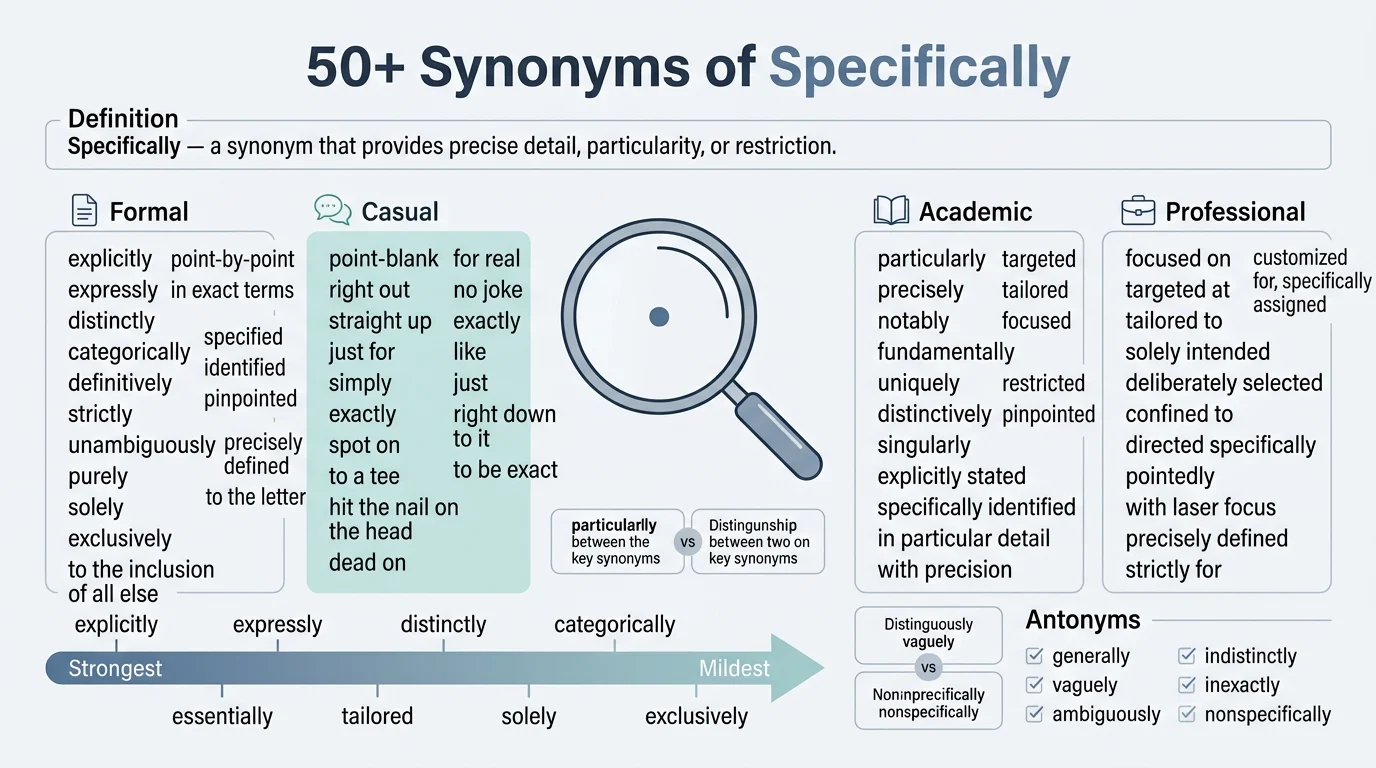
Quick Ans: “Specifically” means in a precise, exact, or particular manner, or for a special purpose. For formal writing, choose particularly, explicitly, or precisely. For casual conversation, use exactly or especially. In academic contexts, namely and that is are strong choices. For emphasis on purpose, select expressly or especially.
Meaning, Tone, and Context
Understanding the core meaning of “specifically” is the first step to using it effectively.
Simple Definition: In a way that is exact, precise, or clearly defined; for a particular purpose or reason.
Part of Speech: Adverb.
Overall Tone: Neutral to emphatic. It adds precision and clarity.
Formality Level: Neutral to formal. The word is appropriate in most contexts.
Common Uses: Native English speakers use it to clarify, emphasize, or distinguish. For example, “I specifically asked for the red one,” or “The report specifically addresses climate change.”
Word Forms: Related words include the adjective specific, the noun specification, and the verb specify.
When and How to Use “Specifically”
“Specifically” is the perfect choice when you want to be precise and unambiguous. Here are seven realistic examples.
Professional: “We are specifically looking for candidates with five years of experience.”
Academic: “The study specifically examines the effects of sleep deprivation on memory.”
Workplace: “I specifically requested that the report be submitted by Friday.”
Personal: “She specifically told me not to wait for her.”
Email: “Please specifically address each point in the proposal.”
Resume: “Specifically managed a team of ten employees across three departments.”
Social Media: “I specifically chose this restaurant for its vegan options.”
Best Synonyms of “Specifically”
No synonym is identical in every situation. Here is your guide to the best replacement for “specifically” based on your writing context.
Most Formal: Particularly is a formal synonym meaning especially or in particular. “The report is particularly concerned with safety.”
Most Precise: Precisely means exactly and accurately. “The instructions were precisely followed.”
For Clarity: Explicitly means clearly and directly stated. “He explicitly told us not to touch it.”
For Naming: Namely is used to introduce a specific example or list. “Two countries, namely France and Germany, opposed the plan.”
For Purpose: Expressly means for a specific purpose. “The rule was expressly designed to prevent fraud.”
For Emphasis: Especially means to a great extent or particularly. “I love fruit, especially mangoes.”
Casual: Exactly is a common informal synonym. “That is exactly what I meant.”
Clarifying: That is or to be specific are common clarifying phrases. “To be specific, the deadline is Friday at noon.”
When Not to Use “Specifically”
Using “specifically” can sound wrong or awkward in certain situations.
When It Sounds Redundant: “Specifically” can be redundant if the sentence is already precise.
Better Choice: Remove it. “I want the red one” instead of “I specifically want the red one.”
When You Mean “Generally”: “Specifically” is the opposite of “generally.”
Better Choice: Generally or usually. “I generally prefer tea.”
When It Sounds Too Formal: In casual conversation, “specifically” can sound stiff.
Better Choice: Exactly or especially. “I want that one exactly.”
Words Commonly Confused With “Specifically”
Word: Especially
Difference: Means particularly or to a great extent. “Specifically” means exactly or precisely.
When to Use: Use it for emphasis on degree.
Example: “I love Italian food, especially pizza.”
Word: Particularly
Difference: Similar to “especially,” often used in formal contexts.
When to Use: Use it in formal writing for emphasis.
Example: “The data is particularly concerning.”
Word: Exactly
Difference: Means precisely and without deviation. “Specifically” is more about particularity.
When to Use: Use it for precision in casual contexts.
Example: “That is exactly what I said.”
Word: Precisely
Difference: Means accurately and exactly. “Specifically” is often about naming.
When to Use: Use it for accuracy.
Example: “The measurements were precisely recorded.”
Word: Explicitly
Difference: Means clearly stated. “Specifically” is about particularity.
When to Use: Use it for clear instructions.
Example: “He explicitly stated the rules.”
Word: Namely
Difference: Used to introduce a specific example. “Specifically” is broader.
When to Use: Use it to list specific items.
Example: “Two people, namely John and Mary, were absent.”
Best Synonyms of “Specifically” by Context
| Context | Best Synonym | Why It Works | Example |
|---|---|---|---|
| Formal writing | Particularly | Formal and emphatic | “The report is particularly concerned with safety.” |
| Academic writing | Namely | Precise for listing | “Two factors, namely cost and time, were critical.” |
| Professional communication | Explicitly | Clear and direct | “He explicitly stated the requirements.” |
| Business emails | Precisely | Accurate and formal | “The instructions were precisely followed.” |
| Legal writing | Expressly | Specific to purpose | “The clause was expressly included.” |
| Casual conversation | Exactly | Simple and natural | “That is exactly what I meant.” |
| Emphasis | Especially | Emphasizes degree | “I love fruit, especially mangoes.” |
| Clarification | To be specific | Clarifying phrase | “To be specific, the deadline is Friday.” |
How to Choose the Best Synonym of “Specifically”
Choosing the right word is a simple decision. Answer these questions.
What is my purpose? For clarity, use explicitly. For naming, use namely. For emphasis, use especially. For precision, use precisely.
What is my audience? For a formal report, use particularly or expressly. For a friend, use exactly.
Am I emphasizing or clarifying? For emphasis, use especially or particularly. For clarifying, use to be specific or namely.
Real Life Examples of “Specifically”
School: Basic: “The teacher specifically said to read chapter five.” Improved: “The teacher explicitly said to read chapter five.”
College: Basic: “The study specifically focuses on teenagers.” Improved: “The study particularly focuses on teenagers.”
Workplace: Basic: “I specifically need the data by noon.” Improved: “I need the data precisely by noon.”
Business: Basic: “The policy specifically addresses harassment.” Improved: “The policy expressly addresses harassment.”
Email: Basic: “Please specifically answer question three.” Improved: “Please specifically answer question three.” (Acceptable for emphasis.)
Conversation: Basic: “I specifically want the blue one.” Improved: “I want the blue one exactly.”
Storytelling: Basic: “She specifically chose the red dress.” Improved: “She deliberately chose the red dress.”
Top 10 Synonyms of “Specifically”
| Synonym | Simple Meaning | Best Used For | Example Sentence |
|---|---|---|---|
| Particularly | Especially, in particular | Formal and emphatic contexts | “The report is particularly concerned with safety.” |
| Precisely | Exactly and accurately | Precision and accuracy contexts | “The instructions were precisely followed.” |
| Explicitly | Clearly and directly stated | Clarity and instruction contexts | “He explicitly stated the rules.” |
| Namely | That is to say | Listing and clarifying contexts | “Two factors, namely cost and time, were critical.” |
| Expressly | For a specific purpose | Legal and purpose contexts | “The clause was expressly included.” |
| Especially | To a great extent | Emphasis and degree contexts | “I love fruit, especially mangoes.” |
| Exactly | Precisely, without deviation | Casual and precise contexts | “That is exactly what I meant.” |
| To be specific | To clarify precisely | Clarifying contexts | “To be specific, the deadline is Friday.” |
| In particular | Especially | Formal and emphatic contexts | “In particular, the safety features are impressive.” |
| Definitively | In a decisive and clear way | Conclusive contexts | “The results definitively proved the theory.” |
Synonyms of “Specifically” by Usage
Professional vs. Personal Synonyms
In the workplace (professional), choose explicitly, precisely, or particularly to be clear and formal. “I explicitly requested the report” is more precise than “I specifically requested the report.”
With friends (personal), exactly, especially, or really keep the tone relaxed.
Formal vs. Conversational Synonyms
For formal writing, use particularly, expressly, or namely. For casual conversations, use exactly, especially, or to be specific.
Academic Synonyms
For research and essays, choose particularly, namely, or precisely. These words sound considered and scholarly.
Professional and Business Synonyms
For maximum impact in business writing, choose explicitly for instructions, precisely for accuracy, and expressly for purpose.
Creative and Literary Synonyms
To add emphasis, choose especially or particularly.
Strongest to Mildest Synonyms
Mild: especially, exactly
Moderate: specifically, particularly, to be specific
Strong: precisely, explicitly, in particular
Very Strong: expressly, namely, definitively
Emotional vs. Neutral Synonyms
Emotional Synonyms: Especially, particularly. These words add emphasis and feeling.
Neutral Synonyms: Specifically, precisely, exactly. These words simply communicate factual information.
Antonyms of “Specifically”
| Antonym | Meaning | Example Sentence |
|---|---|---|
| Generally | In a general manner | “I generally prefer tea.” |
| Broadly | In a wide sense | “The topic was broadly discussed.” |
| Vaguely | In an unclear way | “He vaguely described the plan.” |
| Loosely | Not strictly | “The term is loosely used.” |
| Approximately | Roughly | “The cost is approximately $100.” |
| Roughly | Not precisely | “The estimate is roughly correct.” |
Comparison: “Specifically” vs Similar Words
Specifically vs. Especially
Main Difference: “Especially” emphasizes degree. “Specifically” emphasizes precision.
Which Is Stronger? “Especially” is stronger for emphasis.
Which Is More Formal? Both are similar.
When to Use Each: Use “especially” for degree. Use “specifically” for precision.
Examples:
Specifically: “I specifically asked for the red one.”
Especially: “I love fruit, especially mangoes.”
Specifically vs. Particularly
Main Difference: “Particularly” is more formal. “Specifically” is more direct.
Which Is Stronger? They are similar.
Which Is More Formal? “Particularly” is more formal.
When to Use Each: Use “particularly” in formal writing. Use “specifically” in general contexts.
Examples:
Specifically: “The report specifically addresses safety.”
Particularly: “The report is particularly concerned with safety.”
Specifically vs. Precisely
Main Difference: “Precisely” means exactly. “Specifically” means in particular.
Which Is Stronger? “Precisely” is stronger for accuracy.
Which Is More Formal? Both are formal.
When to Use Each: Use “precisely” for accuracy. Use “specifically” for particularity.
Examples:
Specifically: “I specifically need the data.”
Precisely: “The instructions were precisely followed.”
Specifically vs. Explicitly
Main Difference: “Explicitly” means clearly stated. “Specifically” means in particular.
Which Is Stronger? “Explicitly” is stronger for clarity.
Which Is More Formal? Both are formal.
When to Use Each: Use “explicitly” for clear instructions. Use “specifically” for particularity.
Examples:
Specifically: “I specifically requested the report.”
Explicitly: “He explicitly stated the rules.”
Specifically vs. Namely
Main Difference: “Namely” introduces a specific example. “Specifically” is broader.
Which Is Stronger? “Namely” is more specific.
Which Is More Formal? “Namely” is formal.
When to Use Each: Use “namely” for listing. Use “specifically” for general precision.
Examples:
Specifically: “The study specifically focuses on teenagers.”
Namely: “Two factors, namely cost and time, were critical.”
Common Phrases and Expressions with “Specifically”
Phrase: To be specific
Meaning: To clarify precisely.
Example Sentence: “To be specific, the deadline is Friday at noon.”
Phrase: Specifically speaking
Meaning: In precise terms.
Example Sentence: “Specifically speaking, the law applies to businesses.”
Phrase: More specifically
Meaning: With greater precision.
Example Sentence: “More specifically, the study focuses on teenagers.”
Phrase: Specifically designed
Meaning: Made for a particular purpose.
Example Sentence: “The program is specifically designed for beginners.”
Phrase: Specifically targeted
Meaning: Aimed at a particular group.
Example Sentence: “The campaign was specifically targeted at young voters.”
Common Mistakes to Avoid
Mistake 1: Using “specifically” when you mean “especially”.
Incorrect: “I love fruit, specifically mangoes.”
Better: “I love fruit, especially mangoes.”
Why: “Especially” is for emphasis on degree.
Mistake 2: Using “specifically” when you mean “exactly”.
Incorrect: “That is specifically what I meant.”
Better: “That is exactly what I meant.”
Why: “Exactly” is for precision.
Mistake 3: Overusing “specifically” in conversation.
Incorrect: “I specifically want the blue one.”
Better: “I want the blue one exactly.”
Why: “Exactly” sounds more natural in casual conversation.
Mistake 4: Using “specifically” when you mean “namely”.
Incorrect: “Two people, specifically John and Mary, were absent.”
Better: “Two people, namely John and Mary, were absent.”
Why: “Namely” is for listing specific items.
Mistake 5: Using “specifically” redundantly.
Incorrect: “I specifically want the red one specifically.”
Better: “I specifically want the red one.”
Why: Avoid redundancy.
Frequently Asked Questions
1. What are the best synonyms of “specifically”?
The best synonyms depend on your context. For formal writing, choose particularly or explicitly. For casual conversation, use exactly or especially. For listing, use namely.
2. What are the best formal synonyms of “specifically”?
The best formal synonyms are particularly, precisely, and expressly. These words are suitable for academic papers, professional reports, and business communications.
3. What are common informal synonyms of “specifically”?
For informal settings, use exactly, especially, or to be specific. These alternatives sound more natural in everyday conversation.
4. What is another word for “specifically” in professional writing?
In professional writing, explicitly is an excellent choice. It conveys clarity and directness. Precisely is also strong for accuracy.
5. What is the difference between “specifically” and “especially”?
“Specifically” means in a precise manner. “Especially” means to a great extent or particularly. Use “specifically” for precision and “especially” for emphasis.
6. What is the opposite of “specifically”?
The most direct opposites (antonyms) of specifically are generally, broadly, and vaguely.
Conclusion
“Specifically” is a powerful and precise word for pointing to exact details, making distinctions, and emphasizing particular points. The term is widely accepted in most contexts, yet it can sound redundant or overly formal in certain situations. The best choice among the synonyms of specifically depends entirely on your audience, tone, and purpose. For a formal, precise effect, use particularly or expressly. For a practical, business context, explicitly or precisely works perfectly. For casual conversation, choose exactly or especially. Remember, no single synonym works perfectly in every situation. Your goal is to choose the word that communicates your message with the most clarity and impact. A practical tip for your vocabulary growth is to pay attention to how writers clarify and emphasize and practice using different synonyms in your writing.