Have you ever needed to describe someone’s skill level but felt that “good” or “skilled” did not capture their true ability? You want to highlight expertise and competence, and the word “proficient” comes to mind. But is it the best fit for your audience? Choosing the right synonym for “proficient” can transform a basic compliment into a precise assessment of capability. This guide explores the best synonyms of proficient, explaining exactly which word to use and when.
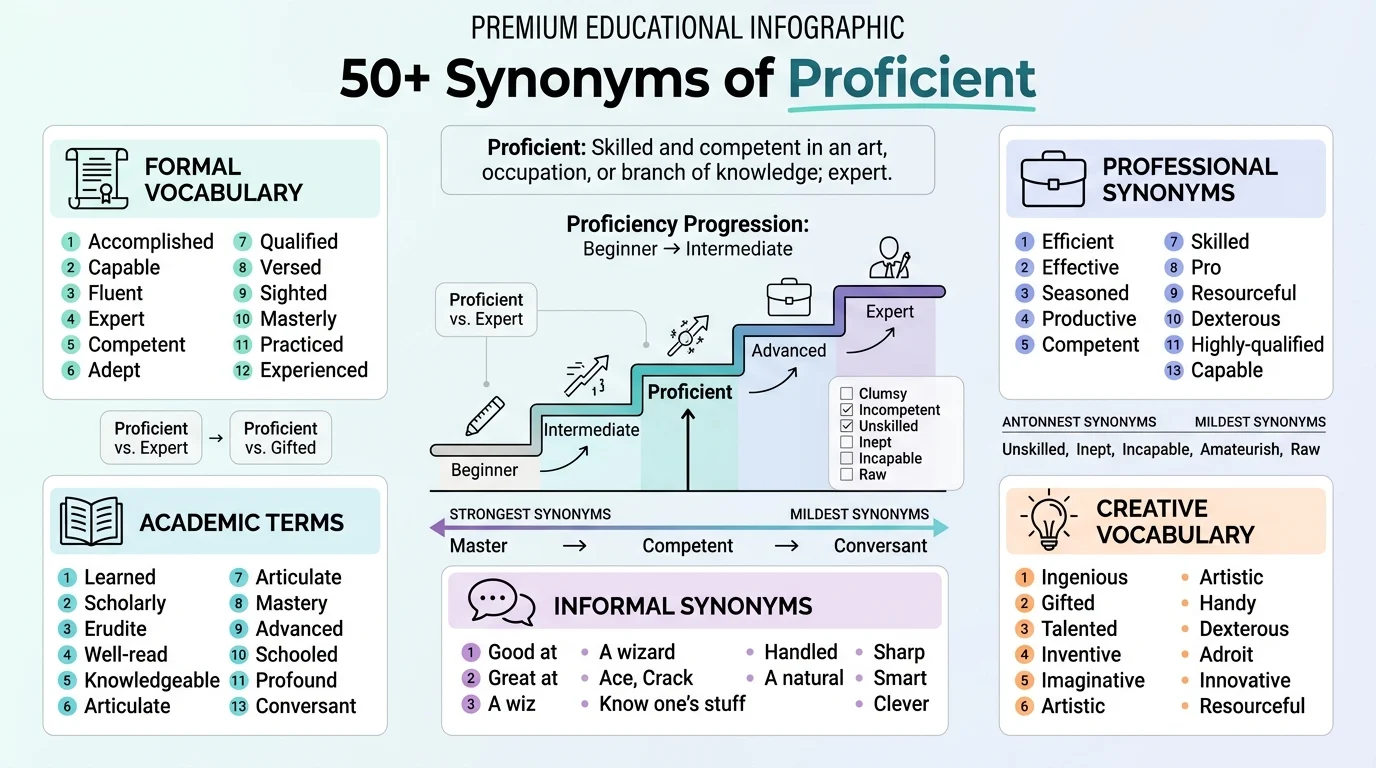
Quick Ans: “Proficient” means having a high level of skill or competence in a particular activity or field. It is a neutral, formal adjective. For professional writing, choose adept or competent. For casual conversation, use capable or skilled. In academic contexts, expert and masterful are strong choices. For a stronger, more dramatic impact, select virtuoso or consummate.
Meaning, Tone, and Context
Understanding the core meaning of “proficient” is the first step to using it effectively.
Simple Definition: Competent or skilled in doing something. Demonstrating a high degree of ability.
Part of Speech: Adjective.
Overall Tone: Neutral to positive. It indicates capability without excessive praise.
Formality Level: Formal. The word is appropriate in professional and academic settings.
Common Uses: Native English speakers use it to describe language ability, job skills, or technical expertise. For example, “She is proficient in Spanish,” or “He is proficient with the new software.”
Word Forms: Related words include the noun proficiency and the adverb proficiently.
When and How to Use “Proficient”
“Proficient” is the perfect choice when you want to emphasize competence and capability. Here are seven realistic examples.
Professional: “Our team needs a candidate who is proficient in data analysis.”
Academic: “Students must become proficient in scientific reasoning before graduation.”
Workplace: “She quickly became proficient in using the new project management system.”
Personal: “After years of practice, he finally felt proficient on the guitar.”
Email: “Please confirm that you are proficient with the required software.”
Resume: “Proficient in Microsoft Excel, Python, and project management methodologies.”
Social Media: “Three months of daily practice made me proficient at watercolor painting.”
Best Synonyms of “Proficient”
No synonym is identical in every situation. Here is your guide to the best replacement for “proficient” based on your writing context.
Professional Writing: Adept. It suggests natural skill and cleverness. “She is adept at negotiating complex contracts.”
Academic Writing: Expert. This is ideal when discussing someone with deep, authoritative knowledge. “The expert analysis revealed new insights.”
Business Communication: Competent. A practical choice that meets expectations. “We need a competent manager to lead the team.”
Casual Conversation: Skilled. It tones down the formality and sounds natural. “He is a skilled carpenter.”
Emotional Writing: Masterful. This word carries weight, suggesting control and artistry. “Her masterful performance moved the audience.”
Creative Writing: Virtuoso. It implies extraordinary technical brilliance. “The virtuoso pianist captivated the crowd.”
Resume Writing: Proficient. This is the standard and expected term for resumes. It communicates reliability and capability.
When Not to Use “Proficient”
Using “proficient” can sound wrong or inadequate in certain situations.
When It Sounds Too Formal: In casual conversation, “proficient” sounds stiff.
Better Choice: Good at or skilled. “He is good at fixing things.”
When You Mean Beginner Level: “Proficient” suggests high competence. It is wrong for someone who is just learning.
Better Choice: Familiar or basic. “She has basic knowledge of the software.”
When Describing Innate Talent: “Proficient” suggests learned skill, not natural ability.
Better Choice: Talented or gifted. “She is a gifted artist.”
When It Sounds Too Modest: You might need a stronger word.
Better Choice: Expert or masterful. “He is an expert in his field.”
Words Commonly Confused With “Proficient”
Several words are often mixed up with “proficient.” Here is how to keep them straight.
Word: Competent
Difference: Means adequate or satisfactory. “Proficient” implies a higher level of skill.
When to Use: Use it when someone meets the minimum requirements.
Example: “She is a competent worker who completes tasks on time.”
Word: Adept
Difference: Suggests natural skill and cleverness. “Proficient” suggests learned skill.
When to Use: Use this for people who seem naturally talented.
Example: “He is adept at solving complex problems quickly.”
Word: Skilled
Difference: More general and common. “Proficient” is more formal.
When to Use: Use it in everyday situations.
Example: “The skilled craftsman built the cabinet perfectly.”
Word: Expert
Difference: Implies the highest level of knowledge and authority. “Proficient” is more modest.
When to Use: Use this when someone has deep, authoritative expertise.
Example: “She is an expert in international law.”
Word: Masterful
Difference: Implies control, artistry, and dominance. “Proficient” is more neutral.
When to Use: Use it for performances or achievements that show exceptional control.
Example: “His masterful handling of the crisis saved the company.”
Word: Virtuoso
Difference: Implies extraordinary technical brilliance. “Proficient” is ordinary by comparison.
When to Use: Use this for artistic or musical brilliance.
Example: “The virtuoso violinist received a standing ovation.”
Best Synonyms of “Proficient” by Context
| Context | Best Synonym | Why It Works | Example |
|---|---|---|---|
| Formal writing | Adept | Suggests natural skill and cleverness. | “The negotiator was adept at finding common ground.” |
| Academic writing | Expert | Conveys authority and deep knowledge. | “The expert opinion carried significant weight.” |
| Professional communication | Competent | Indicates reliability and capability. | “We need a competent project manager.” |
| Business emails | Skilled | Professional yet accessible. | “Our team includes skilled developers.” |
| Resume writing | Proficient | The standard, expected term. | “Proficient in multiple programming languages.” |
| Workplace communication | Capable | Emphasizes ability to perform tasks. | “She is capable of handling this responsibility.” |
| Casual conversation | Good at | Simple, natural, and conversational. | “He is good at fixing cars.” |
| Creative writing | Virtuoso | Evokes extraordinary brilliance. | “The virtuoso performance left the audience speechless.” |
| Emotional writing | Masterful | Suggests control and artistry. | “Her masterful speech inspired the crowd.” |
| Strong emphasis | Consummate | Implies the highest level of skill. | “He is a consummate professional.” |
| Mild tone | Capable | Simple and unassuming. | “She is capable of completing the task.” |
| Social media captions | Skilled | Widely understood and relatable. | “Feeling skilled after mastering this recipe.” |
How to Choose the Best Synonym of “Proficient”
Choosing the right word is a simple decision. Answer these questions.
What is my audience? For a professor or CEO, adept or expert is powerful. For a friend, skilled or good at is more natural.
What is my purpose? Are you trying to praise, inform, or evaluate? Use virtuoso for praise, competent for evaluation, and expert for information.
Am I describing a learned skill or natural talent? For learned skills, proficient or skilled are good. For natural talent, adept or gifted are better.
What is the emotional strength? Virtuoso and masterful are stronger. Capable and competent are mild. Pick the one that matches your message.
Real Life Examples of “Proficient”
To truly master the word, it helps to see how it behaves in the wild and how a stronger synonym can elevate the sentence.
School: Basic: “The student is proficient in math.” Improved: “The student is adept at solving complex algebra problems.”
College: Basic: “She is proficient in French.” Improved: “She is expert in French literature and linguistics.”
Workplace: Basic: “He is proficient with the software.” Improved: “He is skilled at using the software to streamline workflows.”
Business: Basic: “The manager is proficient at delegating.” Improved: “The manager is masterful at delegating tasks effectively.”
Email: Basic: “I am proficient in project management.” Improved: “I am competent in project management and have led several successful initiatives.”
Conversation: Basic: “I am proficient at cooking.” Improved: “I am pretty good at cooking Italian food.”
Storytelling: Basic: “She was proficient on the piano.” Improved: “She was a virtuoso on the piano, captivating everyone in the room.”
Top 10 Synonyms of “Proficient”
| Synonym | Simple Meaning | Best Used For | Example Sentence |
|---|---|---|---|
| Adept | Naturally skilled and clever | Professional, creative, and clever contexts. | “She is adept at thinking on her feet.” |
| Expert | Having the highest level of knowledge | Academic, professional, and authoritative contexts. | “The expert witness testified for three hours.” |
| Competent | Meeting the required standards | Business, workplace, and performance evaluations. | “He is competent to lead the project.” |
| Skilled | Having developed abilities | Everyday and professional contexts. | “The skilled technician repaired the machine.” |
| Capable | Having the ability to do something | Workplaces, personal references, and recommendations. | “She is capable of managing the team.” |
| Masterful | Showing exceptional control and artistry | Artistic, emotional, and performance contexts. | “His masterful direction created a masterpiece.” |
| Virtuoso | Possessing extraordinary technical brilliance | Music, art, and high-performance contexts. | “The virtuoso guitarist amazed everyone.” |
| Consummate | Perfectly skilled and complete | Formal praise and professional accolades. | “He is a consummate leader.” |
| Accomplished | Highly skilled through practice and achievement | Resumes, biographies, and professional profiles. | “The accomplished author has written ten novels.” |
| Qualified | Meeting the necessary requirements | Job applications, certifications, and hiring. | “She is qualified for the position.” |
Synonyms of “Proficient” by Usage
Professional vs. Personal Synonyms
In the workplace (professional), choose competent, qualified, or skilled to describe ability. These words convey reliability and meeting standards. “She is competent in her role” is more precise than “She is good at her job.”
With friends (personal), good at, skilled, or talented keep the tone relaxed and relatable. These alternatives sound natural in everyday conversation.
Formal vs. Conversational Synonyms
For formal writing (reports, essays, professional emails), use adept, expert, or consummate. These choices maintain the sophisticated tone expected in professional documents.
For casual conversations and texting, use good at, skilled, or pretty good. These options sound more natural and less pretentious.
Academic Synonyms
For research and essays, choose precise, authoritative words. Expert is great for authoritative figures, accomplished for achievements, and adept for natural skill. These words sound considered and scholarly.
Using precise academic vocabulary demonstrates expertise and careful thinking. Professors and reviewers expect this level of precision.
Professional and Business Synonyms
For maximum impact in business writing, choose competent for meeting standards, qualified for job applications, and skilled for technical abilities. These words demonstrate confidence and professional awareness.
Business leaders respond to language that conveys reliability and capability. These synonyms project authority.
Creative and Literary Synonyms
To add emotion and imagery to your writing, choose masterful, virtuoso, or consummate. These words create atmosphere and drama.
Literary writers use these alternatives to build character and theme. They transform ordinary descriptions into evocative prose.
Slang or Modern Synonyms
There is no direct slang synonym for “proficient” in mainstream American English. In modern texting, people use good at or simply pro. This straightforward approach works best for casual digital communication.
Strongest to Mildest Synonyms
Mild: capable, competent, qualified
Moderate: skilled, proficient, accomplished
Strong: adept, expert, talented
Very Strong: masterful, virtuoso, consummate
Emotional vs. Neutral Synonyms
Emotional Synonyms: Masterful, virtuoso, consummate. These words often hint at admiration, awe, or inspiration. Use them when you want to evoke feeling.
Neutral Synonyms: Competent, qualified, capable. These words simply communicate factual information. Use them when you want to inform without emotional coloring.
Antonyms of “Proficient”
Here are 15 genuine opposites of “proficient.”
| Antonym | Meaning | Example Sentence |
|---|---|---|
| Incompetent | Lacking the necessary skills | “The incompetent employee made many mistakes.” |
| Inexperienced | Lacking practice or exposure | “The inexperienced driver was nervous on the highway.” |
| Unskilled | Not having developed abilities | “The unskilled laborer struggled with the task.” |
| Incapable | Not having the ability | “She was incapable of completing the project on time.” |
| Amateur | Doing something without professional skill | “His amateur attempt was obvious.” |
| Untrained | Not having received formal instruction | “The untrained staff could not operate the machine.” |
| Clumsy | Lacking coordination or skill | “His clumsy handling of the situation made things worse.” |
| Inept | Having no skill in a particular area | “She was inept at managing conflict.” |
| Bumbling | Acting in a confused, ineffective way | “The bumbling assistant caused chaos in the office.” |
| Unqualified | Not meeting the necessary standards | “He was unqualified for the leadership role.” |
| Novice | A person new to an activity | “The novice player lost every match.” |
| Green | Inexperienced and naive | “The green recruit had much to learn.” |
| Ignorant | Lacking knowledge or awareness | “She was ignorant of basic safety procedures.” |
| Foolish | Lacking good sense or judgment | “His foolish decision cost the company millions.” |
| Unpracticed | Not having recent practice | “She was unpracticed and made several errors.” |
Comparison: “Proficient” vs Similar Words
Proficient vs. Competent
Main Difference: Competent means meeting minimum standards. Proficient means having a high level of skill.
Which Is Stronger? Proficient is stronger and implies greater capability.
Which Is More Formal? Both are formal, but proficient is slightly more sophisticated.
When to Use Each: Use competent when someone meets expectations. Use proficient when someone exceeds them.
Examples:
Proficient: “She is proficient in three languages.”
Competent: “He is competent to handle the daily operations.”
Proficient vs. Adept
Main Difference: Proficient implies learned skill. Adept implies natural cleverness.
Which Is Stronger? Adept is stronger and implies instinctive ability.
Which Is More Formal? Both are formal and professional.
When to Use Each: Use proficient for skills developed through practice. Use adept for natural talent.
Examples:
Proficient: “After training, he became proficient in the software.”
Adept: “She is adept at reading people’s emotions.”
Proficient vs. Expert
Main Difference: Proficient is a high level of skill. Expert is the highest level of knowledge.
Which Is Stronger? Expert is much stronger and implies authority.
Which Is More Formal? Both are formal, but expert carries more weight.
When to Use Each: Use proficient for general capability. Use expert for deep, authoritative knowledge.
Examples:
Proficient: “He is proficient in digital marketing.”
Expert: “She is an expert in international trade law.”
Proficient vs. Skilled
Main Difference: Proficient is more formal. Skilled is more general and common.
Which Is Stronger? They are similar in strength. Proficient implies a higher standard.
Which Is More Formal? Proficient is more formal. Skilled is neutral.
When to Use Each: Use proficient in formal documents. Use skilled in everyday conversation.
Examples:
Proficient: “The applicant is proficient in Excel.”
Skilled: “He is a skilled carpenter.”
Proficient vs. Masterful
Main Difference: Proficient is modest. Masterful implies artistry and dominance.
Which Is Stronger? Masterful is far stronger and more dramatic.
Which Is More Formal? Both are formal, but masterful is more elevated.
When to Use Each: Use proficient for practical skills. Use masterful for performances and achievements.
Examples:
Proficient: “She is proficient at public speaking.”
Masterful: “His masterful presentation won over the board.”
Proficient vs. Virtuoso
Main Difference: Proficient is ordinary. Virtuoso implies extraordinary brilliance.
Which Is Stronger? Virtuoso is the strongest possible term.
Which Is More Formal? Virtuoso is formal and typically used for artistic talent.
When to Use Each: Use proficient for everyday competence. Use virtuoso for exceptional artistic brilliance.
Examples:
Proficient: “He is proficient at the violin.”
Virtuoso: “She is a virtuoso violinist.”
Common Phrases and Expressions with “Proficient”
Phrase: Proficient in
Meaning: Having skill in a particular area.
Example Sentence: “She is proficient in multiple programming languages.”
Phrase: Proficient at
Meaning: Being skilled at performing a task.
Example Sentence: “He is proficient at solving complex problems.”
Phrase: Proficient with
Meaning: Having skill using a tool or technology.
Example Sentence: “She is proficient with Adobe Creative Suite.”
Phrase: Proficiency level
Meaning: The degree of skill or competence.
Example Sentence: “The language test measures proficiency level.”
Phrase: Become proficient
Meaning: To develop skill through practice.
Example Sentence: “It takes time to become proficient at a new skill.”
Common Mistakes to Avoid
Mistake 1: Using “proficient” when you mean “competent”.
Incorrect: “He is proficient to do the basic tasks.”
Better: “He is competent to do the basic tasks.”
Why: Competent means meeting minimum standards. Proficient implies a higher level.
Mistake 2: Using “proficient” for beginner skills.
Incorrect: “After one lesson, she was proficient in French.”
Better: “After one lesson, she had basic knowledge of French.”
Why: Proficiency requires significant practice and experience.
Mistake 3: Overusing “proficient” in resumes.
Incorrect: “Proficient in Excel, Word, PowerPoint, and email.”
Better: “Skilled in Excel and adept at creating PowerPoint presentations.”
Why: Variation makes your resume more engaging and specific.
Mistake 4: Using “expert” when you mean “proficient”.
Incorrect: “He is an expert at using the coffee machine.”
Better: “He is proficient at using the coffee machine.”
Why: Expert implies deep, authoritative knowledge. Proficient is better for everyday skills.
Mistake 5: Using “masterful” for basic competence.
Incorrect: “Her masterful data entry kept the records accurate.”
Better: “Her accurate data entry kept the records updated.”
Why: Masterful implies artistry and brilliance. It sounds ridiculous for routine tasks.
Frequently Asked Questions
1. What are the best synonyms of “proficient”?
The best synonyms depend on your context. For formal writing, choose adept or competent.And for casual conversation, skilled or capable are ideal choices. For the highest level, use expert or masterful.
2. What are the best formal synonyms of “proficient”?
The best formal synonyms are adept, competent, and accomplished. These words are suitable for academic papers, professional reports, and business communications.
3. What are common informal synonyms of “proficient”?
For informal settings, use skilled, capable, or simply good at. These alternatives sound more natural in everyday conversation.
4. What is another word for “proficient” in professional writing?
In professional writing, adept is an excellent choice. It conveys natural skill and cleverness. Competent is also strong for meeting standards.
5. What is the difference between “proficient” and “expert”?
While both indicate skill, proficient means highly capable. Expert implies the highest level of knowledge and authority. Use expert for deep, specialized knowledge.
6. What is the opposite of “proficient”?
The most direct opposites (antonyms) of proficient are incompetent, inexperienced, and unskilled. These words describe people who lack capability.
Conclusion
“Proficient” is a valuable word for describing skill and competence. The term is formal and widely accepted in professional contexts, yet it can sound too modest for extraordinary talent. The best choice among the synonyms of proficient depends entirely on your audience, tone, and purpose.Remember, no single synonym works perfectly in every situation. Your goal is to choose the word that communicates your message with the most clarity and impact. A practical tip for your vocabulary growth is to practice using different synonyms in your daily writing to develop confidence and precision.
Discover More:-
- 50+ Synonyms of Example: Meanings, Uses, Examples, and Best Alternatives
- 50+ Synonyms of Ubiquitous: Meanings, Uses, Examples, and Best Alternatives

Ella Parker is a professional content writer with a passion for creating clear, engaging, and well-researched articles. She focuses on delivering valuable insights and practical information across business, technology, and lifestyle topics.