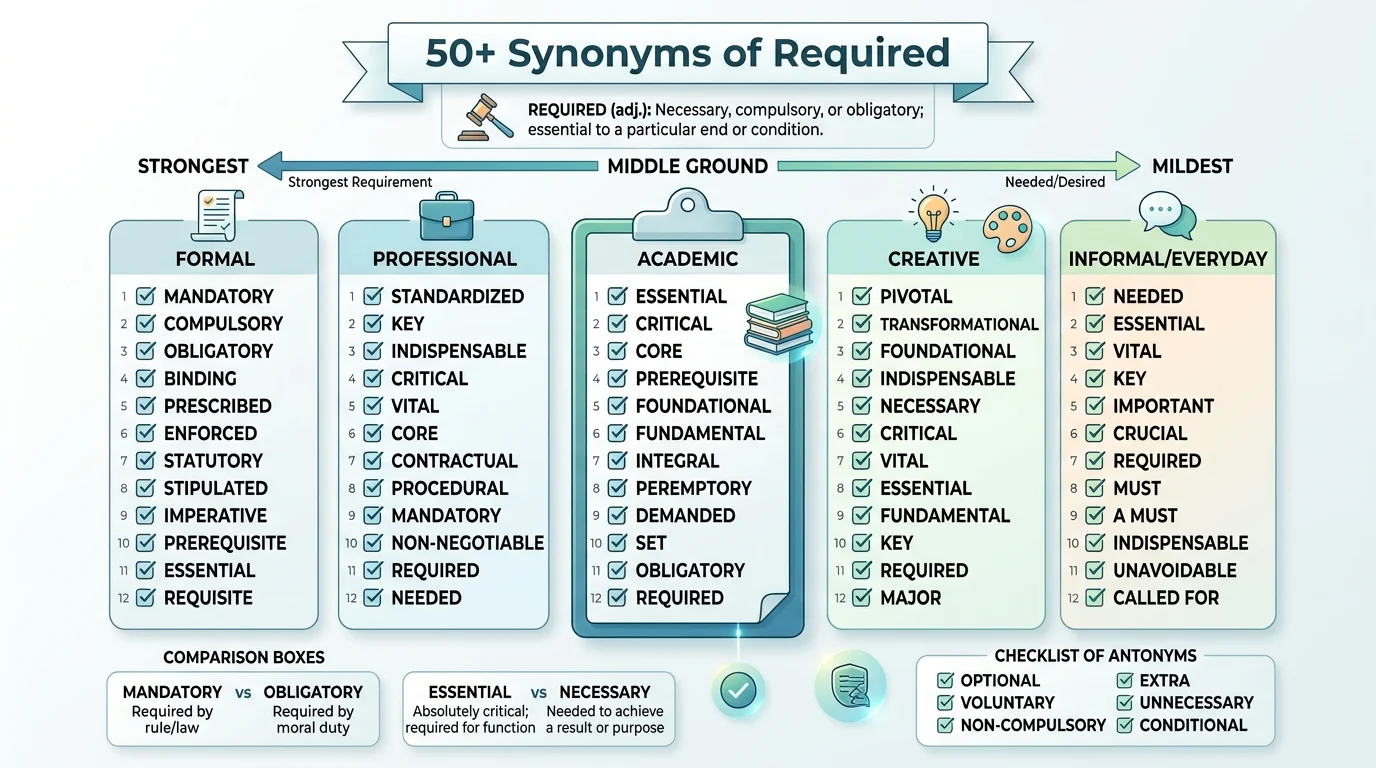
Have you ever needed to express that something is mandatory but felt that “required” sounded too formal or too weak? You want to convey necessity, and the word “required” comes to mind. But is it the best fit for your audience? Choosing the right synonym for “required” can transform a simple instruction into a compelling directive. This guide explores the best synonyms of required, explaining exactly which word to use and when.
Quick Ans: “Required” means officially or legally needed or necessary. It is a formal, neutral adjective. For formal writing, choose mandatory or obligatory. For casual conversation, use necessary or needed. In academic contexts, essential and imperative are strong choices. For a stronger, more urgent impact, select compulsory or paramount.
Meaning, Tone, and Context
Understanding the core meaning of “required” is the first step to using it effectively.
Simple Definition: Officially or legally needed. Something that must be done or provided.
Part of Speech: Adjective.
Overall Tone: Neutral to slightly formal. It indicates necessity without imposing pressure.
Formality Level: Formal. The word is appropriate in professional, legal, and academic settings.
Common Uses: Native English speakers use it for rules, procedures, and obligations. For example, “A valid ID is required,” or “This course is required for graduation.”
Word Forms: Related words include the verb require, the noun requirement, and the adverb necessarily.
When and How to Use “Required”
“Required” is the perfect choice when you want to state a rule or necessity. Here are seven realistic examples.
Professional: “A bachelor’s degree is required for this position.”
Academic: “The required reading list includes ten classic novels.”
Workplace: “Safety training is required for all new employees.”
Personal: “The recipe required three cups of flour.”
Email: “Your response is required by Friday afternoon.”
Resume: “Managed a team of five and ensured all required certifications were current.”
Social Media: “No RSVP required for this free community event.”
Best Synonyms of “Required”
No synonym is identical in every situation. Here is your guide to the best replacement for “required” based on your writing context.
Professional Writing: Mandatory. It suggests an official, non-negotiable rule. “Safety training is mandatory for all employees.”
Academic Writing: Essential. This is ideal when discussing core elements. “Essential reading includes the foundational texts.”
Business Communication: Necessary. A practical choice for stating needs. “We need the necessary approvals before proceeding.”
Casual Conversation: Needed. It tones down the formality and sounds natural. “We needed more time to finish.”
Emotional Writing: Imperative. This word carries weight, suggesting critical importance. “It is imperative that we act now.”
Creative Writing: Indispensable. It implies something cannot be done without. “Her guidance was indispensable to the project.”
Resume Writing: Required. This is the standard and expected term for job descriptions. It communicates clarity and expectations.
When Not to Use “Required”
Using “required” can sound wrong or inadequate in certain situations.
When It Sounds Too Formal: In casual conversation, “required” sounds stiff.
Better Choice: Needed or had to. “We needed more supplies.”
When You Mean Strongly Suggested: “Required” means mandatory, not optional.
Better Choice: Recommended or suggested. “The book is recommended reading.”
When Describing Personal Necessity: “Required” sounds like an external rule.
Better Choice: Needed. “I needed a break.”
When It Sounds Too Harsh: For polite requests, choose a softer word.
Better Choice: Requested. “Your feedback is requested.”
Words Commonly Confused With “Required”
Several words are often mixed up with “required.” Here is how to keep them straight.
Word: Mandatory
Difference: Means required by law or rules. “Required” is more general.
When to Use: Use it for official, legal, or formal obligations.
Example: “Attendance is mandatory for all employees.”
Word: Compulsory
Difference: Means required by law or rules, often for groups. “Required” is more general.
When to Use: Use this for educational and legal requirements.
Example: “Compulsory education lasts until age sixteen.”
Word: Obligatory
Difference: Means required as part of a duty. “Required” is neutral.
When to Use: Use it for social, moral, or formal obligations.
Example: “It is obligatory to wear a suit to the ceremony.”
Word: Essential
Difference: Means absolutely necessary for a purpose. “Required” suggests external rules.
When to Use: Use this for core elements and critical components.
Example: “Water is essential for life.”
Word: Necessary
Difference: More general and less formal. “Required” is more formal.
When to Use: Use it in everyday situations.
Example: “We need the necessary tools for the job.”
Word: Imperative
Difference: Implies urgent importance. “Required” is neutral.
When to Use: Use it for urgent or critical needs.
Example: “It is imperative that we finish this project.”
Best Synonyms of “Required” by Context
| Context | Best Synonym | Why It Works | Example |
|---|---|---|---|
| Formal writing | Mandatory | Suggests official, non-negotiable rules. | “Mandatory safety checks are performed daily.” |
| Academic writing | Essential | Conveys core, foundational importance. | “Essential concepts are covered in the first chapter.” |
| Professional communication | Necessary | Practical and clear for business needs. | “Necessary approvals must be obtained first.” |
| Business emails | Needed | Direct and straightforward. | “Your feedback is needed by Friday.” |
| Resume writing | Required | The standard, expected term. | “Maintained all required certifications.” |
| Workplace communication | Mandatory | Emphasizes non-negotiable rules. | “Mandatory training sessions are scheduled.” |
| Casual conversation | Needed | Simple, natural, and conversational. | “We needed more chairs for the party.” |
| Creative writing | Indispensable | Evokes absolute necessity. | “His calm presence was indispensable during the crisis.” |
| Emotional writing | Imperative | Suggests urgent, critical importance. | “It is imperative that we find a solution.” |
| Strong emphasis | Obligatory | Implies a duty or social pressure. | “It is obligatory to follow the code of conduct.” |
| Mild tone | Needed | Simple and unassuming. | “All we needed was more time.” |
| Social media captions | Needed | Widely understood and relatable. | “No tickets needed for this event.” |
How to Choose the Best Synonym of “Required”
Choosing the right word is a simple decision. Answer these questions.
What is my audience? For a professor or CEO, mandatory or essential is powerful. For a friend, needed or necessary is more natural.
What is my purpose? Are you trying to state a rule, convey urgency, or make a request? Use mandatory for rules, imperative for urgency, and requested for polite appeals.
Am I describing an external rule or a personal need? For external rules, mandatory or compulsory are good. For personal needs, needed or necessary are better.
What is the emotional strength? Imperative and paramount are stronger. Needed and necessary are mild. Pick the one that matches your message.
Real Life Examples of “Required”
To truly master the word, it helps to see how it behaves in the wild and how a stronger synonym can elevate the sentence.
School: Basic: “The required textbook costs fifty dollars.” Improved: “The mandatory textbook for this class costs fifty dollars.”
College: Basic: “This course is required for graduation.” Improved: “This course is compulsory for all students seeking a degree in biology.”
Workplace: Basic: “Safety training is required.” Improved: “Safety training is mandatory for every employee without exception.”
Business: Basic: “Approval is required for the budget.” Improved: “Approval is essential before any budget adjustments can be made.”
Conversation: Basic: “We required more time.” Improved: “We needed more time to finish the presentation.”
Storytelling: Basic: “Her help was needed.” Improved: “Her guidance was indispensable to the success of the mission.”
Top 10 Synonyms of “Required”
| Synonym | Simple Meaning | Best Used For | Example Sentence |
|---|---|---|---|
| Mandatory | Required by law or rules | Legal, official, and workplace contexts. | “Mandatory safety training is held monthly.” |
| Compulsory | Required by authority or law | Educational, legal, and group contexts. | “Compulsory education has improved literacy rates.” |
| Obligatory | Required as a duty or obligation | Social, moral, and formal contexts. | “It is obligatory to stand for the national anthem.” |
| Essential | Absolutely necessary | Academic, professional, and practical contexts. | “Essential supplies are stored in the warehouse.” |
| Necessary | Needed for a purpose | Everyday and general contexts. | “We have the necessary tools for the job.” |
| Imperative | Urgently necessary | Emotional, urgent, and critical contexts. | “It is imperative that we act immediately.” |
| Indispensable | Impossible to do without | Creative, professional, and praise contexts. | “Her expertise is indispensable to the team.” |
| Crucial | Extremely important or necessary | Business, academic, and decision-making contexts. | “Crucial data was missing from the report.” |
| Vital | Absolutely essential or important | Emotional, medical, and serious contexts. | “Vital information must be shared promptly.” |
| Paramout | More important than anything else | Formal, professional, and strong emphasis. | “Patient safety is paramount in this hospital.” |
Synonyms of “Required” by Usage
Professional vs. Personal Synonyms
In the workplace (professional), choose mandatory, compulsory, or essential to convey non-negotiable rules. These words convey official authority. “Mandatory training sessions” is more impactful than “required training sessions.”
With friends (personal), needed or necessary keep the tone relaxed and relatable. These alternatives sound natural in everyday conversation.
Formal vs. Conversational Synonyms
For formal writing (reports, essays, professional emails), use mandatory, obligatory, or imperative. These choices maintain the sophisticated tone expected in professional documents.
For casual conversations and texting, use needed, had to, or necessary. These options sound more natural and less pretentious.
Academic Synonyms
For research and essays, choose precise, authoritative words. Essential is great for core concepts, vital for critical components, and necessary for general needs. These words sound considered and scholarly.
Using precise academic vocabulary demonstrates expertise and careful thinking. Professors and reviewers expect this level of precision.
Professional and Business Synonyms
For maximum impact in business writing, choose mandatory for company policies, crucial for decisions, and essential for resources. These words demonstrate confidence and professional awareness.
Business leaders respond to language that conveys clarity and authority. These synonyms project leadership.
Creative and Literary Synonyms
To add emotion and imagery to your writing, choose indispensable, imperative, or paramount. These words create atmosphere and drama.
Literary writers use these alternatives to build tension and importance. They transform ordinary descriptions into compelling prose.
Slang or Modern Synonyms
There is no direct slang synonym for “required” in mainstream American English. In modern texting, people use needed, had to, or simply must. This straightforward approach works best for casual digital communication.
Strongest to Mildest Synonyms
Mild: needed, necessary, required
Moderate: essential, crucial, vital
Strong: obligatory, compulsory, imperative
Very Strong: mandatory, indispensable, paramount
Emotional vs. Neutral Synonyms
Emotional Synonyms: Imperative, paramount, indispensable. These words often hint at urgency, importance, or crisis. Use them when you want to evoke feeling.
Neutral Synonyms: Required, needed, necessary. These words simply communicate factual information. Use them when you want to inform without emotional coloring.
Antonyms of “Required”
Here are 15 genuine opposites of “required.”
| Antonym | Meaning | Example Sentence |
|---|---|---|
| Optional | Available but not required | “Attendance at the meeting is optional.” |
| Voluntary | Done by choice, not obligation | “The program is voluntary for all employees.” |
| Unnecessary | Not needed | “The extra steps were unnecessary.” |
| Nonessential | Not absolutely needed | “Nonessential items were removed from the budget.” |
| Discretionary | Subject to personal judgment | “The fund is used for discretionary expenses.” |
| Elective | Chosen by the student or participant | “The elective courses are popular with students.” |
| Superfluous | More than is needed | “The report contained superfluous details.” |
| Excess | More than necessary | “Excess inventory was sold at a discount.” |
| Unwanted | Not desired or needed | “The feedback was unwanted and unhelpful.” |
| Useless | Having no practical use | “The useless equipment was discarded.” |
| Irrelevant | Not applicable or related | “Her comments were irrelevant to the discussion.” |
| Inessential | Not necessary | “Inessential details were omitted from the report.” |
| Gratus | Given by choice, not obligation | “His gratus assistance was appreciated.” |
| Free | Not requiring payment or obligation | “Admission to the museum is free.” |
| Uncalled-for | Not required or appropriate | “The harsh criticism was uncalled-for.” |
Comparison: “Required” vs Similar Words
Required vs. Mandatory
Main Difference: Required is more general. Mandatory implies an official, non-negotiable rule.
Which Is Stronger? Mandatory is stronger and more authoritative.
Which Is More Formal? Both are formal, but mandatory is more official.
When to Use Each: Use required for general necessity. Use mandatory for official rules.
Examples:
Mandatory: “Safety training is mandatory for all employees.”
Required vs. Compulsory
Main Difference: Required is general. Compulsory often applies to groups or legal obligations.
Which Is Stronger? Compulsory is stronger in legal contexts.
Which Is More Formal? Both are formal. Compulsory is more legal.
When to Use Each: Use required for individual needs. Use compulsory for group or legal obligations.
Examples:
Required: “We required more information.”
Required vs. Essential
Main Difference: Required implies external obligation. Essential implies intrinsic necessity.
Which Is Stronger? Essential is stronger for core needs.
Which Is More Formal? Both are formal and professional.
When to Use Each: Use required for rules. Use essential for core elements.
Examples:
Essential: “Clean water is essential for human survival.”
Required vs. Necessary
Main Difference: Required is more formal. Necessary is more general and common.
Which Is Stronger? They are similar. Required implies an external demand.
When to Use Each: Use required in formal writing. Use necessary in everyday speech.
Examples:
Necessary: “We took the necessary precautions.”
Required vs. Imperative
Main Difference: Required states a rule. Imperative conveys urgency.
Which Is Stronger? Imperative is much stronger and more dramatic.
Which Is More Formal? Both are formal, but imperative is more emotional.
When to Use Each: Use required for statements. Use imperative for urgent appeals.
Examples:
Required: “This document is required.”
Imperative: “It is imperative that you respond today.”
Required vs. Obligatory
Main Difference: Required is neutral. Obligatory suggests a duty or social pressure.
Which Is Stronger? Obligatory is stronger in social contexts.
Which Is More Formal? Both are formal. Obligatory is slightly more elevated.
When to Use Each: Use required for rules. Use obligatory for duties and customs.
Examples:
Required: “A signature is required.”
Obligatory: “It is obligatory to wear formal attire.”
Common Phrases and Expressions with “Required”
Phrase: Required reading
Meaning: Materials that must be read for a course.
Example Sentence: “The professor assigned three required reading books.”
Phrase: Required by law
Meaning: Legally mandated or obligated.
Example Sentence: “Wearing a seatbelt is required by law in most states.”
Phrase: As required
Meaning: In accordance with the rules or needs.
Example Sentence: “All forms must be submitted as required by the regulations.”
Phrase: Required documentation
Meaning: Official papers that must be provided.
Example Sentence: “Please submit all required documentation with your application.”
Phrase: Required course
Meaning: A class that must be completed for a degree.
Example Sentence: “Statistics is a required course for all psychology majors.”
Phrase: Required skills
Meaning: The abilities needed for a job.
Example Sentence: “The job posting lists all required skills.”
Common Mistakes to Avoid
Mistake 1: Using “required” when you mean “recommended”.
Incorrect: “The book is required reading, but you can skip it.”
Better: “The book is recommended reading, but you can skip it.”
Why: Required means mandatory. Recommended means optional.
Mistake 2: Using “required” for personal needs.
Incorrect: “I required a break after the long meeting.”
Better: “I needed a break after the long meeting.”
Why: Required sounds like an external rule. Needed sounds like a personal need.
Mistake 3: Overusing “required” in resumes.
Incorrect: “Met all required deadlines.”
Better: “Consistently met all project deadlines.”
Why: Variation makes your resume more engaging and specific.
Mistake 4: Using “mandatory” for casual situations.
Incorrect: “It is mandatory that we have pizza for dinner.”
Better: “We should have pizza for dinner.”
Why: Mandatory is too formal for personal choices.
Mistake 5: Using “imperative” for routine matters.
Incorrect: “It is imperative that you send the email.”
Better: “Please remember to send the email.”
Why: Imperative implies urgent crisis. It sounds dramatic for routine tasks.
Frequently Asked Questions
1. What are the best synonyms of “required”?
The best synonyms depend on your context. For formal writing, choose mandatory or obligatory.And for casual conversation, needed or necessary are ideal choices. For urgency, use imperative or essential.
2. What are the best formal synonyms of “required”?
The best formal synonyms are mandatory, compulsory, and obligatory. These words are suitable for legal documents, official rules, and professional communications.
3. What are common informal synonyms of “required”?
For informal settings, use needed or necessary. These alternatives sound more natural in everyday conversation.
4. What is another word for “required” in professional writing?
In professional writing, mandatory is an excellent choice. It conveys an official, non-negotiable requirement. Essential is also strong for critical needs.
5. What is the difference between “required” and “mandatory”?
While both indicate necessity, required is more general.
6. What is the opposite of “required”?
The most direct opposites (antonyms) of required are optional, voluntary, and unnecessary. These words describe things that are not mandatory.
Conclusion
“Required” is a useful word for stating necessity and obligation. The term is formal and widely accepted in professional contexts, yet it can sound too harsh for polite requests or too weak for urgent matters. The best choice among the synonyms of required depends entirely on your audience, tone, and purpose. Remember, no single synonym works perfectly in every situation. Your goal is to choose the word that communicates your message with the most clarity and impact. A practical tip for your vocabulary growth is to practice using different synonyms in your daily writing to develop confidence and precision.
Discover More:-
- 50+ Synonyms of Example: Meanings, Uses, Examples, and Best Alternatives
- 50+ Synonyms of Ubiquitous: Meanings, Uses, Examples, and Best Alternatives

Amelia Brooks is a professional content writer and digital publishing specialist with a passion for creating clear, engaging, and informative content. She has extensive experience writing about technology, business, lifestyle, and online services.