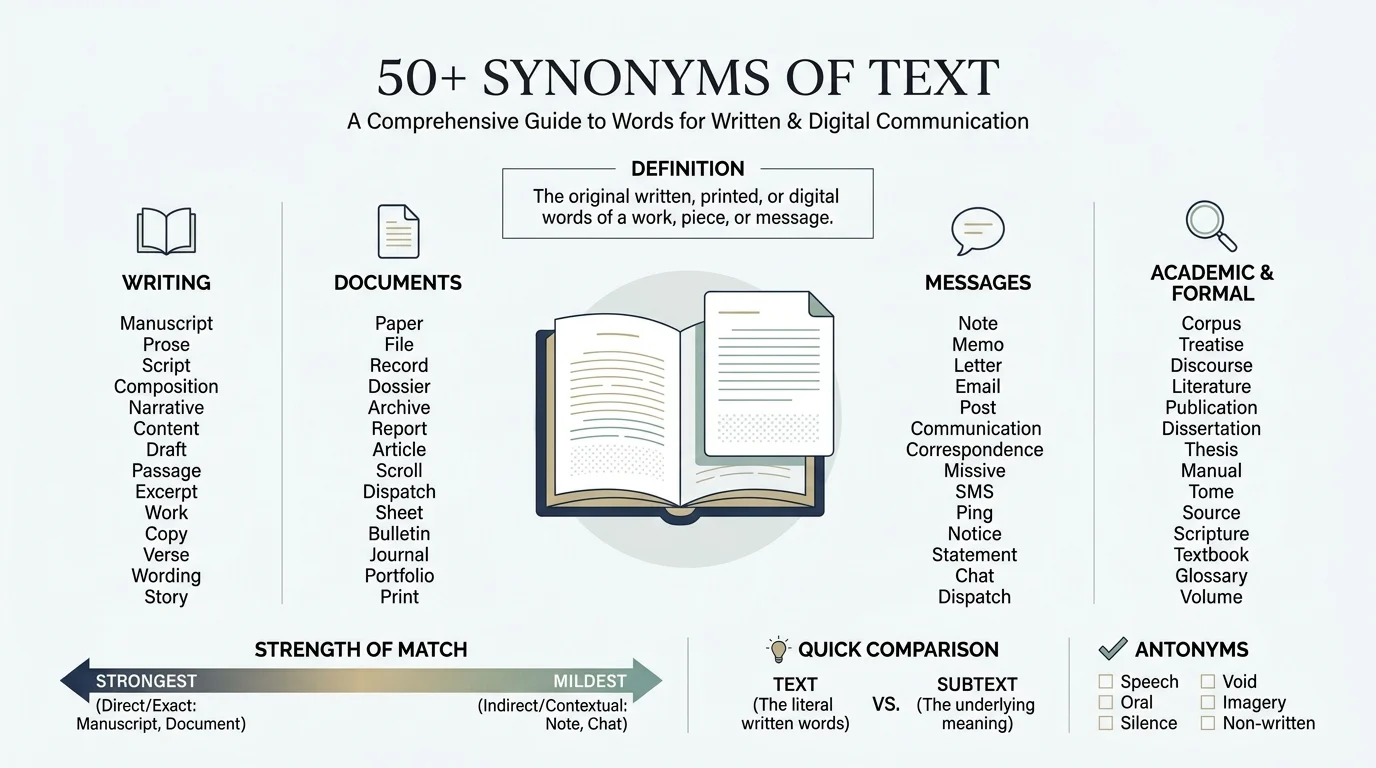
Have you ever needed to describe written words, a message, or the main body of a document but felt that “text” was too broad or repetitive? You want to capture the specific nature of the written content, whether it is a passage, a script, or a message, and the word “text” comes to mind. Choosing the right synonym for “text” can transform a basic statement into a precise description of writing, content, or communication. This guide explores the best synonyms of text, explaining exactly which word to use and when.
Quick Ans: “Text” means written or printed words, the main body of a document, or a message. For written content, choose writing, prose, or passage. For documents, use document, manuscript, or copy. For messages, use message, note, or communication. For academic contexts, use source, excerpt, or transcript.
Meaning, Tone, and Context
Understanding the core meaning of “text” is the first step to using it effectively.
Simple Definition: Written or printed words, especially the main body of a book or document; a message or communication.
Part of Speech: Noun and verb.
Overall Tone: Neutral. It is a functional word used across all contexts.
Formality Level: Neutral to formal. The word works in most contexts.
Common Uses: Native English speakers use it in publishing (“the text of the book”), messaging (“send me a text”), academia (“primary text”), and technology (“text editor”).
Word Forms: Related words include the adjective textual, the noun texture, and the verb text.
When and How to Use “Text”
“Text” is the perfect choice when you want to describe written content or a message. Here are seven realistic examples.
Publishing: “The text of the novel was beautifully written.”
Academic: “Students must analyze the primary text.”
Messaging: “I will send you a text when I arrive.”
Professional: “Please review the text of the contract.”
Technology: “The text editor has many features.”
Legal: “The text of the law is clear.”
Social Media: “The text in the image is hard to read.”
Best Synonyms of “Text”
No synonym is identical in every situation. Here is your guide to the best replacement for “text” based on your writing context.
For Written Content
Most Direct: Writing means written words. “The writing is clear and concise.”
Prose: Prose means ordinary written language. “The prose was elegant.”
Passage: Passage means a section of text. “The passage was difficult to understand.”
Content: Content means the material in a document. “The content is informative.”
For Documents and Manuscripts
Document: Document means a written record. “The document is confidential.”
Manuscript: Manuscript means a handwritten or unpublished text. “The manuscript was submitted.”
Copy: Copy means text for publication. “The copy needs editing.”
Draft: Draft means a preliminary version. “The first draft is complete.”
For Messages and Communication
Message: Message means a communication. “I received your message.”
Note: Note means a short written message. “She left a note on the table.”
Communication: Communication means an exchange. “The communication was brief.”
Correspondence: Correspondence means letters or messages. “The correspondence was filed.”
For Academic and Formal Contexts
Source: Source means an original text. “The source is cited.”
Excerpt: Excerpt means a short extract. “The excerpt was included.”
Transcript: Transcript means a written record. “The transcript is available.”
Script: Script means written text for performance. “The script was rehearsed.”
When Not to Use “Text”
Using “text” can sound wrong or awkward in certain situations.
When You Mean “Message”: “Text” is general. “Message” is specific.
Better Choice: Message or note. “I got your message.”
When You Mean “Book”: “Text” is the content. “Book” is the object.
Better Choice: Book or novel. “The book was long.”
When It Sounds Too Technical: In casual conversation, “text” can sound technical.
Better Choice: Message or note. “Send me a message.”
Words Commonly Confused With “Text”
| Word | Difference | When to Use | Example |
|---|---|---|---|
| Writing | General written words | General and academic | “The writing is clear.” |
| Prose | Ordinary written language | Literary and academic | “The prose was elegant.” |
| Document | A written record | Formal and legal | “The document is signed.” |
| Message | A communication | Casual and digital | “I got your message.” |
| Manuscript | Unpublished text | Publishing and academic | “The manuscript was submitted.” |
| Copy | Text for publication | Marketing and publishing | “The copy needs editing.” |
Best Synonyms of “Text” by Context
| Context | Best Synonym | Why It Works | Example |
|---|---|---|---|
| Formal writing | Document | Formal and precise | “The document is confidential.” |
| Academic writing | Source | Standard in research | “The source is cited.” |
| Professional | Copy | Professional and clear | “The copy needs revision.” |
| Business | Correspondence | Business and formal | “The correspondence is filed.” |
| Casual | Message | Simple and natural | “Send me a message.” |
| Technology | Content | Technical and specific | “The content is loaded.” |
| Literary | Prose | Literary and descriptive | “The prose was beautiful.” |
How to Choose the Best Synonym of “Text”
Choosing the right word is a simple decision. Answer these questions.
What type of text am I describing? For written content, use writing, prose, or passage. And For documents, use document, manuscript, or copy. For messages, use message or note. For academic, use source or excerpt.
What is my audience? For a formal report, use document or source. For a friend, use message or note.
What is my purpose? Are you describing content, a document, or a message? The correct synonym depends entirely on this.
What is the emotional strength? Prose is literary. Message is neutral. Pick the one that matches your message.
Real Life Examples of “Text”
School: Basic: “The text is long.” Improved: “The passage is long and complex.”
College: Basic: “The text is important.” Improved: “The source is essential for the analysis.”
Workplace: Basic: “Read the text.” Improved: “Review the document.”
Business: Basic: “The text is ready.” Improved: “The copy is ready for publication.”
Email: Basic: “Send me a text.” Improved: “Send me a message.”
Conversation: Basic: “The text was clear.” Improved: “The writing was clear.”
Storytelling: Basic: “The text was beautiful.” Improved: “The prose was beautiful.”
Top 10 Synonyms of “Text”
| Synonym | Simple Meaning | Best Used For | Example Sentence |
|---|---|---|---|
| Writing | Written words | General and academic | “The writing is clear.” |
| Prose | Ordinary written language | Literary and academic | “The prose was elegant.” |
| Passage | A section of text | Reading and analysis | “The passage was difficult.” |
| Document | A written record | Formal and legal | “The document is signed.” |
| Message | A communication | Casual and digital | “I got your message.” |
| Manuscript | Unpublished text | Publishing and academic | “The manuscript was submitted.” |
| Copy | Text for publication | Marketing and publishing | “The copy needs editing.” |
| Source | An original text | Academic and research | “The source is cited.” |
| Excerpt | A short extract | Academic and publishing | “The excerpt was included.” |
| Content | The material in a document | Technology and publishing | “The content is informative.” |
Synonyms of “Text” by Usage
Professional vs. Personal Synonyms
In the workplace, choose document, copy, or correspondence. With friends, use message, note, or text.
Formal vs. Conversational Synonyms
For formal writing, use document, source, or prose. For casual conversations, use message, note, or text.
Academic Synonyms
For research and essays, choose source for citations, excerpt for extracts, and passage for analysis.
Professional and Business Synonyms
For maximum impact, choose copy for marketing, document for contracts, and correspondence for letters.
Creative and Literary Synonyms
To add emotion and imagery, choose prose, passage, or manuscript. These words create atmosphere.
Slang or Modern Synonyms
In modern American slang, text, message, or DM are common. For example, “Send me a DM.” These are casual and should be avoided in formal writing.
Strongest to Mildest Synonyms
Mild: note, message, content
Moderate: text, writing, passage
Strong: document, manuscript, prose
Very Strong: source, transcript, correspondence
Emotional vs. Neutral Synonyms
Emotional Synonyms: Prose, manuscript, passage. These words hint at creativity and depth. Use them when you want to evoke feeling.
Neutral Synonyms: Text, document, message. These words communicate factual information.
Antonyms of “Text”
| Antonym | Meaning | Example Sentence |
|---|---|---|
| Speech | Spoken words | “His speech was inspiring.” |
| Image | A visual representation | “The image spoke louder than words.” |
| Silence | Absence of sound | “The silence was deafening.” |
| Blank | Empty space | “The page was blank.” |
| Illustration | A picture | “The illustration was colorful.” |
| Diagram | A visual explanation | “The diagram clarified the concept.” |
| Picture | A visual image | “The picture was framed.” |
| Photo | A photograph | “The photo captured the moment.” |
| Video | Moving images | “The video went viral.” |
| Audio | Sound recording | “The audio was clear.” |
| Gesture | A movement | “His gesture was kind.” |
| Symbol | A sign | “The symbol represented peace.” |
| Icon | A representation | “The icon was recognizable.” |
| Graph | A visual data representation | “The graph showed the trend.” |
| Chart | A visual display | “The chart was informative.” |
Comparison: “Text” vs Similar Words
Text vs. Writing
Main Difference: “Text” is the content. “Writing” is the act or result.
Which Is Stronger? They are similar.
Which Is More Formal? Both are neutral.
When to Use Each: Use “text” for content. Use “writing” for style.
Examples:
Text: “The text is clear.”
Writing: “The writing is elegant.”
Text vs. Document
Main Difference: “Text” is the words. “Document” is the whole file.
Which Is Stronger? “Document” is more formal.
Which Is More Formal? “Document” is more formal.
When to Use Each: Use “document” for official papers. Use “text” for general content.
Examples:
Text: “The text is long.”
Document: “The document is confidential.”
Text vs. Message
Main Difference: “Text” can mean a message. “Message” is more general.
Which Is Stronger? They are similar.
Which Is More Formal? Both are neutral.
When to Use Each: Use “message” for communication. Use “text” for written content.
Examples:
Text: “The text of the book.”
Message: “I got your message.”
Text vs. Prose
Main Difference: “Prose” is literary. “Text” is general.
Which Is Stronger? “Prose” is more literary.
Which Is More Formal? “Prose” is more formal.
When to Use Each: Use “prose” for literature. Use “text” for general contexts.
Examples:
Text: “The text is informative.”
Prose: “The prose was beautiful.”
Text vs. Copy
Main Difference: “Copy” is for publication. “Text” is general.
Which Is Stronger? “Copy” is more specific.
Which Is More Formal? Both are formal.
When to Use Each: Use “copy” for marketing. Use “text” for general contexts.
Examples:
Text: “The text is ready.”
Copy: “The copy needs editing.”
Text vs. Source
Main Difference: “Source” is an original text. “Text” is general.
Which Is Stronger? “Source” is more academic.
Which Is More Formal? “Source” is more formal.
When to Use Each: Use “source” for research. Use “text” for general contexts.
Examples:
Text: “The text is long.”
Source: “The source is cited.”
Common Phrases and Expressions with “Text”
Phrase: Text message
Meaning: A written message sent electronically.
Example Sentence: “I sent her a text message.”
Phrase: Body text
Meaning: The main content of a document.
Example Sentence: “The body text is single-spaced.”
Phrase: Plain text
Meaning: Unformatted text.
Example Sentence: “Save the file as plain text.”
Phrase: Textbook
Meaning: A book for study.
Example Sentence: “The textbook is required.”
Phrase: Sacred text
Meaning: A religious writing.
Example Sentence: “The sacred text is revered.”
Phrase: Full text
Meaning: The complete written version.
Example Sentence: “The full text is available online.”
Common Mistakes to Avoid
Mistake 1: Using “text” when you mean “message”.
Incorrect: “I got your text.”
Better: “I got your message.”
Why: “Message” is more general.
Mistake 2: Using “text” when you mean “book”.
Incorrect: “The text is on the shelf.”
Better: “The book is on the shelf.”
Why: “Book” is the object.
Mistake 3: Overusing “text” in conversation.
Incorrect: “Send me a text.”
Better: “Send me a message.”
Why: “Message” sounds more natural.
Mistake 4: Using “text” when you mean “document”.
Incorrect: “Sign the text.”
Better: “Sign the document.”
Why: “Document” is for official papers.
Mistake 5: Using “text” when you mean “prose”.
Incorrect: “The text was beautiful.”
Better: “The prose was beautiful.”
Why: “Prose” is for literary style.
Frequently Asked Questions
1. What are the best synonyms of “text”?
The best synonyms depend on your context. For written content, choose writing or prose. And For documents, use document or manuscript. For messages, use message or note.
2. What are the best formal synonyms of “text”?
The best formal synonyms are document, manuscript, and source. These words are suitable for academic papers, professional reports, and legal documents.
3. What are common informal synonyms of “text”?
For informal settings, use message, note, or text. These alternatives sound more natural in everyday conversation.
4. What is another word for “text” in professional writing?
In professional writing, copy is an excellent choice. It conveys text for publication. Document is also strong for official papers.
5. What is the difference between “text” and “message”?
“Text” is written content. “Message” is a communication. Use “message” for communication and “text” for written content.
6. What is the opposite of “text”?
The most direct opposites (antonyms) of text are speech, image, and silence. These words describe non-written forms of communication.
Conclusion
“Text” is a fundamental and versatile word for describing written content, documents, and messages. The term is neutral and widely accepted in all contexts, yet it can sound too broad for specific descriptions or too technical for casual conversation. The best choice among the synonyms of text depends entirely on your audience, tone, and purpose. Remember, no single synonym works perfectly in every situation. Your goal is to choose the word that communicates your message with the most clarity and impact. A practical tip for your vocabulary growth is to pay attention to how writers describe written content and practice using different synonyms in your writing.









