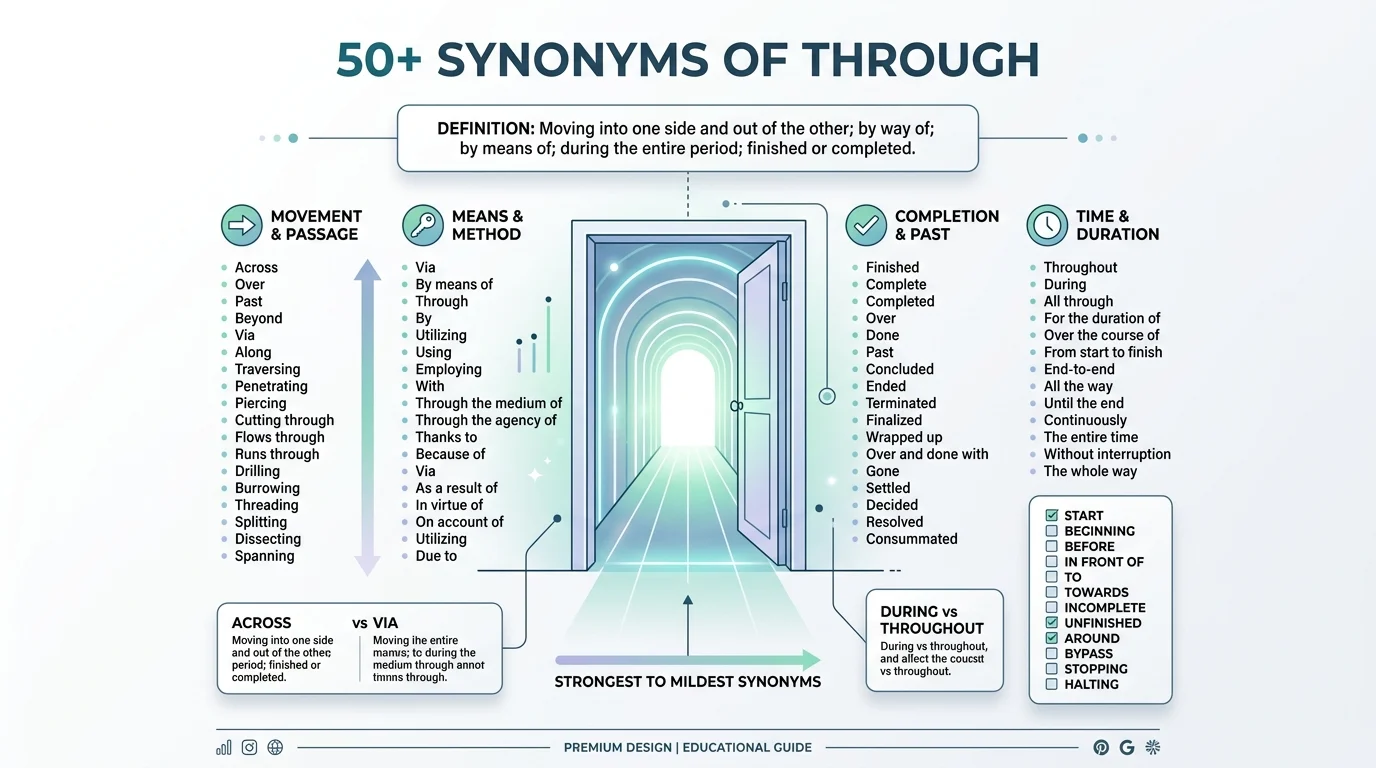
Have you ever needed to describe movement from one side to another, the completion of a task, or the means by which something is done but felt that “through” was too simple or repetitive? You want to capture the specific sense of passage, completion, or agency, and the word “through” comes to mind. Choosing the right synonym for “through” can transform a basic statement into a precise expression of movement, cause, or completion. This guide explores the best synonyms of through, explaining exactly which word to use and when.
Quick Ans: “Through” means moving in one side and out the other, by means of, from beginning to end, or finished. For physical movement, choose across, past, or via. For means and agency, use by, by means of, or via. For completion, use finished, done, or complete. For time, use throughout or during.
Meaning, Tone, and Context
Understanding the core meaning of “through” is the first step to using it effectively.
Simple Definition: Moving in one side and out the other; by means of; from beginning to end; finished.
Part of Speech: Preposition, adverb, and adjective.
Overall Tone: Neutral. It is a functional word used in many contexts.
Formality Level: Neutral. The word works in most contexts, from casual to formal.
Common Uses: Native English speakers use it to describe movement (“walked through the door”), means (“paid through an app”), completion (“I am through with the project”), and time (“worked through the night”).
Word Forms: Related words include the preposition throughout, the adjective thorough, and the noun throughway.
When and How to Use “Through”
“Through” is the perfect choice when you want to express movement, means, or completion. Here are seven realistic examples.
Physical Movement: “The train passed through the tunnel.”
Means/Agency: “We communicated through email.”
Completion: “She is through with her exams.”
Time: “He worked through the night to finish the report.”
Experience: “They went through a difficult time.”
Causation: “The error occurred through carelessness.”
Social Media: “We are through the hardest part of the project.”
Best Synonyms of “Through”
No synonym is identical in every situation. Here is your guide to the best replacement for “through” based on your writing context.
For Physical Movement
Across: Across means from one side to the other. “He walked across the bridge.”
Past: Past means moving by something. “We drove past the old house.”
Via: Via means by way of. “We traveled to Rome via Paris.”
Into: Into means entering. “She walked into the room.”
Beyond: Beyond means on the other side. “The village is beyond the mountains.”
For Means and Agency
By: By means through the use of. “We traveled by car.”
By means of: By means of is formal for through. “The message was sent by means of a courier.”
Via: Via is common for means. “We spoke via video call.”
Using: Using means employing. “She paid using her phone.”
With: With means by using. “He opened it with a key.”
For Completion
Finished: Finished means completed. “The project is finished.”
Done: Done means completed. “I am done with my work.”
Complete: Complete means fully finished. “The task is complete.”
Over: Over means ended. “The meeting is over.”
Concluded: Concluded means brought to an end. “The investigation is concluded.”
For Time
Throughout: Throughout means all the way through. “She worked throughout the night.”
During: During means throughout a period. “He slept during the flight.”
All through: All through is informal for throughout. “It rained all through the day.”
When Not to Use “Through”
Using “through” can sound wrong or awkward in certain situations.
When You Mean “Finished”: “Through” can be vague.
Better Choice: Finished or done. “I am finished with the report.”
When It Sounds Too Informal: In formal writing, “through” can be replaced with more precise terms.
Better Choice: By means of or via. “The data was collected by means of surveys.”
When Describing a Tunnel: “Through” is fine, but along may be more precise.
Better Choice: Along. “We walked along the tunnel.”
Words Commonly Confused With “Through”
Word: Threw
Difference: “Threw” is the past tense of throw. “Through” indicates movement or means.
When to Use: Use it for throwing something.
Example: “He threw the ball through the window.”
Word: Thorough
Difference: “Thorough” means complete and careful. “Through” indicates movement.
When to Use: Use it for careful work.
Example: “She did a thorough investigation.”
Word: Throughout
Difference: “Throughout” means in every part. “Through” can be more specific.
When to Use: Use it for time or space.
Example: “The museum is open throughout the year.”
Word: Across
Difference: “Across” is from one side to another. “Through” involves entering and exiting.
When to Use: Use it for crossing surfaces.
Example: “We walked across the street.”
Word: Via
Difference: “Via” means by way of. “Through” is more general.
When to Use: Use it for routes or means.
Example: “We flew to London via Dublin.”
Word: By
Difference: “By” indicates means. “Through” can also indicate means.
When to Use: Use it for methods of transport or action.
Example: “We traveled by train.”
Best Synonyms of “Through” by Context
| Context | Best Synonym | Why It Works | Example |
|---|---|---|---|
| Physical movement | Across | From one side to the other | “He walked across the bridge.” |
| Physical movement | Past | Moving by something | “We drove past the house.” |
| Means/Agency | Via | By way of | “We spoke via video call.” |
| Means/Agency | By | Through the use of | “We traveled by car.” |
| Completion | Finished | Completed | “The project is finished.” |
| Completion | Done | Completed | “I am done with my work.” |
| Time | Throughout | All the way through | “She worked throughout the night.” |
| Time | During | Throughout a period | “He slept during the flight.” |
How to Choose the Best Synonym of “Through”
Choosing the right word is a simple decision. Answer these questions.
What type of “through” am I describing? For movement, use across or past. And For means, use by or via. For completion, use finished or done. For time, use throughout or during.
What is my audience? For a formal report, use by means of or via. For a friend, use by or done.
What is my purpose? Are you describing movement, means, or completion? The correct synonym depends entirely on this.
What is the emotional strength? Finished and done are stronger for completion. Across is neutral for movement. Pick the one that matches your message.
Real Life Examples of “Through”
School: Basic: “The student went through the book.” Improved: “The student read throughout the book.”
College: Basic: “She is through with her thesis.” Improved: “She is finished with her thesis.”
Workplace: Basic: “We went through the proposal.” Improved: “We reviewed the proposal thoroughly.”
Business: Basic: “The deal went through.” Improved: “The deal was completed successfully.”
Email: Basic: “I am through with the report.” Improved: “I am done with the report.”
Conversation: Basic: “We drove through the tunnel.” Improved: “We drove across the tunnel.”
Storytelling: Basic: “He walked through the forest.” Improved: “He walked throughout the forest.”
Top 10 Synonyms of “Through”
| Synonym | Simple Meaning | Best Used For | Example Sentence |
|---|---|---|---|
| Across | From one side to the other | Physical movement | “He walked across the street.” |
| Past | Moving by something | Physical movement | “We drove past the school.” |
| Via | By way of | Means and routes | “We spoke via email.” |
| By | Through the use of | Means and agency | “We traveled by plane.” |
| By means of | Through the use of | Formal means | “The data was collected by means of surveys.” |
| Finished | Completed | Completion | “The work is finished.” |
| Done | Completed | Completion | “I am done with the task.” |
| Complete | Fully finished | Completion | “The project is complete.” |
| Throughout | All the way through | Time and space | “She worked throughout the day.” |
| During | Throughout a period | Time | “He slept during the movie.” |
Synonyms of “Through” by Usage
Professional vs. Personal Synonyms
In the workplace, choose via, by means of, or finished. With friends, use by, done, or across.
Formal vs. Conversational Synonyms
For formal writing, use by means of, via, or throughout. For casual conversations, use by, done, or past.
Academic Synonyms
For research and essays, choose via for methods, throughout for time, and by means of for formal means.
Professional and Business Synonyms
For maximum impact, choose via for communication, finished for completion, and throughout for time.
Creative and Literary Synonyms
To add emotion and imagery, choose across, beyond, or throughout. These words create atmosphere.
Slang or Modern Synonyms
In modern American slang, done, over, or through are common. For example, “I am so done with this.” These are casual and should be avoided in formal writing.
Strongest to Mildest Synonyms
Mild: by, past, across
Moderate: through, via, during
Strong: finished, done, complete
Very Strong: throughout, by means of, concluded
Emotional vs. Neutral Synonyms
Emotional Synonyms: Finished, done, over. These words hint at finality. Use them when you want to evoke feeling.
Neutral Synonyms: By, via, across. These words simply communicate factual information.
Antonyms of “Through”
| Antonym | Meaning | Example Sentence |
|---|---|---|
| Around | On all sides | “We walked around the building.” |
| Back | To a previous position | “He went back to the start.” |
| Before | Earlier in time | “We arrived before the storm.” |
| Incomplete | Not finished | “The project is incomplete.” |
| Unfinished | Not completed | “The work is unfinished.” |
| Ongoing | Continuing | “The process is ongoing.” |
| Blocked | Obstructed | “The path is blocked.” |
| Stopped | Halted | “The traffic is stopped.” |
Comparison: “Through” vs Similar Words
Through vs. Across
Main Difference: “Through” involves entering and exiting. “Across” is from one side to the other.
Which Is Stronger? They serve different purposes.
Which Is More Formal? Both are neutral.
When to Use Each: Use “through” for tunnels and forests. Use “across” for streets and bridges.
Examples:
Through: “We walked through the forest.”
Across: “We walked across the bridge.”
Through vs. Via
Main Difference: “Through” is more general. “Via” is specific to routes or means.
Which Is Stronger? “Via” is more formal.
Which Is More Formal? “Via” is more formal.
When to Use Each: Use “via” for routes and means. Use “through” for general movement.
Examples:
Through: “We communicated through email.”
Via: “We communicated via email.”
Through vs. By
Main Difference: “Through” indicates means. “By” indicates agency or method.
Which Is Stronger? They are similar.
Which Is More Formal? Both are neutral.
When to Use Each: Use “by” for methods. Use “through” for processes.
Examples:
Through: “We succeeded through hard work.”
By: “We succeeded by working hard.”
Through vs. Finished
Main Difference: “Through” means done. “Finished” is more direct.
Which Is Stronger? “Finished” is stronger for completion.
Which Is More Formal? Both are neutral.
When to Use Each: Use “finished” for completion. Use “through” for movement.
Examples:
Through: “I am through with the project.”
Finished: “I am finished with the project.”
Through vs. Throughout
Main Difference: “Through” is specific. “Throughout” means in every part.
Which Is Stronger? “Throughout” is stronger for completeness.
Which Is More Formal? Both are formal.
When to Use Each: Use “throughout” for time and space. Use “through” for specific movement.
Examples:
Through: “We walked through the park.”
Throughout: “The park is beautiful throughout.”
Through vs. During
Main Difference: “Through” can indicate time. “During” is specific to time.
Which Is Stronger? “During” is more specific to time.
Which Is More Formal? Both are formal.
When to Use Each: Use “during” for time periods. Use “through” for movement.
Examples:
Through: “He worked through the night.”
During: “He slept during the night.”
Common Phrases and Expressions with “Through”
Phrase: Go through
Meaning: To experience or examine.
Example Sentence: “She went through a difficult time.”
Phrase: Through and through
Meaning: Completely.
Example Sentence: “He is a gentleman through and through.”
Phrase: See through
Meaning: To understand the truth.
Example Sentence: “I can see through his lies.”
Phrase: Follow through
Meaning: To complete something.
Example Sentence: “You must follow through on your promises.”
Phrase: Through thick and thin
Meaning: In good times and bad.
Example Sentence: “They stayed together through thick and thin.”
Phrase: Fall through
Meaning: To fail to happen.
Example Sentence: “The deal fell through.”
Common Mistakes to Avoid
Mistake 1: Confusing “through” and “threw”.
Incorrect: “He walked threw the door.”
Better: “He walked through the door.”
Why: “Threw” is the past tense of throw.
Mistake 2: Confusing “through” and “thorough”.
Incorrect: “She did a through investigation.”
Better: “She did a thorough investigation.”
Why: “Thorough” means complete and careful.
Mistake 3: Using “through” when you mean “finished”.
Incorrect: “I am through the report.”
Better: “I am finished with the report.”
Why: “Finished” is more precise for completion.
Mistake 4: Using “through” when you mean “via”.
Incorrect: “We spoke through email.”
Better: “We spoke via email.”
Why: “Via” is more formal for means.
Mistake 5: Using “through” when you mean “throughout”.
Incorrect: “She worked through the day.”
Better: “She worked throughout the day.”
Why: “Throughout” means all the way through.
Frequently Asked Questions
1. What are the best synonyms of “through”?
The best synonyms depend on your context. For movement, choose across or past. And For means, use by or via. For completion, use finished or done. For time, use throughout or during.
2. What are the best formal synonyms of “through”?
The best formal synonyms are via, by means of, and throughout. These words are suitable for academic papers, professional reports, and business communications.
3. What are common informal synonyms of “through”?
For informal settings, use done, over, or by. These alternatives sound more natural in everyday conversation.
4. What is another word for “through” in professional writing?
In professional writing, via is an excellent choice for means. Finished is also strong for completion.
5. What is the difference between “through” and “thorough”?
“Through” indicates movement or means. “Thorough” means complete and careful. They are commonly confused but have different meanings.
6. What is the opposite of “through”?
The most direct opposites of “through” are around, back, and incomplete. These words describe different directions or states.
Conclusion
“Through” is a versatile and essential word for describing movement, means, completion, and time. The term is neutral and widely accepted in most contexts, yet it can sound too simple or vague for specific descriptions. The best choice among the synonyms of through depends entirely on your audience, tone, and purpose. Remember, no single synonym works perfectly in every situation. Your goal is to choose the word that communicates your message with the most clarity and impact. A practical tip for your vocabulary growth is to pay attention to how writers describe movement and completion and practice using different synonyms in your writing.










1 thought on “50+ Synonyms of Through: Meanings, Uses, Examples, and Best Alternatives 2026”