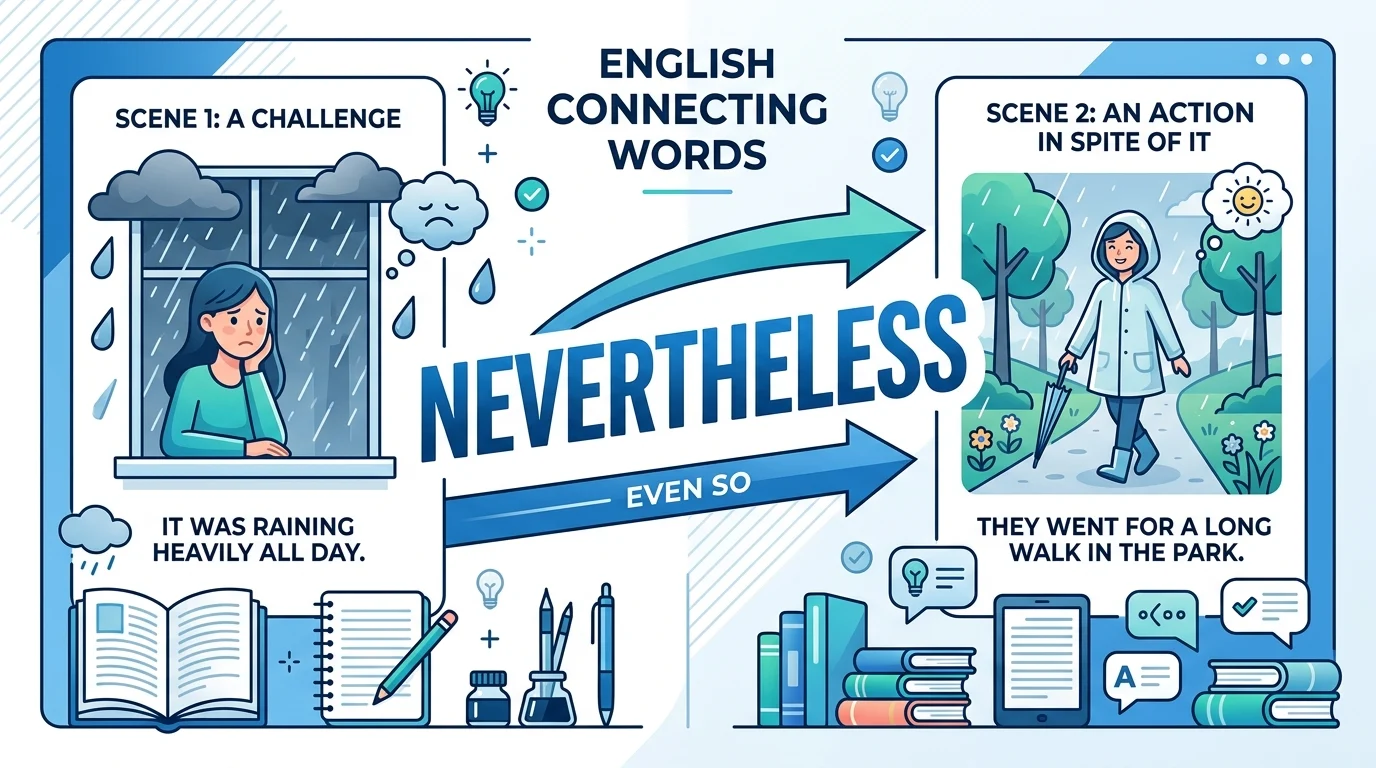
Quick Ans: Nevertheless is an adverb that means “in spite of that,” “even so,” or “despite what was just mentioned.” It is used to introduce a statement that contrasts with or qualifies the previous one. The word is common in formal writing, academic English, professional communication, and everyday conversations.
If you’ve come across the word nevertheless while reading a book, writing an essay, or having a conversation, you may be wondering exactly what it means and how to use it correctly.
Although nevertheless may sound formal, it’s actually a simple and useful word that helps connect two contrasting ideas. It shows that something happened despite a difficulty, obstacle, or opposing fact.
For example:
“It was raining. Nevertheless, we went hiking.”
The sentence tells us that even though it was raining, the hike still happened.
This guide explains everything you need to know about the meaning of nevertheless, including its definition, pronunciation, grammar, sentence examples, synonyms, differences from similar words, common mistakes, usage tips, and frequently asked questions.
Quick Answer Box
| Topic | Answer |
|---|---|
| Meaning | In spite of that; even so |
| Part of Speech | Adverb |
| Common Use | Connecting contrasting ideas |
| Formality | Neutral to formal |
| Similar Words | However, still, even so, despite that, nonetheless |
| Example | “She was tired. Nevertheless, she finished the race.” |
What Does Nevertheless Mean?
The word nevertheless means:
- In spite of that
- Even so
- Despite what has just been said
- Regardless of the previous situation
It introduces a statement that contrasts with the previous one without completely changing the subject.
Example:
“The exam was difficult. Nevertheless, everyone completed it.”
The difficulty didn’t stop people from finishing the exam.
Full Definition
According to standard English usage, nevertheless is an adverb used to connect two ideas where the second statement happens despite the first.
It helps express:
- Contrast
- Persistence
- Unexpected outcomes
- Determination
- Positive results despite challenges
Because of this, it frequently appears in:
- Academic writing
- News articles
- Business reports
- Professional emails
- Books
- Formal speeches
- Everyday English
Context and Usage
Understanding the context makes using nevertheless much easier.
Showing Contrast
Example:
“The weather was terrible. Nevertheless, the event continued.”
Expressing Determination
Example:
“She was nervous. Nevertheless, she gave an excellent presentation.”
Unexpected Results
Example:
“The project faced delays. Nevertheless, it finished on time.”
Everyday Conversation
Although slightly formal, people still use it naturally.
Example:
“I’m really busy. Nevertheless, I’ll help you.”
Real-Life Examples
Conversation Example 1
Emma: It’s getting late.
Sophia: Nevertheless, let’s finish the movie.
Conversation Example 2
Jake: The test was really hard.
Ryan: Nevertheless, I think I passed.
Conversation Example 3
Olivia: It’s expensive.
Lucas: Nevertheless, I think it’s worth buying.
Conversation Example 4
Sarah: We missed the first train.
Ava: Nevertheless, we’ll still arrive before lunch.
Conversation Example 5
David: The weather forecast says rain.
Emily: Nevertheless, let’s go camping.
Where Is Nevertheless Commonly Used?
Academic Writing
Students often use nevertheless to compare ideas in essays.
Example:
“The results were unexpected. Nevertheless, the hypothesis remained valid.”
Business Communication
Professionals use the word when discussing risks or achievements.
Example:
“Sales declined during the quarter. Nevertheless, profits increased.”
Everyday English
Although shorter alternatives exist, nevertheless is still widely understood.
Example:
“I’m tired. Nevertheless, I’ll come.”
Books and Literature
Authors frequently use the word to transition between contrasting events.
News Articles
Journalists use nevertheless when reporting balanced information.
Example:
“The storm caused significant damage. Nevertheless, emergency services responded quickly.”
Synonyms of Nevertheless
Several words have similar meanings.
- However
- Nonetheless
- Even so
- Still
- Yet
- Despite that
- In spite of that
- Regardless
- All the same
Each has a slightly different tone, but all express contrast.
Nevertheless vs. Nonetheless
These two words are almost identical.
Example:
“The task was difficult. Nevertheless, we completed it.”
“The task was difficult. Nonetheless, we completed it.”
In most situations, either word works correctly.
Nevertheless vs. However
Although similar, they’re not always interchangeable.
Example:
“The restaurant was crowded. However, we found a table.”
“The restaurant was crowded. Nevertheless, we found a table.”
Both are correct, but nevertheless emphasizes overcoming the obstacle slightly more.
Common Mistakes
Using It Without Contrast
Incorrect:
“I bought milk. Nevertheless, I went home.”
There’s no contrasting idea.
Overusing the Word
Using nevertheless in every paragraph can make writing sound repetitive.
Mix it with:
- However
- Even so
- Still
- Yet
- Nonetheless
Incorrect Punctuation
Correct:
“It was cold. Nevertheless, we continued walking.”
Incorrect:
“It was cold nevertheless we continued walking.”
A comma is usually needed after nevertheless when it begins a sentence.
When Not to Use Nevertheless
Avoid using nevertheless when no contrast exists.
Incorrect:
“I woke up early. Nevertheless, I ate breakfast.”
These actions don’t conflict.
Better:
“I woke up late. Nevertheless, I arrived on time.”
Here the contrast is clear.
Usage Tips
To use nevertheless naturally:
- Use it when introducing an unexpected result.
- Don’t force it into every sentence.
- Place it at the beginning or middle of a sentence.
- Use proper punctuation.
- Consider shorter alternatives in casual conversations.
Frequently Asked Questions
What does nevertheless mean?
It means in spite of that, even so, or despite what was just mentioned.
Is nevertheless formal?
Yes. It’s more common in formal writing but is still understood in everyday English.
Can nevertheless start a sentence?
Yes.
Example:
“Nevertheless, we decided to continue.”
Is nevertheless the same as however?
They’re similar, but nevertheless places slightly more emphasis on overcoming a challenge.
What’s the difference between nevertheless and nonetheless?
Very little. Most writers use them interchangeably.
Is nevertheless an adverb?
Yes.
Can I use nevertheless in essays?
Absolutely. It’s commonly used in academic writing.
Should I use nevertheless in text messages?
You can, but words like “still” or “anyway” often sound more natural in casual texting.
Is nevertheless old-fashioned?
No. Although formal, it’s still widely used in modern English.
How do I remember the meaning?
Think of it as meaning “even so” or “despite that.”
Conclusion
The meaning of nevertheless is simple once you understand its purpose. It means “in spite of that,” “even so,” or “despite what was just mentioned,” and it’s used to connect two ideas that contrast with each other.
Whether you’re writing an academic essay, preparing a business report, reading a novel, or simply improving your English vocabulary, nevertheless is an excellent transition word that makes your writing clearer and more professional. By learning when to use it—and when not to—you’ll be able to express contrasting ideas naturally and confidently.
Discover More:-
- Occupation Meaning: Definition, Types, Examples & How It’s Used 2026
- Progressive Meaning: Definition, Uses, Examples & Explained 2026

Alexander Cole is a professional content writer and researcher who specializes in creating informative, reader-friendly, and well-researched articles. He is committed to publishing accurate, valuable, and engaging content that helps readers stay informed and make smarter decisions.