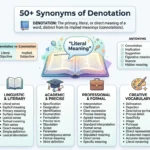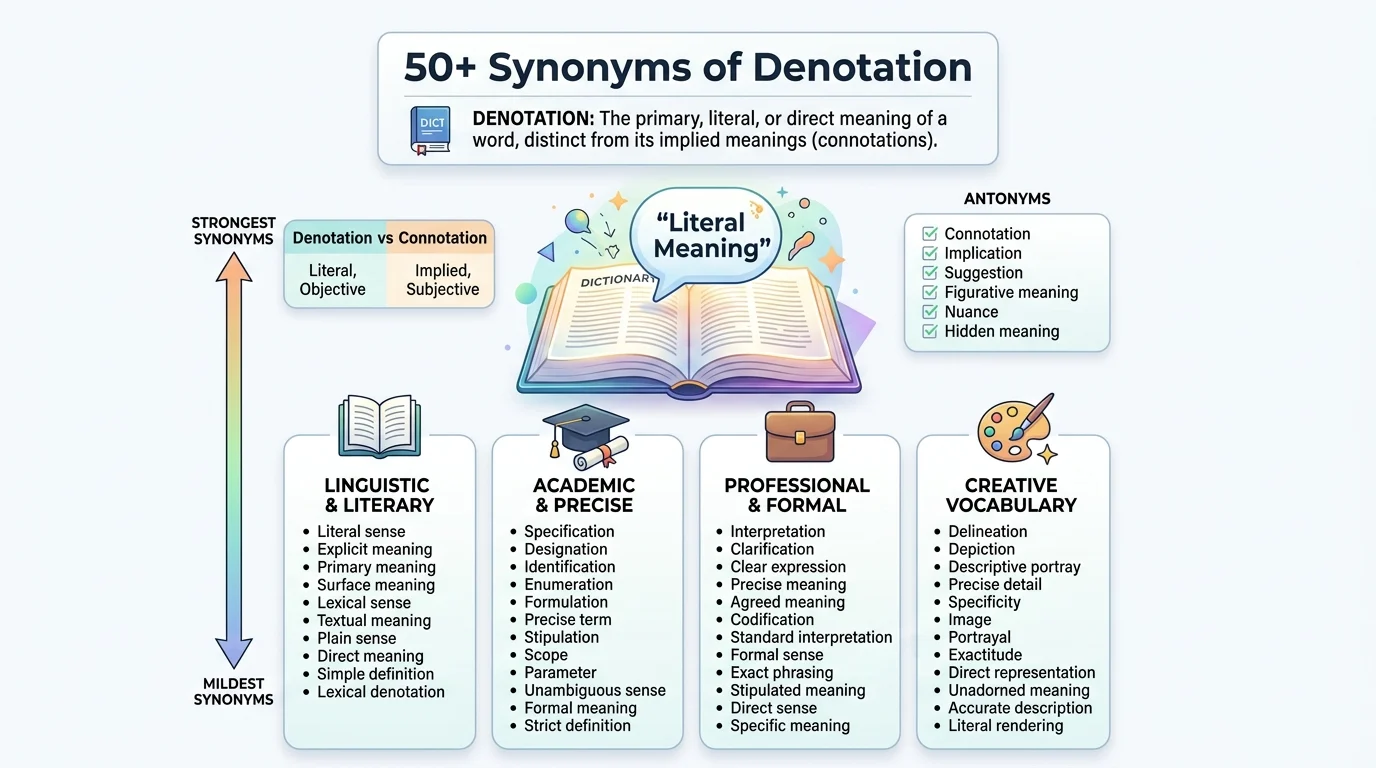
Ever found yourself explaining the exact, dictionary definition of a word but struggling to find the right term? You want to describe the literal meaning as opposed to the emotional association, and the word “denotation” comes to mind. Choosing the right synonym for “denotation” can transform a vague explanation into a precise linguistic analysis. This guide explores the best synonyms of denotation, explaining exactly which word to use and when.
Quick Ans: “Denotation” means the literal, primary meaning of a word or expression, as opposed to the feelings it suggests . It is a neutral, academic noun. For linguistic contexts, choose reference or extension. For general usage, use meaning or indication. In philosophical discussions, designation is preferred. For a more precise term, select signification.
Meaning, Tone, and Context
Understanding the core meaning of “denotation” is the first step to using it effectively .
Simple Definition: The literal dictionary meaning of a word, phrase, or symbol; the direct, explicit meaning as distinct from its associated ideas .
Part of Speech: Noun .
Overall Tone: Neutral and academic. It is a technical term used in linguistics, logic, and semantics .
Formality Level: Formal. The word is primarily used in academic, philosophical, and linguistic contexts .
Common Uses: Native English speakers use it when distinguishing a word’s literal meaning from its emotional associations. For example, “The denotation of ‘rose’ is a certain type of flower, while its connotation suggests romance” .
Word Forms: Related words include the verb denote, the adjective denotative, and the adverb denotatively.
When and How to Use “Denotation”
“Denotation” is the perfect choice when you want to emphasize the literal, objective meaning of language. Here are seven realistic examples.
Linguistic: “The denotation of the word ‘dog’ is a four-legged canine animal.”
Academic: “In literary analysis, it is crucial to distinguish between a word’s denotation and its connotation” .
Philosophical: “The term’s logical denotation is the class of objects to which it applies” .
Pedagogical: “The teacher asked the students to identify the denotation of the unfamiliar vocabulary words.”
Technical: “In semiotics, the denotation of a sign is its first-level, literal meaning.”
Legal: “The contract requires a strict interpretation based on the denotation of the terms used.”
Writing: “Using a dictionary can help you confirm the precise denotation of a word.”
Best Synonyms of “Denotation”
No synonym is identical in every situation. Here is your guide to the best replacement for “denotation” based on your writing context .
Linguistic Writing: Reference. It emphasizes the actual object or concept a word points to. “The reference of the phrase ‘morning star’ is the planet Venus.”
Semantic Writing: Meaning. A more general and accessible synonym. “The exact meaning of the word is ambiguous” .
Philosophical Writing: Designation. It denotes the formal act of signifying. “The designation of the city as a cultural center was debated” .
Logical Writing: Extension. This refers to the set of all things to which a term applies. “The extension of ‘planet’ includes all known planets” .
General Academic Writing: Signification. A formal term for meaning. “The signification of a sentence can change depending on context.”
Casual Conversation: Meaning or definition. “What is the definition of that term?”
Creative Writing: Literal meaning. “The literal meaning of the phrase was simple.”
When Not to Use “Denotation”
Using “denotation” can sound out of place in certain situations.
When It Sounds Too Technical: In casual conversation, “denotation” sounds overly academic.
Better Choice: Meaning or definition. “The meaning of the word is straightforward” .
When You Mean Implied Meaning: “Denotation” is the opposite of connotation, which is the emotional association .
Better Choice: Connotation. “The connotation of the word is positive.”
When Describing a Symbol’s Role: “Denotation” is about meaning, not function.
Better Choice: Function or role. “The symbol’s role in the text was symbolic.”
When It Is Too Broad: “Denotation” is a specific term. For simpler cases, definition works.
Better Choice: Definition. “The definition is in the dictionary.”
Words Commonly Confused With “Denotation”
Several words are often mixed up with “denotation.” Here is how to keep them straight .
Word: Connotation
Difference: Refers to the emotional or associated meaning. “Denotation” is the literal, dictionary meaning .
When to Use: Use it when discussing feelings, ideas, or cultural associations.
Example: “The word ‘home’ has a warm connotation.”
Word: Meaning
Difference: A broader term encompassing both denotation and connotation. “Denotation” is a specific type of meaning .
When to Use: Use it for general references.
Example: “What is the meaning of life?”
Word: Definition
Difference: The formal statement of a word’s meaning. “Denotation” is the literal meaning itself.
When to Use: Use this for dictionary entries.
Example: “The definition of ‘apple’ is a red fruit.”
Word: Reference
Difference: The actual object a word points to. “Denotation” is the meaning itself .
When to Use: Use this when discussing the real-world thing.
Example: “The reference of ‘Obama’ is the former US president.”
Word: Indication
Difference: A sign or suggestion. “Denotation” is a specific meaning .
When to Use: Use this for pointing out or hinting.
Example: “The weather is an indication of the coming storm.”
Word: Extension
Difference: The class of things a term applies to. “Denotation” is the meaning .
When to Use: Use this in logic and semantics.
Example: “The extension of ‘mammal’ includes dogs, cats, and humans.”
Best Synonyms of “Denotation” by Context
| Context | Best Synonym | Why It Works | Example |
|---|---|---|---|
| Linguistic writing | Reference | Emphasizes the object or concept. | “The reference of the word is unclear.” |
| Semantic writing | Meaning | General and widely understood. | “The primary meaning is in the dictionary” . |
| Philosophical writing | Designation | Formal and precise. | “The designation of the term was debated” . |
| Logical writing | Extension | Accurate for the set of objects. | “The extension of ‘planet’ has changed” . |
| General academic | Signification | Formal term for meaning. | “The signification of the sign is clear.” |
| Casual conversation | Definition | Simple and accessible. | “Look up the definition of that word.” |
| Creative writing | Literal meaning | Descriptive and clear. | “The literal meaning of the phrase was simple.” |
How to Choose the Best Synonym of “Denotation”
Choosing the right word is a simple decision. Answer these questions.
What is my audience? For a professor or linguist, reference or extension is powerful. For a friend, meaning or definition is more natural.
What is my purpose? Are you discussing the literal meaning or the emotional association? Use denotation for literal, connotation for emotion .
Am I describing a word, a symbol, or a concept? For words, denotation or meaning works. For symbols, designation or signification is better.
What is the emotional strength? Denotation is neutral. Meaning is neutral. Pick the one that matches your message.
Real Life Examples of “Denotation”
To truly master the word, it helps to see how it behaves in the wild and how a stronger synonym can elevate the sentence.
School: Basic: “The denotation of the word is in the book.” Improved: “The definition of the word is in the dictionary.”
College: Basic: “We studied denotation in class.” Improved: “We studied the literal meaning of words in linguistics class.”
Workplace: Basic: “The denotation of the policy is clear.” Improved: “The meaning of the policy is unambiguous.”
Academic: Basic: “The denotation of ‘democracy’ matters.” Improved: “The reference of ‘democracy’ has been debated for centuries.”
Writing: Basic: “Check the denotation of the term.” Improved: “Confirm the dictionary definition of the term.”
Conversation: Basic: “What is the denotation of that word?” Improved: “What does that word mean?”
Storytelling: Basic: “The denotation of the symbol was powerful.” Improved: “The literal meaning of the symbol was powerful.”
Top 10 Synonyms of “Denotation”
| Synonym | Simple Meaning | Best Used For | Example Sentence |
|---|---|---|---|
| Reference | The act of pointing to or naming something | Linguistic and philosophical contexts. | “The reference of ‘water’ is the liquid H2O.” |
| Meaning | The idea or concept conveyed | General, everyday, and academic usage. | “The meaning of the sentence was clear.” |
| Designation | The act of naming or indicating | Formal and logical contexts. | “The designation of the city as a hub was appropriate” . |
| Extension | The class of objects to which a term applies | Semantic and logical contexts. | “The extension of ‘dog’ includes all dog breeds” . |
| Signification | The meaning or sense of a word | Formal and semiotic contexts. | “The signification of the sign was debated.” |
| Definition | A statement of the exact meaning | General and pedagogical contexts. | “The definition of ‘democracy’ has evolved.” |
| Indication | A sign or signal pointing to something | General and signaling contexts. | “The dark clouds were an indication of rain” . |
| Naming | The verbal act of naming | Linguistic and rhetorical contexts. | “The naming of the species was approved” . |
| Literal Meaning | The exact, dictionary meaning | Creative, educational, and explanatory contexts. | “The literal meaning of the phrase is often overlooked” . |
| Substance | The essential meaning | Philosophical and logical contexts. | “The substance of the argument was about meaning” . |
Synonyms of “Denotation” by Usage
Professional vs. Personal Synonyms
In the workplace (professional), choose meaning, definition, or reference to describe terms. These words convey professionalism and precision. “The meaning of the clause is specific” is more practical than “The denotation is specific.”
With friends (personal), meaning or definition keep the tone relaxed and relatable.
Formal vs. Conversational Synonyms
For formal writing (reports, essays, professional documents), use reference, designation, or signification . These choices maintain the sophisticated tone expected in professional documents .
For casual conversations and texting, use meaning, definition, or what it means. These options sound more natural.
Academic Synonyms
For research and essays, choose precise, authoritative words . Reference is great for meaning, extension for logic, and designation for formal naming . These words sound considered and scholarly .
Professional and Business Synonyms
For maximum impact in professional writing, choose meaning for clarity, definition for precision, and reference for specific applications. These words demonstrate confidence and professional awareness.
Creative and Literary Synonyms
To add precision to your writing, choose literal meaning or exact meaning . These create clarity and explain concepts.
Strongest to Mildest Synonyms
Mild: meaning, definition, sense
Moderate: denotation, signification, indication
Strong: reference, designation, extension
Very Strong: literal meaning, primary signification
Emotional vs. Neutral Synonyms
Emotional Synonyms: (Avoid for denotation) Connotation is used for emotional meaning . Denotation is purely neutral.
Neutral Synonyms: Meaning, definition, reference, extension, signification. These words simply communicate factual information without emotional coloring .
Antonyms of “Denotation”
Here are 15 genuine opposites of “denotation” .
| Antonym | Meaning | Example Sentence |
|---|---|---|
| Connotation | The emotional or associated meaning | “The connotation of ‘home’ is warmth and comfort” . |
| Implication | The suggested meaning | “The implication of his words was clear.” |
| Suggestion | An indirect indication | “The suggestion was that he knew more.” |
| Allusion | An indirect reference | “The allusion to the book was subtle.” |
| Insinuation | A subtle and unpleasant hint | “The insinuation was insulting.” |
| Innuendo | An indirect or subtle hint | “The innuendo in the speech was inappropriate.” |
| Undertone | A subtle quality or feeling | “There was an undertone of sadness in her voice.” |
| Overtones | An additional meaning or quality | “The speech had political overtones.” |
| Metaphor | A figure of speech | “The metaphor was powerful.” |
| Symbolism | The use of symbols to represent ideas | “The symbolism of the dove is peace.” |
| Figurative Meaning | Meaning not literal | “The figurative meaning of the phrase is unique.” |
| Implied Meaning | Meaning suggested but not stated | “The implied meaning was different.” |
| Contextual Meaning | Meaning determined by context | “The contextual meaning shifted.” |
| Interpretation | A personal understanding | “Her interpretation was original.” |
| Association | A mental connection | “The association with the holiday was joyful.” |
Comparison: “Denotation” vs Similar Words
Denotation vs. Connotation
Main Difference: Denotation is the literal meaning. Connotation is the emotional and associated meaning .
Which Is Stronger? They serve different purposes. Denotation is objective. Connotation is subjective.
Which Is More Formal? Both are formal, but denotation is more technical.
When to Use Each: Use denotation for dictionary definitions. Use connotation for emotional associations.
Examples:
Denotation: “The denotation of ‘dog’ is a canine animal” .
Connotation: “The connotation of ‘dog’ can be loyalty and friendship” .
Denotation vs. Reference
Main Difference: Denotation is the meaning itself. Reference is the act of pointing or the actual object .
Which Is Stronger? They are similar. Reference is more concrete.
Which Is More Formal? Both are formal.
When to Use Each: Use denotation for meaning. Use reference for the actual thing.
Examples:
Denotation: “The denotation of ‘Venus’ is the planet.”
Reference: “The reference of ‘Venus’ is the second planet from the sun” .
Denotation vs. Meaning
Main Difference: Denotation is a specific type of literal meaning. Meaning is broader .
Which Is Stronger? Denotation is more precise.
Which Is More Formal? Denotation is more formal.
When to Use Each: Use denotation for literal meaning. Use meaning for general sense.
Examples:
Denotation: “The denotation of the word is clear.”
Meaning: “The meaning of the phrase is ambiguous” .
Denotation vs. Designation
Main Difference: Denotation is the meaning. Designation is the act of naming .
Which Is Stronger? They are different. Designation emphasizes the act.
Which Is More Formal? Both are formal.
When to Use Each: Use denotation for meaning. Use designation for formal naming.
Examples:
Denotation: “The denotation of ‘writer’ is one who writes.”
Designation: “The designation of the city as a cultural center happened in 2010” .
Denotation vs. Extension
Main Difference: Denotation is the meaning. Extension is the set of things a term applies to .
Which Is Stronger? They serve different purposes in semantics.
Which Is More Formal? Both are very formal.
When to Use Each: Use denotation for meaning. Use extension for the class of objects.
Examples:
Denotation: “The denotation of ‘satellite’ is a celestial body orbiting a planet.”
Extension: “The extension of ‘satellite’ includes both natural moons and artificial satellites” .
Denotation vs. Signification
Main Difference: Denotation is the literal meaning. Signification is the act of meaning.
Which Is Stronger? They are similar. Signification is more philosophical.
Which Is More Formal? Both are formal.
When to Use Each: Use denotation for literal meaning. Use signification for the process of meaning.
Examples:
Denotation: “The denotation of ‘red’ is a color.”
Signification: “The signification of the symbol is complex.”
Common Phrases and Expressions with “Denotation”
Phrase: Literal denotation
Meaning: The exact, dictionary meaning.
Example Sentence: “The literal denotation of the word is different from its usage.”
Phrase: Denotation and connotation
Meaning: The two levels of meaning: literal and emotional .
Example Sentence: “Understanding denotation and connotation is essential for literary analysis” .
Phrase: Direct denotation
Meaning: The primary, explicit meaning.
Example Sentence: “The direct denotation of the sign is clear.”
Phrase: Primary denotation
Meaning: The main meaning of a word.
Example Sentence: “The primary denotation of the term is in the dictionary.”
Common Mistakes to Avoid
Mistake 1: Using “denotation” when you mean “connotation”.
Incorrect: “The denotation of the word ‘home’ is comfort.”
Better: “The connotation of the word ‘home’ is comfort” .
Why: Denotation is literal; connotation is emotional.
Mistake 2: Using “denotation” in casual conversation.
Incorrect: “What is the denotation of that word?”
Better: “What does that word mean?”
Why: Denotation sounds too technical for everyday situations .
Mistake 3: Confusing “denotation” with “definition”.
Incorrect: “Look up the denotation in the dictionary.”
Better: “Look up the definition in the dictionary.”
Why: Definition is the formal statement; denotation is the literal meaning.
Mistake 4: Using “denotation” when you mean “reference”.
Incorrect: “The denotation of ‘Obama’ is the former president.”
Better: “The reference of ‘Obama’ is the former president” .
Why: Reference points to the actual object.
Mistake 5: Using “denotation” without explaining the contrast to connotation.
Incorrect: “The denotation is important.”
Better: “The denotation, or literal meaning, is important as opposed to its connotation.”
Why: The term “denotation” is most useful when contrasted with “connotation” .
Frequently Asked Questions
1. What are the best synonyms of “denotation”?
The best synonyms depend on your context. For linguistic contexts, choose reference or extension. For general usage, use meaning or indication. In philosophical discussions, designation is preferred.
2. What are the best formal synonyms of “denotation”?
The best formal synonyms are reference, designation, and signification. These words are suitable for academic papers, professional reports, and philosophical communications .
3. What are common informal synonyms of “denotation”?
For informal settings, use meaning, definition, or what it means. These alternatives sound more natural in everyday conversation.
4. What is another word for “denotation” in professional writing?
In professional writing, meaning or definition is an excellent choice. It conveys clarity and precision. Reference is also strong for specific applications.
5. What is the difference between “denotation” and “connotation”?
Denotation is the literal, dictionary meaning of a word. Connotation is the emotional or associated meaning. Use denotation for objective definitions and connotation for subjective associations .
6. What is the opposite of “denotation”?
The most direct opposites (antonyms) of denotation are connotation, implication, and suggestion. These words describe the associated or suggested meaning .
Conclusion
“Denotation” is a precise and essential word for describing the literal, dictionary meaning of language. The term is formal and widely accepted in academic and linguistic contexts, yet it can sound too technical in everyday conversation. The best choice among the synonyms of denotation depends entirely on your audience, tone, and purpose. Remember, no single synonym works perfectly in every situation. Your goal is to choose the word that communicates your message with the most clarity and impact. A practical tip for your vocabulary growth is to pay attention to the difference between a word’s literal meaning and its emotional associations in your reading and writing.
Discover More:
- 50+ Synonyms of Persuade: Meanings, Uses, Examples, and Best Alternatives 2026
- 50+ Synonyms of Things: Meanings, Uses, Examples, and Best Alternatives 2026

Ella Parker is a professional content writer with a passion for creating clear, engaging, and well-researched articles. She focuses on delivering valuable insights and practical information across business, technology, and lifestyle topics.