Have you ever needed to describe something that is delicate, understated, or not immediately obvious but felt that “faint” or “slight” did not fully capture the nuance? You want to highlight refinement, tact, or cleverness, and the word “subtle” comes to mind. But is it the best fit for your audience? Choosing the right synonym for “subtle” can transform a simple observation into a precise description of delicacy, sophistication, or understated power. This guide explores the best synonyms of subtle, explaining exactly which word to use and when.
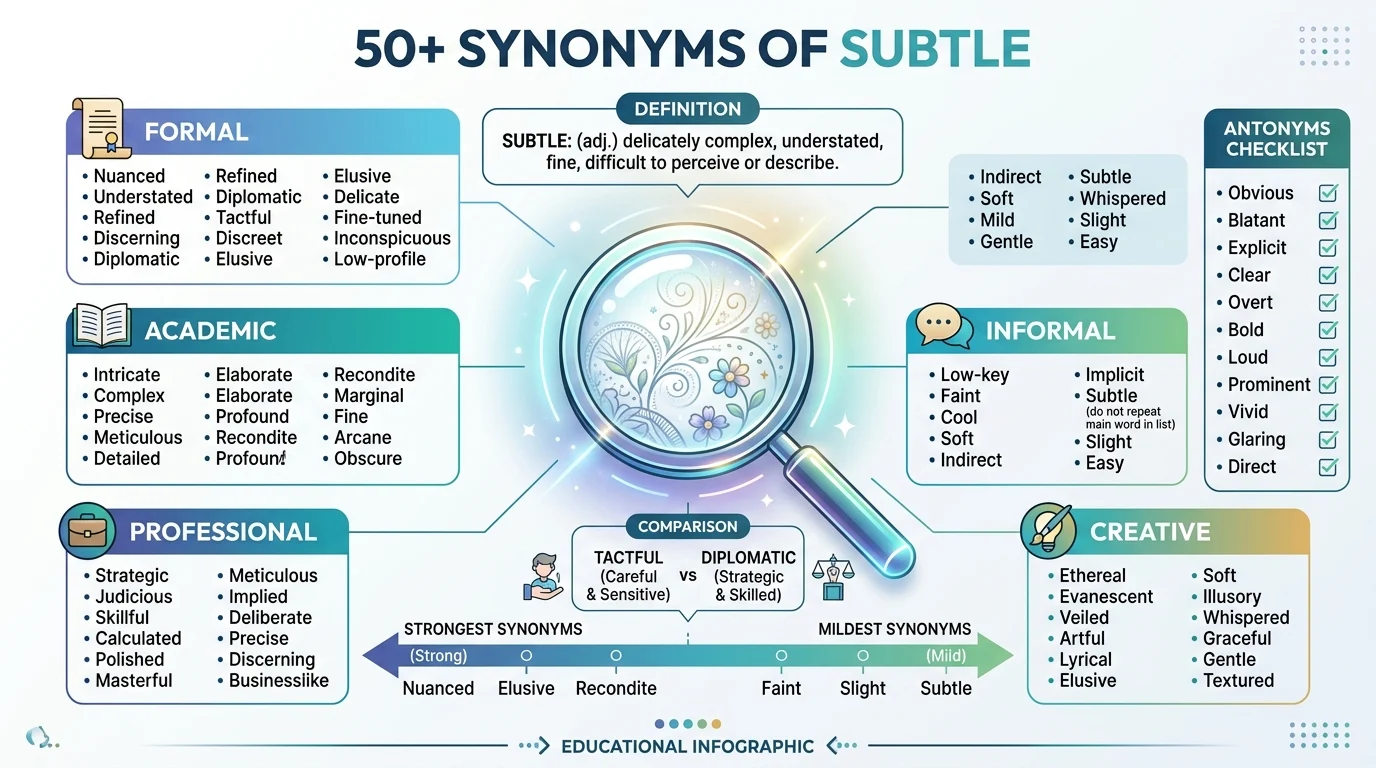
Quick Ans: “Subtle” means delicate, elusive, not immediately obvious, or characterized by skill and cleverness. It is a positive, nuanced adjective. For formal writing, choose understated or refined. For casual conversation, use faint or slight. In academic contexts, nuanced and perceptive are strong choices. For a stronger, more dramatic impact, select penetrating or exquisite.
Meaning, Tone, and Context
Understanding the core meaning of “subtle” is the first step to using it effectively.
Simple Definition: So delicate or precise as to be difficult to analyze or describe. Not obvious or conspicuous. Crafty or clever.
Part of Speech: Adjective.
Overall Tone: Positive to neutral. It indicates sophistication, intelligence, and refinement.
Formality Level: Formal to neutral. The word is appropriate in professional, academic, and literary contexts.
Common Uses: Native English speakers use it to describe differences, flavors, colors, smells, arguments, and humor. For example, “There is a subtle difference between the two wines,” or “She has a subtle sense of humor.”
Word Forms: Related words include the noun subtlety, the adverb subtly, and the noun subtleness.
When and How to Use “Subtle”
“Subtle” is the perfect choice when you want to emphasize delicacy, refinement, or understated cleverness. Here are seven realistic examples.
Professional: “The marketing campaign used subtle cues to influence consumer behavior.”
Academic: “The researcher noted a subtle but significant pattern in the data.”
Workplace: “She used subtle negotiation tactics to reach an agreement.”
Personal: “There is a subtle sweetness to the sauce that makes it delicious.”
Email: “I noticed a subtle change in the project timeline that we should discuss.”
Resume: “Used subtle persuasion techniques to close difficult sales.”
Social Media: “The subtle colors of this sunset are breathtaking.”
Best Synonyms of “Subtle”
No synonym is identical in every situation. Here is your guide to the best replacement for “subtle” based on your writing context.
Professional Writing: Refined. It suggests sophistication and polish. “The refined strategy yielded excellent results.”
Academic Writing: Nuanced. This is ideal when discussing complex, multi-layered ideas. “The nuanced argument considered multiple perspectives.”
Business Communication: Understated. A practical choice for describing design, style, or messaging. “The understated branding was highly effective.”
Casual Conversation: Slight. It tones down the formality and sounds natural. “There is a slight difference in color.”
Emotional Writing: Delicate. This word carries weight, suggesting gentleness and fragility. “Her delicate handling of the situation was admirable.”
Creative Writing: Exquisite. It implies extreme beauty and refinement. “The exquisite detail in the painting was remarkable.”
Resume Writing: Perceptive. Use it to describe keen insight or understanding. “Demonstrated perceptive problem-solving skills.”
When Not to Use “Subtle”
Using “subtle” can sound wrong or awkward in certain situations.
When It Sounds Too Positive: “Subtle” is usually positive. It sounds strange for negative things.
Better Choice: Faint or slight. “There was a faint odor in the room.”
When You Mean Obvious: “Subtle” is the opposite of obvious.
Better Choice: Obvious or clear. “The obvious solution was overlooked.”
When It Sounds Too Vague: “Subtle” can be vague if you need specific details.
Better Choice: Specific or precise. “The precise measurement was 0.5 degrees.”
When It Is Too Formal: In casual conversation, “subtle” can sound out of place.
Better Choice: Kind of or sort of. “It is kind of different, you know.”
Words Commonly Confused With “Subtle”
Several words are often mixed up with “subtle.” Here is how to keep them straight.
Word: Faint
Difference: Means barely perceptible. “Subtle” implies more sophistication.
When to Use: Use it for sounds, smells, and impressions.
Example: “There was a faint sound in the distance.”
Word: Slight
Difference: Means small in degree. “Subtle” implies more cleverness.
When to Use: Use this for small differences or amounts.
Example: “There was a slight change in temperature.”
Word: Understated
Difference: Means presented in a restrained way. “Subtle” is broader.
When to Use: Use this for style, design, and messaging.
Example: “The understated decor was elegant.”
Word: Refined
Difference: Means polished and cultured. “Subtle” is about cleverness.
When to Use: Use this for manners, tastes, and products.
Example: “She has refined taste in art.”
Word: Nuanced
Difference: Means having subtle shades of meaning. “Subtle” is more general.
When to Use: Use this for arguments and discussions.
Example: “The nuanced debate considered all sides.”
Word: Delicate
Difference: Means easily broken or fragile. “Subtle” is about cleverness.
When to Use: Use this for objects, situations, and feelings.
Example: “The delicate vase was priceless.”
Best Synonyms of “Subtle” by Context
| Context | Best Synonym | Why It Works | Example |
|---|---|---|---|
| Formal writing | Refined | Suggests sophistication and polish. | “The refined strategy was effective.” |
| Academic writing | Nuanced | Precise for complex ideas. | “The nuanced analysis was insightful.” |
| Professional communication | Understated | Emphasizes restraint and elegance. | “The understated approach worked.” |
| Business emails | Perceptive | Professional and clear. | “Her perceptive feedback improved the project.” |
| Resume writing | Perceptive | Highlights insight and cleverness. | “Perceptive problem-solving skills.” |
| Workplace communication | Subtle | The standard, expected term. | “We need subtle messaging.” |
| Casual conversation | Slight | Simple, natural, and conversational. | “There is a slight difference.” |
| Creative writing | Exquisite | Evokes extreme beauty and refinement. | “The exquisite detail was stunning.” |
| Emotional writing | Delicate | Suggests gentleness and fragility. | “The delicate moment was unforgettable.” |
| Strong emphasis | Penetrating | Suggests keen insight and depth. | “The penetrating analysis revealed new truths.” |
| Mild tone | Faint | Simple and unassuming. | “There was a faint odor.” |
| Social media captions | Kind of | Widely understood and relatable. | “It is kind of different.” |
How to Choose the Best Synonym of “Subtle”
Choosing the right word is a simple decision. Answer these questions.
What is my audience? For a professor or CEO, nuanced or refined is powerful. For a friend, slight or kind of is more natural.
What is my purpose? Are you describing an idea, a style, or a difference? Use nuanced for ideas, understated for style, and slight for differences.
Am I describing a physical or abstract quality? For physical things, faint or slight work. For abstract ideas, nuanced or perceptive are better.
What is the emotional strength? Exquisite and penetrating are stronger. Slight and faint are mild. Pick the one that matches your message.
Real Life Examples of “Subtle”
To truly master the word, it helps to see how it behaves in the wild and how a stronger synonym can elevate the sentence.
School: Basic: “The painting has a subtle color scheme.” Improved: “The painting has a refined color scheme that is easy on the eyes.”
College: Basic: “The argument was subtle.” Improved: “The argument was nuanced, considering many perspectives.”
Workplace: Basic: “We need a subtle approach.” Improved: “We need a perceptive approach that anticipates reactions.”
Business: Basic: “The campaign was subtle.” Improved: “The understated campaign was surprisingly effective.”
Email: Basic: “There is a subtle error in the report.” Improved: “There is a slight error in the report that needs correction.”
Conversation: Basic: “The food has a subtle flavor.” Improved: “The food has a delicate flavor that is incredible.”
Storytelling: Basic: “Her subtle smile said everything.” Improved: “Her exquisite smile spoke volumes without a word.”
Top 10 Synonyms of “Subtle”
| Synonym | Simple Meaning | Best Used For | Example Sentence |
|---|---|---|---|
| Refined | Polished and sophisticated | Formal, professional, and cultural contexts. | “The refined design impressed everyone.” |
| Nuanced | Having subtle shades of meaning | Academic, intellectual, and debate contexts. | “The nuanced argument was convincing.” |
| Understated | Restrained and elegant | Design, style, and communication contexts. | “The understated branding was effective.” |
| Perceptive | Having keen insight | Personal, professional, and intellectual contexts. | “Her perceptive comments helped us.” |
| Delicate | Gentle and fragile | Emotional, physical, and aesthetic contexts. | “The delicate moment was beautiful.” |
| Exquisite | Extremely beautiful and refined | Art, design, and high-quality contexts. | “The exquisite detail was amazing.” |
| Slight | Small in degree | Differences, amounts, and casual contexts. | “There was a slight change.” |
| Faint | Barely perceptible | Sounds, smells, and impressions. | “There was a faint noise.” |
| Penetrating | Keen and incisive | Analysis, insight, and intellectual contexts. | “The penetrating insight changed everything.” |
| Elegant | Graceful and stylish | Design, solutions, and manner contexts. | “The elegant solution solved the problem.” |
Synonyms of “Subtle” by Usage
Professional vs. Personal Synonyms
In the workplace (professional), choose perceptive, refined, or understated to describe strategies, approaches, and designs. These words convey professionalism and sophistication. “The refined strategy yielded excellent results” is more precise than “The subtle strategy yielded excellent results.”
With friends (personal), slight, kind of, or sort of keep the tone relaxed and relatable. These alternatives sound natural in everyday conversation.
Formal vs. Conversational Synonyms
For formal writing (reports, essays, professional emails), use nuanced, refined, or perceptive. These choices maintain the sophisticated tone expected in professional documents.
For casual conversations and texting, use slight, faint, or kind of. These options sound more natural and less pretentious.
Academic Synonyms
For research and essays, choose precise, authoritative words. Nuanced is great for arguments, perceptive for insights, and refined for methodology. These words sound considered and scholarly.
Using precise academic vocabulary demonstrates expertise and careful thinking. Professors and reviewers expect this level of precision.
Professional and Business Synonyms
For maximum impact in business writing, choose understated for branding, perceptive for leadership, and refined for products. These words demonstrate confidence and professional awareness.
Business leaders respond to language that conveys sophistication and insight. These synonyms project authority.
Creative and Literary Synonyms
To add emotion and imagery to your writing, choose exquisite, delicate, or elegant. These words create atmosphere and evoke beauty.
Literary writers use these alternatives to build mood and subtlety. They transform ordinary descriptions into evocative prose.
Slang or Modern Synonyms
In modern American slang, low-key is sometimes used to describe something subtle or understated. For example, “That was a low-key comment,” or “The design is very low-key.” These are acceptable in casual, friendly contexts. Avoid them in professional or academic writing.
Strongest to Mildest Synonyms
Mild: slight, faint, kind of
Moderate: subtle, perceptive, refined
Strong: nuanced, understated, delicate
Very Strong: exquisite, penetrating, elegant
Emotional vs. Neutral Synonyms
Emotional Synonyms: Exquisite, delicate, elegant. These words often hint at beauty, admiration, or sensitivity. Use them when you want to evoke feeling.
Neutral Synonyms: Slight, faint, perceptive. These words simply communicate factual information. Use them when you want to inform without emotional coloring.
Antonyms of “Subtle”
Here are 15 genuine opposites of “subtle.”
| Antonym | Meaning | Example Sentence |
|---|---|---|
| Obvious | Easily perceived or understood | “The obvious error was corrected.” |
| Blatant | Completely obvious and conspicuous | “The blatant mistake was embarrassing.” |
| Harsh | Rough and unpleasant | “The harsh criticism was difficult to hear.” |
| Clumsy | Awkward in movement or action | “His clumsy attempt failed.” |
| Gross | Very obvious and unacceptable | “The gross error was significant.” |
| Unsubtle | Not subtle | “The unsubtle hint was ignored.” |
| Blunt | Direct and lacking delicacy | “Her blunt comment offended everyone.” |
| Crude | Rough and undeveloped | “The crude plan needed work.” |
| Conspicuous | Easily seen | “The conspicuous sign was helpful.” |
| Noticeable | Easily noticed | “The noticeable change was welcome.” |
| Overdone | Excessive and lacking restraint | “The overdone decor was garish.” |
| Tactless | Lacking sensitivity | “His tactless remark ruined the mood.” |
| Inelegant | Lacking grace or refinement | “The inelegant solution was rejected.” |
| Heavy-handed | Lacking subtlety and finesse | “The heavy-handed approach failed.” |
| Gaudy | Showy and tasteless | “The gaudy design was criticized.” |
Comparison: “Subtle” vs Similar Words
Subtle vs. Faint
Main Difference: Subtle implies cleverness or refinement. Faint implies weakness or distance.
Which Is Stronger? Subtle is stronger for sophistication. Faint is about perception.
Which Is More Formal? Both are formal, but subtle is more sophisticated.
When to Use Each: Use faint for physical sensations. Use subtle for ideas and differences.
Examples:
Subtle: “There is a subtle difference in tone.”
Faint: “There was a faint sound in the distance.”
Subtle vs. Slight
Main Difference: Slight means small in degree. Subtle implies more cleverness.
Which Is Stronger? Subtle is stronger for sophistication.
Which Is More Formal? Both are formal, but subtle is more nuanced.
When to Use Each: Use slight for small differences. Use subtle for clever differences.
Examples:
Subtle: “The subtle hint went unnoticed.”
Slight: “There was a slight change.”
Subtle vs. Understated
Main Difference: Subtle is about cleverness. Understated is about restraint.
Which Is Stronger? They are similar. Understated emphasizes elegance.
Which Is More Formal? Both are formal.
When to Use Each: Use understated for design and style. Use subtle for ideas and actions.
Examples:
Subtle: “His subtle humor was appreciated.”
Understated: “The understated decor was elegant.”
Subtle vs. Nuanced
Main Difference: Subtle is general. Nuanced is about multiple shades of meaning.
Which Is Stronger? Nuanced is stronger for intellectual contexts.
Which Is More Formal? Both are formal.
When to Use Each: Use nuanced for arguments and analyses. Use subtle for general delicacy.
Examples:
Subtle: “The subtle difference was hard to spot.”
Nuanced: “The nuanced argument was persuasive.”
Subtle vs. Delicate
Main Difference: Subtle is about cleverness. Delicate is about fragility.
Which Is Stronger? Delicate is more emotional.
Which Is More Formal? Both are formal.
When to Use Each: Use delicate for feelings and objects. Use subtle for ideas and differences.
Examples:
Subtle: “The subtle point was missed.”
Delicate: “The delicate situation required care.”
Subtle vs. Perceptive
Main Difference: Subtle describes the quality. Perceptive describes the observer.
Which Is Stronger? Perceptive is stronger about the person.
Which Is More Formal? Both are formal.
When to Use Each: Use perceptive for people. Use subtle for things.
Examples:
Subtle: “The subtle clue was hidden.”
Perceptive: “Her perceptive observation was spot-on.”
Common Phrases and Expressions with “Subtle”
Phrase: Subtle difference
Meaning: A small, not obvious difference.
Example Sentence: “There is a subtle difference between the two paintings.”
Phrase: Subtle hint
Meaning: A clue that is not obvious.
Example Sentence: “She gave a subtle hint about her wishes.”
Phrase: Subtle sense of humor
Meaning: Understated and clever humor.
Example Sentence: “His subtle sense of humor takes time to understand.”
Phrase: Subtle change
Meaning: A small, gradual change.
Example Sentence: “There has been a subtle change in his attitude.”
Phrase: Subtle flavor
Meaning: A delicate, not overpowering taste.
Example Sentence: “The subtle flavor of the herb was delightful.”
Phrase: Subtle distinction
Meaning: A small but important difference.
Example Sentence: “There is a subtle distinction between the two terms.”
Common Mistakes to Avoid
Mistake 1: Using “subtle” when you mean “faint”.
Incorrect: “There was a subtle sound in the distance.”
Better: “There was a faint sound in the distance.”
Why: Faint is for physical perceptions. Subtle is for cleverness.
Mistake 2: Using “subtle” when you mean “slight”.
Incorrect: “There was a subtle difference in size.”
Better: “There was a slight difference in size.”
Why: Slight is for small amounts. Subtle is for clever differences.
Mistake 3: Overusing “subtle” in casual conversation.
Incorrect: “The food has a subtle flavor.”
Better: “The food has a delicate flavor.”
Why: Delicate sounds more natural in conversation.
Mistake 4: Using “subtle” for obvious things.
Incorrect: “The subtle error was obvious.”
Better: “The glaring error was obvious.”
Why: Subtle means not obvious.
Mistake 5: Confusing “nuanced” with “subtle”.
Incorrect: “His subtle argument considered many sides.”
Better: “His nuanced argument considered many sides.”
Why: Nuanced is for complex arguments. Subtle is for cleverness.
Frequently Asked Questions
1. What are the best synonyms of “subtle”?
The best synonyms depend on your context. For formal writing, choose refined or nuanced. And for casual conversation, slight or faint are ideal choices. For creative writing, use exquisite or delicate.
2. What are the best formal synonyms of “subtle”?
The best formal synonyms are refined, nuanced, and perceptive. These words are suitable for academic papers, professional reports, and business communications.
3. What are common informal synonyms of “subtle”?
For informal settings, use slight, faint, or kind of. These alternatives sound more natural in everyday conversation.
4. What is another word for “subtle” in professional writing?
In professional writing, understated is an excellent choice. It conveys restraint and elegance. Perceptive is also strong for insights and problem-solving.
5. What is the difference between “subtle” and “nuanced”?
While both indicate delicacy, subtle is about cleverness or not being obvious. Nuanced is about having multiple layers of meaning. Use nuanced for complex arguments and subtle for clever differences.
6. What is the opposite of “subtle”?
The most direct opposites (antonyms) of subtle are obvious, blatant, and unsubtle. These words describe things that are easily perceived.
Conclusion
“Subtle” is a sophisticated and versatile word for describing delicacy, cleverness, and refinement. The term is positive and widely accepted in most contexts, yet it can sound too vague for specific situations or too formal for casual conversation. The best choice among the synonyms of subtle depends entirely on your audience, tone, and purpose. Remember, no single synonym works perfectly in every situation. Your goal is to choose the word that communicates your message with the most clarity and impact. A practical tip for your vocabulary growth is to pay attention to how writers describe understated qualities and practice using different synonyms in your writing.
Discover More:
- 50+ Synonyms of Moderate: Meanings, Uses, Examples, and Best Alternatives 2026
- 50+ Synonyms of Consequences: Meanings, Uses, Examples, and Best Alternatives 2026

Ella Parker is a professional content writer with a passion for creating clear, engaging, and well-researched articles. She focuses on delivering valuable insights and practical information across business, technology, and lifestyle topics.