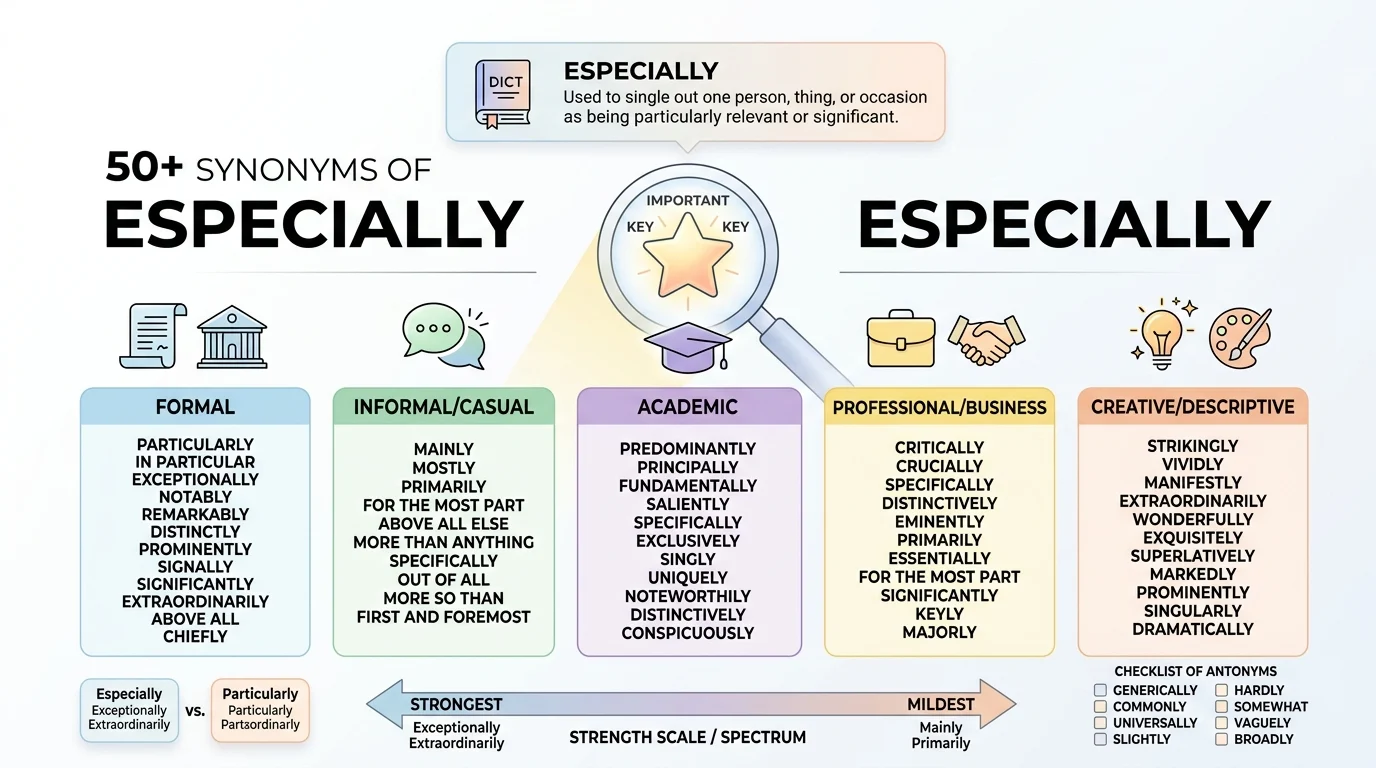
Have you ever needed to single out a particular person, thing, or situation as more important or relevant than others? You want to add emphasis and precision to your statement, and the word “especially” comes to mind. But is it the best fit for your audience? Choosing the right synonym for “especially” can transform a simple statement into a powerful, nuanced expression of priority, exception, or degree. This guide explores the best synonyms of especially, explaining exactly which word to use and when.
Quick Ans: “Especially” means above all, more than others, or particularly. It is a neutral, versatile adverb used for emphasis. For formal writing, choose particularly or notably. For casual conversation, use really or super. In academic contexts, principally and chiefly are strong choices. For a stronger, more dramatic impact, select above all or in particular.
Meaning, Tone, and Context
Understanding the core meaning of “especially” is the first step to using it effectively.
Simple Definition: To a great extent, above all, or particularly. Used to single out something as more important or relevant.
Part of Speech: Adverb.
Overall Tone: Neutral. It simply adds emphasis or distinction.
Formality Level: Neutral. The word works in most contexts, from casual to formal.
Common Uses: Native English speakers use it constantly to add emphasis, single out examples, or indicate a higher degree. For example, “I love all fruits, especially strawberries,” or “She is especially talented at painting.”
Word Forms: Related words include the adjective special and the noun specialty.
When and How to Use “Especially”
“Especially” is the perfect choice when you want to add emphasis or single something out. Here are seven realistic examples.
Professional: “All employees must complete the training, especially those in customer-facing roles.”
Academic: “The study focused on several factors, especially environmental influences.”
Workplace: “We value all contributions, especially ideas that drive innovation.”
Personal: “I enjoy many hobbies, especially reading and hiking.”
Email: “We are excited about all candidates, especially those with leadership experience.”
Resume: “I excel in all aspects of project management, especially timeline planning.”
Social Media: “Love everything about this city, especially the food scene.”
Best Synonyms of “Especially”
No synonym is identical in every situation. Here is your guide to the best replacement for “especially” based on your writing context.
Professional Writing: Notably. It suggests something that stands out and is worth noting. “The team performed well, notably the marketing department.”
Academic Writing: Particularly. This is ideal when discussing specific examples or cases. “The research, particularly the recent studies, supports this conclusion.”
Business Communication: Principally. A practical choice for highlighting main reasons. “The success was principally due to the sales team.”
Casual Conversation: Really. It tones down the formality and sounds natural. “I really love this song.”
Emotional Writing: Above all. This phrase carries weight, suggesting ultimate priority. “Above all, she valued honesty.”
Creative Writing: Chiefly. It implies a primary focus among many. “The novel was chiefly about love and loss.”
Resume Writing: Specifically. Use it to highlight precise skills or experiences. “I have experience in digital marketing, specifically SEO and content strategy.”
When Not to Use “Especially”
Using “especially” can sound wrong or awkward in certain situations.
When It Sounds Too Vague: “Especially” can be vague if you need to be precise.
Better Choice: Specifically or exactly. “I want the blue one, specifically.”
When You Mean “Very”: “Especially” adds emphasis, but very is simpler for degree.
Better Choice: Very or extremely. “The movie was very good.”
When It Is Overused: Using “especially” too often sounds repetitive.
Better Choice: Particularly or notably. Vary your vocabulary.
When It Sounds Too Formal: In casual conversation, “especially” can sound formal.
Better Choice: Really or so. “I really like that song.”
Words Commonly Confused With “Especially”
Several words are often mixed up with “especially.” Here is how to keep them straight.
Word: Specially
Difference: Means for a specific purpose. “Especially” means particularly.
When to Use: Use it when something is done for a specific reason.
Example: “The cake was made specially for her birthday.”
Word: Particularly
Difference: Means more than usual. “Especially” is very similar.
When to Use: Use this for emphasis on a specific point.
Example: “I am particularly interested in this topic.”
Word: Specifically
Difference: Means in a precise way. “Especially” is about emphasis.
When to Use: Use this for exact details.
Example: “I specifically asked for a window seat.”
Word: Notably
Difference: Means in a way that is worth noting. “Especially” is about degree.
When to Use: Use this for standout examples.
Example: “Several leaders, notably the CEO, attended.”
Word: Chiefly
Difference: Means primarily or mainly. “Especially” is about one among many.
When to Use: Use this for the main reason or focus.
Example: “The company was chiefly concerned with profits.”
Word: Principally
Difference: Means mainly or primarily. “Especially” is about exceptional cases.
When to Use: Use this for the main or most important reason.
Example: “The funding was principally from government grants.”
Best Synonyms of “Especially” by Context
| Context | Best Synonym | Why It Works | Example |
|---|---|---|---|
| Formal writing | Notably | Suggests something worth attention. | “The results, notably the third quarter, were impressive.” |
| Academic writing | Particularly | Precise for specific examples. | “The study focused on several factors, particularly temperature.” |
| Professional communication | Principally | Emphasizes the main reason. | “The delay was principally due to supply issues.” |
| Business emails | Specifically | Professional and precise. | “We need feedback on the budget, specifically the marketing portion.” |
| Resume writing | Particularly | Highlights key skills. | “I excel in analytics, particularly data visualization.” |
| Workplace communication | Especially | The standard, neutral term. | “All teams will participate, especially the sales team.” |
| Casual conversation | Really | Simple, natural, and conversational. | “I really like your new haircut.” |
| Creative writing | Chiefly | Evokes a primary focus. | “The story was chiefly about redemption.” |
| Emotional writing | Above all | Suggests ultimate importance. | “Above all, she loved her family.” |
| Strong emphasis | In particular | Adds strong focus. | “One detail, in particular, stood out.” |
| Mild tone | Pretty | Simple and unassuming. | “The movie was pretty good.” |
| Social media captions | Especially | Widely understood and relatable. | “Love this weather, especially the sunsets.” |
How to Choose the Best Synonym of “Especially”
Choosing the right word is a simple decision. Answer these questions.
What is my audience? For a professor or CEO, notably or particularly is powerful. For a friend, really or so is more natural.
What is my purpose? Are you trying to emphasize, specify, or prioritize? Use above all for emphasis, specifically for specification, and principally for priority.
Am I highlighting a reason, an example, or a degree? For reasons, chiefly or principally work.And for examples, particularly or notably are better. For degree, especially or really are best.
What is the emotional strength? Above all is stronger. Pretty is mild. Pick the one that matches your message.
Real Life Examples of “Especially”
To truly master the word, it helps to see how it behaves in the wild and how a stronger synonym can elevate the sentence.
School: Basic: “I like all subjects, especially math.” Improved: “I like all subjects, particularly math and science.”
College: Basic: “The professor, especially the guest lecturer, was inspiring.” Improved: “The professor, notably the guest lecturer, was inspiring.”
Workplace: Basic: “All employees should attend, especially managers.” Improved: “All employees should attend, particularly managers.”
Business: Basic: “Our success is due to many factors, especially innovation.” Improved: “Our success is due to many factors, principally innovation.”
Email: Basic: “Please review the report, especially the conclusion.” Improved: “Please review the report, specifically the conclusion.”
Conversation: Basic: “I especially love this song.” Improved: “I really love this song.”
Storytelling: Basic: “She valued many things, especially honesty.” Improved: “Above all, she valued honesty.”
Top 10 Synonyms of “Especially”
| Synonym | Simple Meaning | Best Used For | Example Sentence |
|---|---|---|---|
| Particularly | More than usual or in particular | Formal, academic, and professional contexts. | “I am particularly interested in this topic.” |
| Notably | In a way worth noting | Formal, professional, and standout contexts. | “The team, notably the new members, performed well.” |
| Principally | Mainly or primarily | Business, academic, and reason contexts. | “The project was principally about sustainability.” |
| Specifically | In a precise way | Professional, technical, and detail contexts. | “I specifically requested this color.” |
| Chiefly | Mainly or primarily | Creative, literary, and reason contexts. | “The story was chiefly about love.” |
| Above all | More than anything else | Emotional, persuasive, and priority contexts. | “Above all, be kind.” |
| In particular | Especially or specifically | Formal, academic, and emphasis contexts. | “One issue, in particular, was concerning.” |
| Really | Very or truly | Casual conversation and personal contexts. | “I really appreciate your help.” |
| Especially | Above all or particularly | All contexts | “I love all fruit, especially strawberries.” |
| Predominantly | Mainly or for the most part | Academic, professional, and majority contexts. | “The audience was predominantly young.” |
Synonyms of “Especially” by Usage
Professional vs. Personal Synonyms
In the workplace (professional), choose principally, particularly, or notably to highlight key points. These words convey precision and professionalism. “The success was principally due to good planning” is more precise than “The success was especially due to good planning.”
With friends (personal), really, super, or so keep the tone relaxed and relatable. These alternatives sound natural in everyday conversation.
Formal vs. Conversational Synonyms
For formal writing (reports, essays, professional emails), use notably, particularly, or principally. These choices maintain the sophisticated tone expected in professional documents.
For casual conversations and texting, use really, super, or so. These options sound more natural and less pretentious.
Academic Synonyms
For research and essays, choose precise, authoritative words. Particularly is great for specific examples, principally for main reasons, and notably for standout findings. These words sound considered and scholarly.
Using precise academic vocabulary demonstrates expertise and careful thinking. Professors and reviewers expect this level of precision.
Professional and Business Synonyms
For maximum impact in business writing, choose principally for main reasons, specifically for details, and notably for standout points. These words demonstrate confidence and professional awareness.
Business leaders respond to language that conveys clarity and precision. These synonyms project authority.
Creative and Literary Synonyms
To add emotion and imagery to your writing, choose above all or chiefly. These words create emphasis and rhythm.
Literary writers use these alternatives to build emphasis and priority. They transform ordinary sentences into evocative prose.
Slang or Modern Synonyms
In modern American slang, super or chaotic are used for emphasis. For example, “I super love this song,” or “It is actually good.” These are acceptable in casual contexts. Avoid them in professional or academic writing.
Strongest to Mildest Synonyms
Mild: pretty, sort of, kind of
Moderate: especially, particularly, notably
Strong: principally, chiefly, specifically
Very Strong: above all, in particular, predominantly
Emotional vs. Neutral Synonyms
Emotional Synonyms: Above all, really, notably. These words often hint at passion, priority, or admiration. Use them when you want to evoke feeling.
Neutral Synonyms: Particularly, specifically, chiefly. These words simply communicate factual information. Use them when you want to inform without emotional coloring.
Antonyms of “Especially”
Here are 15 genuine opposites of “especially.”
| Antonym | Meaning | Example Sentence |
|---|---|---|
| Generally | In a general way | “The weather is generally warm.” |
| Usually | In most cases | “I usually eat breakfast at home.” |
| Typically | In a typical way | “The food is typically good here.” |
| Commonly | In a common way | “This is commonly found in nature.” |
| Ordinarily | In an ordinary way | “Ordinarily, I would agree.” |
| Normally | In a normal way | “I normally wake up early.” |
| Broadly | In a broad way | “The policy applies broadly.” |
| Generally speaking | In general | “Generally speaking, I agree.” |
| In general | Generally | “In general, the plan worked.” |
| On the whole | In all respects | “On the whole, the project was successful.” |
| Overall | In total | “Overall, the experience was positive.” |
| All in all | Considering everything | “All in all, it was a good year.” |
| With exceptions | Not universally | “The rule applies with exceptions.” |
| Notably except | With notable exceptions | “Everyone attended, notably except John.” |
| Generally except | In general but not always | “Generally except for holidays, we work.” |
Comparison: “Especially” vs Similar Words
Especially vs. Particularly
Main Difference: They are almost identical. Particularly is slightly more formal.
Which Is Stronger? They are equal in strength.
Which Is More Formal? Particularly is slightly more formal.
When to Use Each: Use especially in most contexts. Use particularly in formal writing.
Examples:
Especially: “I love all sports, especially tennis.”
Particularly: “The report, particularly the conclusion, was well-written.”
Especially vs. Specially
Main Difference: Especially means particularly. Specially means for a specific purpose.
Which Is Stronger? They are different in meaning.
Which Is More Formal? Both are formal.
When to Use Each: Use especially for emphasis. Use specially for purpose.
Examples:
Especially: “I especially like this one.”
Specially: “The dress was made specially for her.”
Especially vs. Specifically
Main Difference: Especially emphasizes importance. Specifically emphasizes exactness.
Which Is Stronger? Specifically is more precise.
Which Is More Formal? Both are formal.
When to Use Each: Use especially for emphasis. Use specifically for details.
Examples:
Especially: “I like all subjects, especially math.”
Specifically: “I want the blue one, specifically.”
Especially vs. Notably
Main Difference: Especially emphasizes degree. Notably emphasizes standing out.
Which Is Stronger? Notably suggests more significance.
Which Is More Formal? Notably is more formal.
When to Use Each: Use especially for degree. Use notably for standout examples.
Examples:
Especially: “I am especially proud of this work.”
Notably: “The team, notably the captain, performed well.”
Especially vs. Chiefly
Main Difference: Especially emphasizes one among many. Chiefly emphasizes the main focus.
Which Is Stronger? Chiefly is stronger for priority.
Which Is More Formal? Both are formal.
When to Use Each: Use especially for exceptions. Use chiefly for main reasons.
Examples:
Especially: “I like many books, especially mysteries.”
Chiefly: “The novel was chiefly about redemption.”
Especially vs. Above All
Main Difference: Especially emphasizes one among many. Above all emphasizes ultimate importance.
Which Is Stronger? Above all is much stronger.
Which Is More Formal? Above all is more dramatic and emotional.
When to Use Each: Use especially for emphasis. Use above all for ultimate priority.
Examples:
Especially: “I enjoy many activities, especially swimming.”
Above all: “Above all, be honest.”
Common Phrases and Expressions with “Especially”
Phrase: Especially now
Meaning: Particularly at this time.
Example Sentence: “We need to work together, especially now.”
Phrase: Especially when
Meaning: Particularly in certain situations.
Example Sentence: “I like to read, especially when I am traveling.”
Phrase: Not especially
Meaning: Not very or not particularly.
Example Sentence: “I am not especially interested in that topic.”
Phrase: Especially for
Meaning: Particularly for a specific purpose or person.
Example Sentence: “This gift is especially for you.”
Phrase: Especially since
Meaning: Particularly given that.
Example Sentence: “I am excited, especially since we have been planning this for months.”
Phrase: Especially true
Meaning: Particularly accurate or applicable.
Example Sentence: “This is especially true for beginners.”
Common Mistakes to Avoid
Mistake 1: Confusing “especially” with “specially”.
Incorrect: “The cake was made especially for her birthday.”
Better: “The cake was made specially for her birthday.”
Why: Specially means for a specific purpose. Especially means particularly.
Mistake 2: Using “especially” when you mean “specifically”.
Incorrect: “I especially asked for the window seat.”
Better: “I specifically asked for the window seat.”
Why: Specifically means exact.
Mistake 3: Overusing “especially” in formal writing.
Incorrect: “The report is especially comprehensive.”
Better: “The report is particularly comprehensive.”
Why: Particularly is more formal.
Mistake 4: Using “especially” for every emphasis.
Incorrect: “I especially like this. That is especially good.”
Better: “I really like this. That is particularly good.”
Why: Variation improves writing.
Mistake 5: Using “especially” when you mean “mostly”.
Incorrect: “The audience was especially young.”
Better: “The audience was predominantly young.”
Why: Predominantly means mostly.
Frequently Asked Questions
1. What are the best synonyms of “especially”?
The best synonyms depend on your context. For formal writing, choose particularly or notably. And for casual conversation, really or super are ideal choices. For emphasizing priority, use above all.
2. What are the best formal synonyms of “especially”?
The best formal synonyms are particularly, notably, and principally. These words are suitable for academic papers, professional reports, and business communications.
3. What are common informal synonyms of “especially”?
For informal settings, use really, so, or super. These alternatives sound more natural in everyday conversation.
4. What is another word for “especially” in professional writing?
In professional writing, notably is an excellent choice. It suggests something worth noting. Principally is also strong for highlighting main reasons.
5. What is the difference between “especially” and “particularly”?
While both indicate emphasis, especially is slightly more common and neutral. Particularly is slightly more formal. Use either interchangeably in most contexts.
6. What is the opposite of “especially”?
The most direct opposites (antonyms) of especially are generally, usually, and normally. These words describe things that are not singled out.
Conclusion
“Especially” is a versatile and essential word for adding emphasis and singling out important points. The term is neutral and widely accepted in most contexts, yet it can sound overused or too formal in casual conversation. The best choice among the synonyms of especially depends entirely on your audience, tone, and purpose. Remember, no single synonym works perfectly in every situation. Your goal is to choose the word that communicates your message with the most clarity and impact. A practical tip for your vocabulary growth is to pay attention to how writers add emphasis and practice using different synonyms in your writing.
Discover More:
- 50+ Synonyms of Unfair: Meanings, Uses, Examples, and Best Alternatives
- 50+ Synonyms of Moderate: Meanings, Uses, Examples, and Best Alternatives 2026

Alexander Cole is a professional content writer and researcher who specializes in creating informative, reader-friendly, and well-researched articles. He is committed to publishing accurate, valuable, and engaging content that helps readers stay informed and make smarter decisions.
1 thought on “50+ Synonyms of Especially: Meanings, Uses, Examples, and Best Alternatives 2026”