Have you ever needed to describe something immense, expansive, or seemingly limitless but felt that “big” or “large” did not fully capture the scale? You want to highlight size, extent, or magnitude, and the word “vast” comes to mind. But is it the best fit for your audience? Choosing the right synonym for “vast” can transform a simple description into a powerful image of scale and grandeur. This guide explores the best synonyms of vast, explaining exactly which word to use and when.
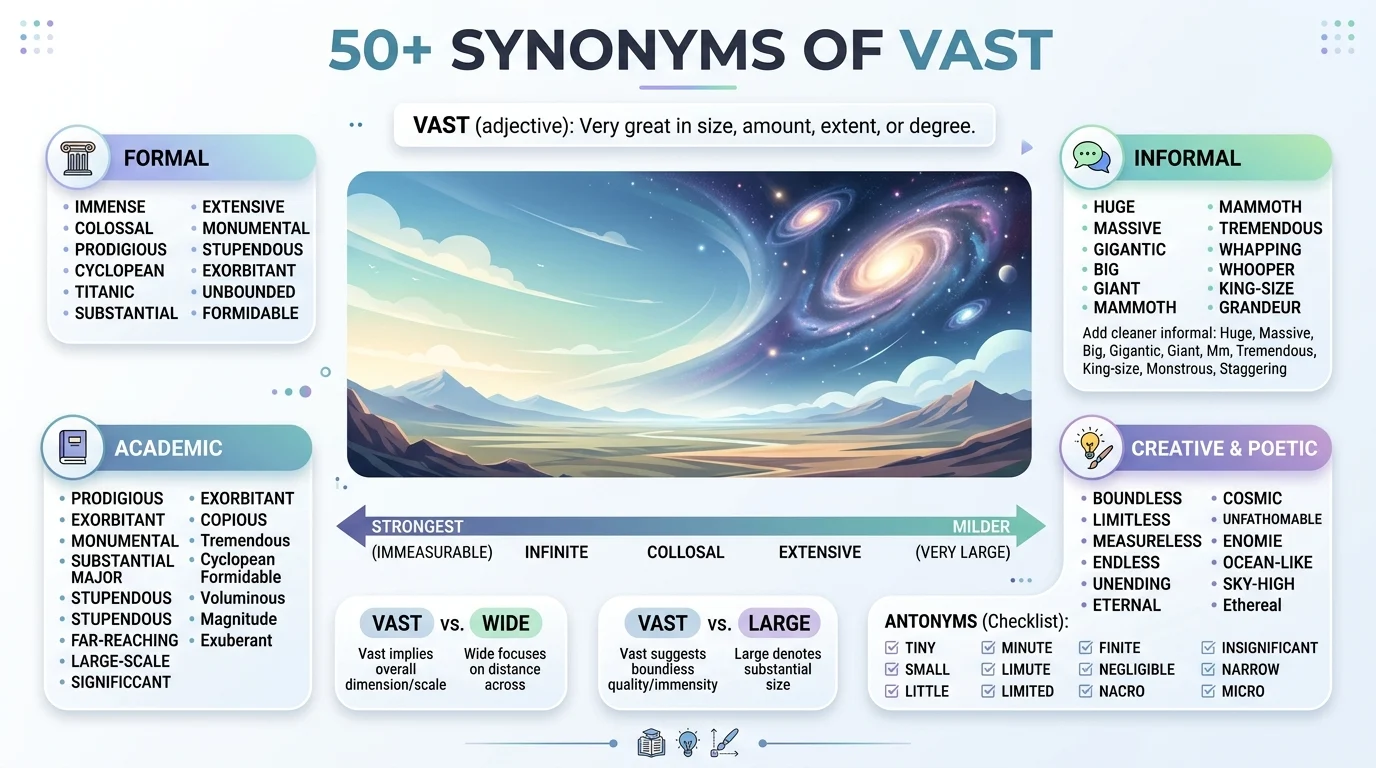
Quick Ans: “Vast” means extremely large in size, amount, or degree, often implying great expanse or range. It is a positive, dramatic adjective. For formal writing, choose immense or tremendous. For casual conversation, use huge or massive. In academic contexts, extensive and far-reaching are strong choices. For a stronger, more dramatic impact, select boundless or limitless.
Meaning, Tone, and Context
Understanding the core meaning of “vast” is the first step to using it effectively.
Simple Definition: Very great in size, extent, amount, or degree. Extremely large.
Part of Speech: Adjective.
Overall Tone: Neutral to positive and dramatic. It indicates impressive scale and magnitude.
Formality Level: Formal. The word is appropriate in professional and literary contexts.
Common Uses: Native English speakers use it to describe landscapes, knowledge, resources, and differences. For example, “The vast desert stretched for miles,” or “She has a vast knowledge of history.”
Word Forms: Related words include the noun vastness and the adverb vastly.
When and How to Use “Vast”
“Vast” is the perfect choice when you want to emphasize extreme size or extent. Here are seven realistic examples.
Professional: “The company has a vast network of suppliers across the globe.”
Academic: “The researcher has a vast understanding of the subject matter.”
Workplace: “Our database contains a vast amount of customer information.”
Personal: “The vast ocean stretched out before us.”
Email: “We have a vast array of options available for the project.”
Resume: “Managed a vast portfolio of over 100 client accounts.”
Social Media: “The vast landscapes of the national park are breathtaking.”
Best Synonyms of “Vast”
No synonym is identical in every situation. Here is your guide to the best replacement for “vast” based on your writing context.
Professional Writing: Immense. It suggests greatness in size or extent. “The project required an immense amount of resources.”
Academic Writing: Extensive. This is ideal when discussing broad coverage or knowledge. “The extensive research covered multiple decades.”
Business Communication: Substantial. A practical choice for significant amounts. “We made a substantial investment in the project.”
Casual Conversation: Huge. It tones down the formality and sounds natural. “That is a huge building.”
Emotional Writing: Boundless. This word carries weight, suggesting something without limits. “Her boundless energy inspired everyone.”
Creative Writing: Limitless. It implies infinite possibility and scope. “The limitless sky stretched above them.”
Resume Writing: Comprehensive. Use it to describe broad experience or knowledge. “I have comprehensive experience in project management.”
When Not to Use “Vast”
Using “vast” can sound wrong or awkward in certain situations.
When It Sounds Too Dramatic: “Vast” is a dramatic word. It sounds ridiculous for small things.
Better Choice: Large or big. “We have a large office.”
When You Mean Detailed: “Vast” is about size, not detail.
Better Choice: Detailed or thorough. “She has thorough knowledge of the topic.”
When It Sounds Too Vague: “Vast” can be vague if you need exact measurements.
Better Choice: Specific number. “The warehouse measures 10,000 square feet.”
When It Is Too Formal: In casual conversation, “vast” can sound out of place.
Better Choice: Big or huge. “That is a huge deal.”
Words Commonly Confused With “Vast”
Several words are often mixed up with “vast.” Here is how to keep them straight.
Word: Immense
Difference: Suggests greatness in size or extent. “Vast” emphasizes expanse.
When to Use: Use it for something that is extremely large.
Example: “The immense mountain towered over the valley.”
Word: Enormous
Difference: Means exceptionally large. “Vast” emphasizes extent.
When to Use: Use this for things that are unusually large.
Example: “The enormous elephant weighed several tons.”
Word: Extensive
Difference: Means covering a large area or range. “Vast” is about extent.
When to Use: Use this for knowledge, research, or coverage.
Example: “The extensive report covered all aspects.”
Word: Massive
Difference: Means large and heavy or solid. “Vast” is about extent.
When to Use: Use this for physical size or impact.
Example: “The massive structure was built to last.”
Word: Boundless
Difference: Means without limits. “Vast” is very large but has limits.
When to Use: Use this for endless or infinite things.
Example: “Her boundless optimism was infectious.”
Word: Infinite
Difference: Means without any limits. “Vast” is limited but very large.
When to Use: Use this for truly limitless things.
Example: “The universe is infinite.”
Best Synonyms of “Vast” by Context
| Context | Best Synonym | Why It Works | Example |
|---|---|---|---|
| Formal writing | Immense | Suggests greatness in size. | “The immense task took years to complete.” |
| Academic writing | Extensive | Precise for coverage and range. | “The extensive research was published.” |
| Professional communication | Substantial | Emphasizes significance and size. | “We need a substantial investment.” |
| Business emails | Significant | Professional and widely understood. | “We saw significant growth this quarter.” |
| Resume writing | Comprehensive | Emphasizes breadth and depth. | “Comprehensive experience in marketing.” |
| Workplace communication | Large | The standard, neutral term. | “We have a large team.” |
| Casual conversation | Huge | Simple, natural, and conversational. | “That is a huge house.” |
| Creative writing | Boundless | Evokes infinite possibility. | “The boundless prairie stretched before them.” |
| Emotional writing | Limitless | Suggests no boundaries. | “Her limitless imagination created worlds.” |
| Strong emphasis | Monumental | Suggests historical importance. | “The monumental achievement was celebrated.” |
| Mild tone | Big | Simple and unassuming. | “The big project is due next week.” |
| Social media captions | Massive | Widely understood and relatable. | “Massive views from the top of the mountain.” |
How to Choose the Best Synonym of “Vast”
Choosing the right word is a simple decision. Answer these questions.
What is my audience? For a professor or CEO, immense or extensive is powerful. For a friend, huge or massive is more natural.
What is my purpose? Are you trying to impress, inform, or describe? Use monumental for impress, comprehensive for information, and large for description.
Am I describing physical space, knowledge, or amount? For physical space, vast or immense work. And for knowledge, extensive or comprehensive are better. For amounts, substantial or considerable are best.
What is the emotional strength? Boundless and limitless are stronger. Big and large are mild. Pick the one that matches your message.
Real Life Examples of “Vast”
To truly master the word, it helps to see how it behaves in the wild and how a stronger synonym can elevate the sentence.
School: Basic: “The library has a vast collection.” Improved: “The library has an extensive collection of rare books.”
College: Basic: “The professor has vast knowledge.” Improved: “The professor has comprehensive knowledge of the subject.”
Workplace: Basic: “We have a vast amount of data.” Improved: “We have a substantial amount of data to analyze.”
Business: Basic: “The company has a vast market.” Improved: “The company has a far-reaching market presence.”
Email: Basic: “We have a vast array of options.” Improved: “We have a comprehensive array of options to choose from.”
Conversation: Basic: “The park is vast.” Improved: “The park is huge. It takes hours to walk across.”
Storytelling: Basic: “The vast desert stretched ahead.” Improved: “The boundless desert stretched ahead, meeting the horizon.”
Top 10 Synonyms of “Vast”
| Synonym | Simple Meaning | Best Used For | Example Sentence |
|---|---|---|---|
| Immense | Extremely large in size | Formal, dramatic, and descriptive contexts. | “The immense mountain range stretched for miles.” |
| Extensive | Covering a wide area or range | Academic, research, and knowledge contexts. | “The extensive research covered many topics.” |
| Substantial | Considerable in amount or size | Business, finance, and significance contexts. | “The substantial investment paid off.” |
| Comprehensive | Including everything | Knowledge, reports, and coverage contexts. | “The comprehensive report covered all aspects.” |
| Boundless | Without limits | Emotional, creative, and descriptive contexts. | “Her boundless energy was inspiring.” |
| Limitless | Having no restrictions | Creative, philosophical, and abstract contexts. | “The limitless possibilities excited her.” |
| Massive | Large and heavy or solid | Physical size, impact, and casual contexts. | “The massive building dominated the skyline.” |
| Enormous | Exceptionally large | Size, amount, and dramatic contexts. | “The enormous crowd filled the stadium.” |
| Gigantic | Very large and imposing | Physical size and dramatic contexts. | “The gigantic statue impressed everyone.” |
| Far-reaching | Having wide effects or implications | Policy, business, and consequences contexts. | “The far-reaching changes affected everyone.” |
Synonyms of “Vast” by Usage
Professional vs. Personal Synonyms
In the workplace (professional), choose substantial, comprehensive, or extensive to describe resources, knowledge, and scope. These words convey professionalism and precision. “We have a substantial budget” is more precise than “We have a vast budget.”
With friends (personal), huge, massive, or big keep the tone relaxed and relatable. These alternatives sound natural in everyday conversation.
Formal vs. Conversational Synonyms
For formal writing (reports, essays, professional emails), use immense, extensive, or substantial. These choices maintain the sophisticated tone expected in professional documents.
For casual conversations and texting, use huge, massive, or big. These options sound more natural and less pretentious.
Academic Synonyms
For research and essays, choose precise, authoritative words. Extensive is great for research, comprehensive for coverage, and substantial for data. These words sound considered and scholarly.
Using precise academic vocabulary demonstrates expertise and careful thinking. Professors and reviewers expect this level of precision.
Professional and Business Synonyms
For maximum impact in business writing, choose substantial for amounts, far-reaching for impact, and comprehensive for scope. These words demonstrate confidence and professional awareness.
Business leaders respond to language that conveys clarity and significance. These synonyms project authority.
Creative and Literary Synonyms
To add emotion and imagery to your writing, choose boundless, limitless, or immense. These words create atmosphere and evoke wonder.
Literary writers use these alternatives to build grandeur and scale. They transform ordinary descriptions into evocative prose.
Slang or Modern Synonyms
In modern American slang, ginormous (a blend of gigantic and enormous) or huge are sometimes used for emphasis. For example, “That is a ginormous building,” or “It is huge.” These are acceptable in casual contexts. Avoid them in professional or academic writing.
Strongest to Mildest Synonyms
Mild: big, large, considerable
Moderate: substantial, extensive, significant
Strong: immense, enormous, massive
Very Strong: boundless, limitless, infinite
Emotional vs. Neutral Synonyms
Emotional Synonyms: Boundless, limitless, immense. These words often hint at wonder, awe, or inspiration. Use them when you want to evoke feeling.
Neutral Synonyms: Large, big, extensive. These words simply communicate factual information. Use them when you want to inform without emotional coloring.
Antonyms of “Vast”
Here are 15 genuine opposites of “vast.”
| Antonym | Meaning | Example Sentence |
|---|---|---|
| Tiny | Extremely small | “The tiny insect was barely visible.” |
| Minute | Very small | “The minute details required a magnifying glass.” |
| Minuscule | Extremely small | “The minuscule font was hard to read.” |
| Small | Not large | “The small room was cozy.” |
| Limited | Not extensive | “The limited resources were a challenge.” |
| Narrow | Not wide | “The narrow path was hard to navigate.” |
| Restricted | Limited in scope | “The restricted access was a problem.” |
| Tiny | Very small in size | “The tiny house was charming.” |
| Insignificant | Small and unimportant | “The insignificant detail was overlooked.” |
| Petite | Small and delicate | “Her petite frame was elegant.” |
| Compact | Closely and neatly packed | “The compact car was easy to park.” |
| Miniature | Very small scale | “The miniature model was perfect.” |
| Finite | Having limits | “The finite resources were exhausted.” |
| Meager | Lacking in quantity | “The meager meal was not enough.” |
| Scanty | Small in amount | “The scanty evidence was unconvincing.” |
Comparison: “Vast” vs Similar Words
Vast vs. Immense
Main Difference: Vast emphasizes expanse. Immense emphasizes size and greatness.
Which Is Stronger? They are similar in strength. Immense suggests more weight.
Which Is More Formal? Both are formal and literary.
When to Use Each: Use vast for expanse and extent. Use immense for size and significance.
Examples:
Vast: “The vast prairie stretched to the horizon.”
Immense: “The immense mountain was daunting.”
Vast vs. Enormous
Main Difference: Vast is about extent. Enormous is about unusual size.
Which Is Stronger? Enormous suggests more abnormality.
Which Is More Formal? Both are formal.
When to Use Each: Use vast for expanse. Use enormous for unusual bigness.
Examples:
Vast: “The vast ocean was calm.”
Enormous: “The enormous whale breached the surface.”
Vast vs. Extensive
Main Difference: Vast is about physical extent. Extensive is about coverage or range.
Which Is Stronger? They are similar. Extensive is more precise about coverage.
Which Is More Formal? Both are formal.
When to Use Each: Use vast for physical extent. Use extensive for knowledge and coverage.
Examples:
Vast: “The vast desert was empty.”
Extensive: “Her extensive knowledge impressed everyone.”
Vast vs. Massive
Main Difference: Vast is about extent. Massive is about weight and solidity.
Which Is Stronger? Massive suggests more physical presence.
Which Is More Formal? Both are formal.
When to Use Each: Use vast for expanse. Use massive for physical size and impact.
Examples:
Vast: “The vast plains were beautiful.”
Massive: “The massive rock blocked the path.”
Vast vs. Boundless
Main Difference: Vast is very large but limited. Boundless is without limits.
Which Is Stronger? Boundless is much stronger and more dramatic.
Which Is More Formal? Both are formal, but boundless is more poetic.
When to Use Each: Use vast for physical space. Use boundless for abstract things.
Examples:
Vast: “The vast area was undeveloped.”
Boundless: “Her boundless energy was remarkable.”
Vast vs. Far-reaching
Main Difference: Vast is about size. Far-reaching is about impact or consequences.
Which Is Stronger? They are different. Far-reaching emphasizes effects.
Which Is More Formal? Both are formal.
When to Use Each: Use vast for physical extent. Use far-reaching for consequences.
Examples:
Vast: “The vast forest was dense.”
Far-reaching: “The far-reaching changes affected everyone.”
Common Phrases and Expressions with “Vast”
Phrase: Vast majority
Meaning: A very large majority.
Example Sentence: “The vast majority of voters supported the policy.”
Phrase: Vast difference
Meaning: A very large difference.
Example Sentence: “There is a vast difference between the two proposals.”
Phrase: Vast array
Meaning: A wide range of options.
Example Sentence: “The store offers a vast array of products.”
Phrase: Vast knowledge
Meaning: Very broad and deep knowledge.
Example Sentence: “He has a vast knowledge of world history.”
Phrase: Vast expanse
Meaning: A very large area.
Example Sentence: “The vast expanse of the ocean was awe-inspiring.”
Phrase: Vast amount
Meaning: A very large quantity.
Example Sentence: “A vast amount of data was collected.”
Common Mistakes to Avoid
Mistake 1: Using “vast” when you mean “extensive”.
Incorrect: “She has a vast research background.”
Better: “She has an extensive research background.”
Why: Extensive is better for knowledge and coverage.
Mistake 2: Using “vast” for small things.
Incorrect: “The vast kitchen was 200 square feet.”
Better: “The large kitchen was 200 square feet.”
Why: Vast is for extremely large things.
Mistake 3: Overusing “vast” in casual conversation.
Incorrect: “I have a vast amount of homework.”
Better: “I have a huge amount of homework.”
Why: Huge sounds more natural in casual conversation.
Mistake 4: Using “vast” when you mean “huge”.
Incorrect: “That is a vast building.”
Better: “That is a huge building.”
Why: Huge is more common for everyday things.
Mistake 5: Using “boundless” when you mean “vast”.
Incorrect: “The boundless area was 10 miles wide.”
Better: “The vast area was 10 miles wide.”
Why: Boundless implies no limits.
Frequently Asked Questions
1. What are the best synonyms of “vast”?
The best synonyms depend on your context. For formal writing, choose immense or extensive. And for casual conversation, huge or massive are ideal choices. For dramatic effect, use boundless or limitless.
2. What are the best formal synonyms of “vast”?
The best formal synonyms are immense, extensive, and substantial. These words are suitable for academic papers, professional reports, and business communications.
3. What are common informal synonyms of “vast”?
For informal settings, use huge, massive, or big. These alternatives sound more natural in everyday conversation.
4. What is another word for “vast” in professional writing?
In professional writing, substantial is an excellent choice. It conveys significant size or amount. Extensive is also strong for coverage and knowledge.
5. What is the difference between “vast” and “immense”?
While both indicate extreme size, vast emphasizes expanse and extent. Immense emphasizes greatness and magnitude. Use vast for wide areas and immense for heavy significance.
6. What is the opposite of “vast”?
The most direct opposites (antonyms) of vast are tiny, minute, and small. These words describe things that are extremely small.
Conclusion
“Vast” is a powerful and dramatic word for describing extreme size, extent, or magnitude. The term is formal and widely accepted in most contexts, yet it can sound too dramatic for small things or too formal for casual conversation. The best choice among the synonyms of vast depends entirely on your audience, tone, and purpose. Remember, no single synonym works perfectly in every situation. Your goal is to choose the word that communicates your message with the most clarity and impact. A practical tip for your vocabulary growth is to pay attention to how writers describe scale and practice using different synonyms in your writing.
Discover More:
- 50+ Synonyms of Radiation: Meanings, Uses, Examples, and Best Alternatives 2026
- 50+ Synonyms of Justice: Meanings, Uses, Examples, and Best Alternatives 2026

Amelia Brooks is a professional content writer and digital publishing specialist with a passion for creating clear, engaging, and informative content. She has extensive experience writing about technology, business, lifestyle, and online services.