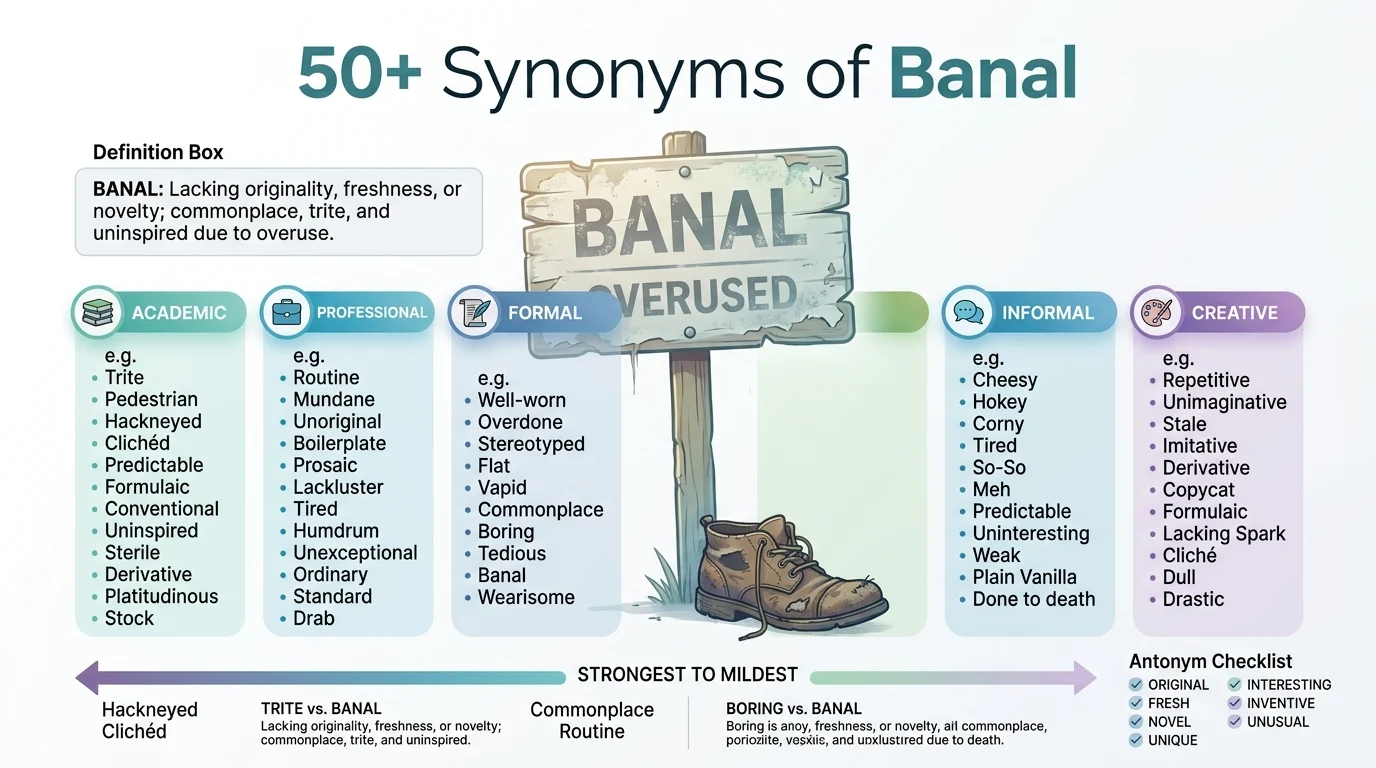
Have you ever struggled to describe a movie, a speech, or a conversation that felt utterly predictable and uninspired? You know something is boring and unoriginal, but calling it “boring” does not quite capture the specific quality of being worn out from overuse. The word “banal” comes to mind. Choosing the right synonym for “banal” can transform a simple critique into a precise description of dullness and lack of originality. This guide explores the best synonyms of banal, explaining exactly which word to use and when.
Quick Ans: “Banal” means boring, ordinary, and not interesting because it is used too often or lacks originality. It is a negative adjective with a formal tone . For professional writing, choose trite or hackneyed. For casual conversation, use boring or dull. In academic contexts, commonplace and stereotypical are strong choices. For a stronger, more dramatic impact, select clichéd or threadbare.
Meaning, Tone, and Context
Understanding the core meaning of “banal” is the first step to using it effectively.
Simple Definition: Dull or stale because of overuse. Devoid of freshness or originality .
Part of Speech: Adjective.
Overall Tone: Negative and critical. It expresses disapproval because something is too ordinary and lacks impact .
Formality Level: Formal. The word is commonly used in literary and critical contexts.
Common Uses: Native English speakers use it to critique creative works, conversations, and ideas that are predictable and unoriginal. For example, “The dialogue in the movie was banal,” or “His speech was full of banal platitudes.”
Word Forms: Related words include the noun banality, the adverb banally, and the noun banalities .
When and How to Use “Banal”
“Banal” is the perfect choice when you want to criticize something for being both dull and unoriginal. Here are seven realistic examples.
Professional: “The consultant’s banal recommendations offered no new solutions.”
Academic: “The study avoided banal conclusions by examining unusual data patterns.”
Workplace: “We need to move beyond banal team-building exercises and try something innovative.”
Personal: “I find small talk about the weather to be incredibly banal.”
Email: “The report was well-written but somewhat banal in its analysis.”
Resume: “Replaced banal job descriptions with dynamic, action-oriented language.”
Social Media: “Tired of the same banal content on my feed. Need some fresh perspectives.”
Best Synonyms of “Banal”
No synonym is identical in every situation. Here is your guide to the best replacement for “banal” based on your writing context.
Professional Writing: Trite. It suggests something has become weak and uninteresting through overuse. “His trite remarks added nothing to the discussion.”
Academic Writing: Commonplace. This is ideal when discussing ideas that are ordinary and not special. “The theory has become commonplace in the field” .
Business Communication: Unoriginal. A practical choice for describing lack of creativity. “The marketing campaign was unoriginal and ineffective.”
Casual Conversation: Boring. It tones down the formality and sounds natural. “The movie was so boring I almost fell asleep.”
Emotional Writing: Clichéd. This word carries a dismissive tone, suggesting something is both overused and annoying. “His clichéd apology made things worse.”
Creative Writing: Hackneyed. It evokes the image of an overworked horse, suggesting something worn out from constant use . “The hackneyed plot failed to impress the audience.”
Resume Writing: Tired. Use it to describe approaches that need updating. “Replaced tired sales strategies with new, effective methods.”
When Not to Use “Banal”
Using “banal” can sound wrong or awkward in certain situations.
When You Mean Simply “Boring”: “Banal” is more than boring; it implies a lack of originality.
Better Choice: Dull or tedious. “The lecture was tedious.”
When You Mean “Ordinary” Without Judgment: “Banal” is always critical.
Better Choice: Common or ordinary. “The design was ordinary.”
When You Need a Stronger Word: “Banal” can be too mild for something truly offensive.
Better Choice: Inane or puerile. “The inane comment was offensive.”
When It Sounds Too Formal: In casual conversation, “banal” sounds pretentious.
Better Choice: Sad or lousy.That joke was so corny.”
Words Commonly Confused With “Banal”
Several words are often mixed up with “banal.” Here is how to keep them straight.
Word: Trite
Difference: Means lacking originality through overuse. “Banal” is the quality; trite describes the result.
When to Use: Use it for comments, phrases, or ideas that have become weak from repetition.
Example: “His trite comments failed to impress” .
Word: Hackneyed
Difference: Means worn out by constant use. “Banal” is the outcome. Hackneyed emphasizes the process.
When to Use: Use this for phrases and plots that are tired and predictable .
Example: “The hackneyed plot was predictable from the start” .
Word: Commonplace
Difference: Means ordinary and not unusual. “Banal” implies a negative judgment. Commonplace is neutral.
When to Use: Use this for things that are simply common.
Example: “Smartphones are commonplace in modern society” .
Word: Clichéd
Difference: Means full of overused expressions. Clichéd focuses on the language.
When to Use: Use this for writing and speech that relies on tired phrases.
Example: “The clichéd dialogue made the film unwatchable.”
Word: Threadbare
Difference: Means worn out and thin. Figuratively, it suggests an argument or idea that is exhausted.
When to Use: Use this for ideas or excuses that have been used too many times.
Example: “His threadbare excuses were no longer acceptable” .
Word: Vapid
Difference: Means lacking flavor or interest. Vapid suggests emptiness, while banal suggests worn-out quality.
When to Use: Use this for things that are flavorless and dull.
Example: “The vapid conversation had no substance.”
Best Synonyms of “Banal” by Context
| Context | Best Synonym | Why It Works | Example |
|---|---|---|---|
| Formal writing | Hackneyed | Suggests ideas worn out from overuse. | “The hackneyed theme failed to resonate.” |
| Academic writing | Commonplace | Neutral yet precise for ordinary concepts. | “The findings were considered commonplace.” |
| Professional communication | Unoriginal | Emphasizes lack of creativity. | “The unoriginal proposal was rejected.” |
| Business emails | Tired | Professional yet critical. | “The tired approach needs updating.” |
| Resume writing | Dull | Describes ineffective strategies. | “Replaced dull presentation methods.” |
| Workplace communication | Predictable | Emphasizes lack of surprise. | “The predictable outcome was expected.” |
| Casual conversation | Corny | Simple, natural, and conversational. | “That is so corny.” |
| Creative writing | Clichéd | Evokes overused expressions. | “The clichéd dialogue ruined the play.” |
| Emotional writing | Trite | Suggests weakness and overuse. | “His trite words could not comfort her.” |
| Strong emphasis | Threadbare | Implies exhausted and worn out. | “The threadbare argument collapsed.” |
| Mild tone | Ordinary | Simple and non-judgmental. | “The meal was ordinary.” |
| Social media captions | Basic | Widely understood and relatable. | “This is too basic for me.” |
How to Choose the Best Synonym of “Banal”
Choosing the right word is a simple decision. Answer these questions.
What is my audience? For a professor or critic, hackneyed or trite is powerful. For a friend, boring or corny is more natural.
What is my purpose? Are you critiquing a creative work, an idea, or a conversation? Use hackneyed for ideas, clichéd for language, and dull for experiences.
Am I describing the content or the impact? For the content, banal or commonplace works. For the impact, tedious or tiresome are better.
What is the emotional strength? Threadbare and hackneyed are stronger. Ordinary and dull are milder. Pick the one that matches your message.
Real Life Examples of “Banal”
To truly master the word, it helps to see how it behaves in the wild and how a stronger synonym can elevate the sentence.
School: Basic: “The essay was banal.” Improved: “The essay was trite and offered no fresh insights.”
College: Basic: “The professor’s lecture was banal.” Improved: “The professor’s lecture was commonplace and covered nothing new” .
Workplace: Basic: “The training was banal.” Improved: “The training was unoriginal and failed to engage employees.”
Business: Basic: “The marketing campaign was banal.” Improved: “The marketing campaign was clichéd and ignored current trends.”
Email: Basic: “The report was banal.” Improved: “The report was tired and offered no actionable insights.”
Conversation: Basic: “The conversation was banal.” Improved: “The conversation was so boring I zoned out.”
Storytelling: Basic: “The plot was banal.” Improved: “The hackneyed plot was predictable from the first chapter” .
Top 10 Synonyms of “Banal”
| Synonym | Simple Meaning | Best Used For | Example Sentence |
|---|---|---|---|
| Trite | Overused and lacking originality | Formal and critical contexts. | “The trite metaphor was ineffective.” |
| Hackneyed | Worn out from overuse | Literary and creative critiques. | “The hackneyed plot was predictable.” |
| Commonplace | Ordinary and not unusual | Neutral and factual contexts. | “The idea is commonplace in the field.” |
| Clichéd | Full of overused expressions | Writing, dialogue, and speech contexts. | “The clichéd dialogue ruined the film.” |
| Threadbare | Worn out and exhausted | Arguments, excuses, and ideas. | “His threadbare excuse was not convincing.” |
| Tired | Lacking energy or freshness | Professional and casual contexts. | “The tired strategy needed an update.” |
| Dull | Lacking interest or excitement | Everyday and casual contexts. | “The lecture was dull and unengaging.” |
| Unoriginal | Lacking creativity | Business and creative contexts. | “The unoriginal design was rejected.” |
| Pedestrian | Lacking imagination | Formal and dismissive contexts. | “His pedestrian style was disappointing.” |
| Stale | No longer fresh | Ideas, humor, and relationships. | “The stale jokes got no laughs.” |
Synonyms of “Banal” by Usage
Professional vs. Personal Synonyms
In the workplace (professional), choose unoriginal, tired, or pedestrian to describe ineffective approaches or work. These words convey critical discernment. “The unoriginal proposal was rejected” is more professional than “The boring proposal was rejected.”
With friends (personal), boring, corny, or sad keep the tone relaxed and relatable. These alternatives sound natural in everyday conversation.
Formal vs. Conversational Synonyms
For formal writing (reports, essays, professional critiques), use hackneyed, trite, or threadbare. These choices maintain the sophisticated tone expected in professional documents .
For casual conversations and texting, use boring, corny, or sad. These options sound more natural and less pretentious.
Academic Synonyms
For research and essays, choose precise, authoritative words. Commonplace is great for ordinary ideas, trite for overused conclusions, and hackneyed for tired arguments. These words sound considered and scholarly.
Using precise academic vocabulary demonstrates expertise and careful thinking. Professors and reviewers expect this level of precision.
Professional and Business Synonyms
For maximum impact in business writing, choose unoriginal for proposals, pedestrian for designs, and tired for strategies. These words demonstrate confidence and professional awareness.
Business leaders respond to language that conveys innovation and freshness. These synonyms project authority.
Creative and Literary Synonyms
To add emotion and imagery to your writing, choose hackneyed, clichéd, or threadbare. These words create atmosphere and develop critique.
Literary writers use these alternatives to build character and theme. They transform ordinary descriptions into evocative prose.
Slang or Modern Synonyms
In modern American slang, basic, corny, or cringe can be used as informal alternatives. For example, “That is so basic,” or “That is corny.” These are acceptable in casual, friendly contexts. Avoid them in professional or academic writing.
Strongest to Mildest Synonyms
Mild: ordinary, dull, commonplace
Moderate: unoriginal, pedestrian, tired
Strong: trite, clichéd, stale
Very Strong: hackneyed, threadbare, shopworn
Emotional vs. Neutral Synonyms
Emotional Synonyms: Hackneyed, threadbare, clichéd. These words often hint at frustration, disappointment, or dismissal. Use them when you want to evoke a critical feeling.
Neutral Synonyms: Commonplace, ordinary, dull. These words simply communicate factual information. Use them when you want to inform without strong emotional coloring.
Antonyms of “Banal”
Here are 15 genuine opposites of “banal” .
| Antonym | Meaning | Example Sentence |
|---|---|---|
| Original | Fresh and new | “The original concept impressed everyone.” |
| Fresh | New and different | “Fresh ideas were needed to save the project.” |
| Innovative | Featuring new methods | “The innovative design won awards.” |
| Groundbreaking | Highly original and important | “The groundbreaking research changed the field.” |
| Novel | New and unusual | “The novel approach solved the problem.” |
| Creative | Using original ideas | “Her creative solution surprised everyone.” |
| Imaginative | Showing creativity | “The imaginative story captured readers.” |
| Inspired | Filled with creativity | “The inspired performance moved the audience.” |
| Unique | Being the only one of its kind | “The unique perspective added value.” |
| Unconventional | Not based on what is usual | “The unconventional method worked.” |
| Piquant | Engagingly stimulating | “The piquant discussion was captivating.” |
| Racy | Lively and exciting | “The racy novel was a bestseller.” |
| Unhackneyed | Not worn out by overuse | “The unhackneyed phrase captured attention.” |
| Trailblazing | Being the first to do something | “The trailblazing initiative set new standards.” |
| Stimulating | Encouraging interest | “The stimulating lecture held attention.” |
Comparison: “Banal” vs Similar Words
Banal vs. Hackneyed
Main Difference: Banal describes the quality of being dull and unoriginal. Hackneyed describes something worn out from overuse .
Which Is Stronger? Hackneyed is stronger and more evocative.
Which Is More Formal? Both are formal, but hackneyed is more literary.
When to Use Each: Use banal for general lack of originality. Use hackneyed for ideas and phrases that have been overused .
Examples:
Banal: “The banal conversation bored everyone.”
Hackneyed: “The hackneyed plot was predictable” .
Banal vs. Trite
Main Difference: Banal means dull and ordinary. Trite specifically means weak because of overuse .
Which Is Stronger? Trite is often stronger and more dismissive.
Which Is More Formal? Both are formal.
When to Use Each: Use banal for general ordinariness. Use trite for comments and phrases that have lost impact .
Examples:
Banal: “The banal speech was forgettable.”
Trite: “His trite remarks added nothing” .
Banal vs. Commonplace
Main Difference: Banal is negative and critical. Commonplace is neutral .
Which Is Stronger? Banal is stronger due to its negative tone.
Which Is More Formal? Both are formal, but commonplace is more academic.
When to Use Each: Use banal when you disapprove. Use commonplace when you are simply stating a fact .
Examples:
Banal: “The banal dialogue ruined the film.”
Commonplace: “Smartphones are commonplace” .
Banal vs. Clichéd
Main Difference: Banal describes overall dullness. Clichéd describes language full of overused expressions.
Which Is Stronger? Clichéd is more specific and often stronger.
Which Is More Formal? Both are formal.
When to Use Each: Use banal for general situations. Use clichéd for writing and speech.
Examples:
Banal: “The banal evening was uneventful.”
Clichéd: “The clichéd dialogue was painful.”
Banal vs. Threadbare
Main Difference: Banal means dull. Threadbare means worn out and exhausted.
Which Is Stronger? Threadbare is stronger and more dramatic.
Which Is More Formal? Both are formal, but threadbare is more literary.
When to Use Each: Use banal for general dullness. Use threadbare for arguments and excuses .
Examples:
Banal: “The banal speech was forgettable.”
Threadbare: “His threadbare excuses failed” .
Common Phrases and Expressions with “Banal”
Phrase: Banal platitudes
Meaning: Dull, unoriginal statements that are supposed to sound wise.
Example Sentence: “The politician’s speech was full of banal platitudes.”
Phrase: Banal conversation
Meaning: Ordinary, uninteresting talk.
Example Sentence: “I try to avoid banal conversation at parties.”
Phrase: Banal and predictable
Meaning: So unoriginal that it is easy to anticipate.
Example Sentence: “The movie was banal and predictable.”
Phrase: The banal
Meaning: Things that are ordinary and uninteresting.
Example Sentence: “The allegations ranged from the banal to the bizarre” .
Common Mistakes to Avoid
Mistake 1: Using “banal” when you mean “boring”.
Incorrect: “The lecture was banal.”
Better: “The lecture was boring.”
Why: Banal implies lack of originality, not just lack of entertainment.
Mistake 2: Using “banal” neutrally.
Incorrect: “The design was banal but functional.”
Better: “The design was ordinary but functional.”
Why: Banal is always critical. Use ordinary for neutral statements.
Mistake 3: Overusing “banal” in casual conversation.
Incorrect: “This pizza is so banal.”
Better: “This pizza is so boring.”
Why: Banal sounds pretentious for everyday things.
Mistake 4: Confusing “hackneyed” with “banal”.
Incorrect: “The hackneyed weather was typical.”
Better: “The banal weather was typical.”
Why: Hackneyed is for overused phrases and ideas, not weather .
Mistake 5: Using “banal” when you mean “unoriginal”.
Incorrect: “The unoriginal work was banal.”
Better: “The work was unoriginal.”
Why: Unoriginal is the cause; banal is the effect.
Frequently Asked Questions
1. What are the best synonyms of “banal”?
The best synonyms depend on your context. For formal writing, choose hackneyed or trite. And for casual conversation, boring or dull are ideal choices. For creative critiques, use clichéd or threadbare .
2. What are the best formal synonyms of “banal”?
The best formal synonyms are hackneyed, trite, and commonplace. These words are suitable for academic papers, professional reports, and business communications .
3. What are common informal synonyms of “banal”?
For informal settings, use boring, corny, or sad. These alternatives sound more natural in everyday conversation.
4. What is another word for “banal” in professional writing?
In professional writing, unoriginal is an excellent choice. It conveys lack of creativity without the literary tone. Pedestrian is also strong for dismissive critiques.
5. What is the difference between “banal” and “hackneyed”?
While both indicate a lack of originality, banal means dull and ordinary . Hackneyed specifically means worn out from overuse, like an overworked horse . Use hackneyed for phrases and plots .
6. What is the opposite of “banal”?
The most direct opposites (antonyms) of banal are original, fresh, and innovative . These words describe things that are new and creative.
Conclusion
“Banal” is a powerful and critical word for describing things that are dull and unoriginal. The term is formal and widely accepted in literary and professional contexts, yet it can sound pretentious in casual conversation. The best choice among the synonyms of banal depends entirely on your audience, tone, and purpose. Remember, no single synonym works perfectly in every situation. Your goal is to choose the word that communicates your message with the most clarity and impact. A practical tip for your vocabulary growth is to pay attention to how critics describe unoriginal work and practice using different synonyms in your writing.
Discover More:
- 50+ Synonyms of Impactful: Meanings, Uses, Examples, and Best Alternatives 2026
- 50+ Synonyms of Required: Meanings, Uses, Examples, and Best Alternatives 2026

Ella Parker is a professional content writer with a passion for creating clear, engaging, and well-researched articles. She focuses on delivering valuable insights and practical information across business, technology, and lifestyle topics.
1 thought on “50+ Synonyms of Banal: Meanings, Uses, Examples, and Best Alternatives 2026”