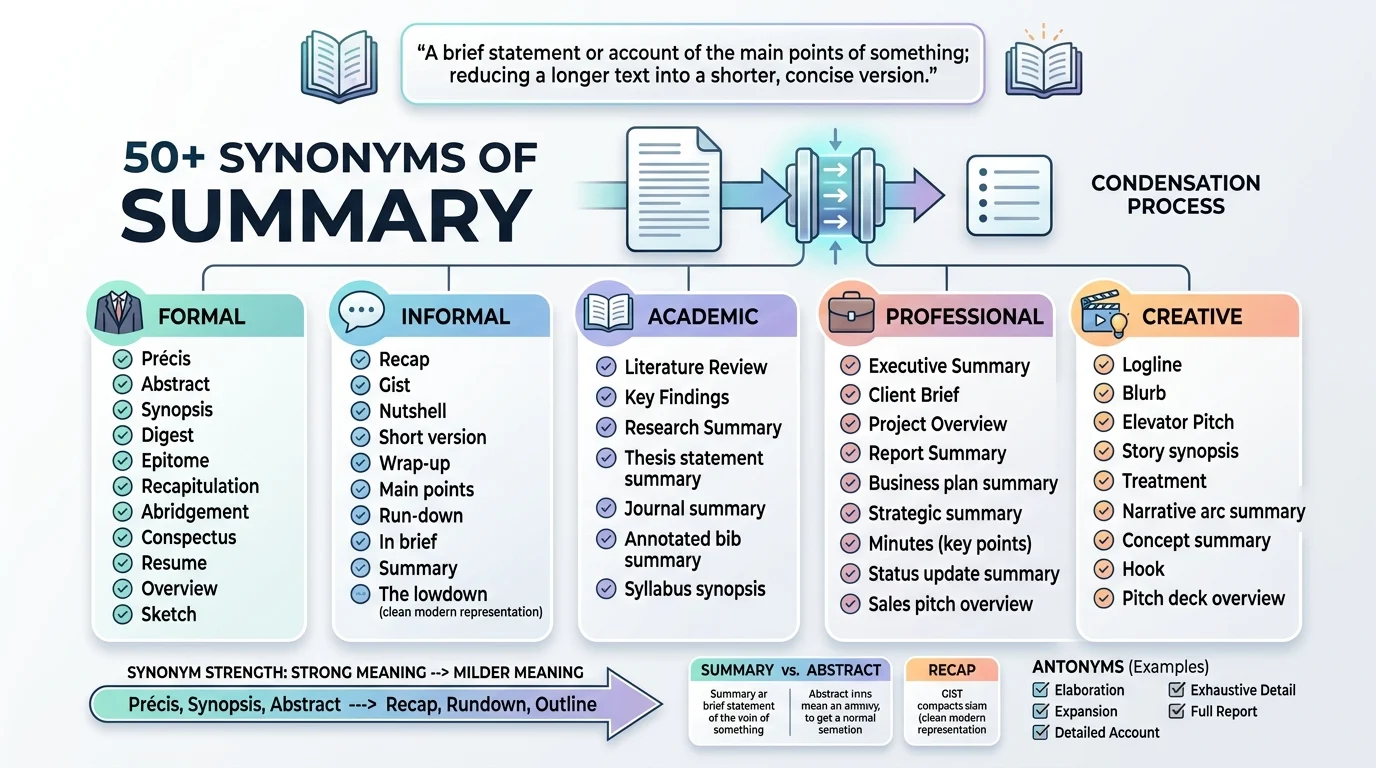
Have you ever needed to condense a lengthy report, article, or presentation into a few concise sentences? You want to present the main points without overwhelming your audience, and the word “summary” comes to mind. But is it the best fit for your context? Choosing the right synonym for “summary” can transform a simple recap into a precise, professional, or creative condensation of information. This guide explores the best synonyms of summary, explaining exactly which word to use and when.
Quick Ans: “Summary” means a brief statement or account that presents the main points of something in a concise form . It is a neutral, versatile noun. For professional writing, choose executive summary or brief. For academic writing, use abstract or synopsis. For casual conversation, recap or rundown are excellent choices. For a formal, comprehensive overview, select compendium or digest. For creative contexts, précis or abridgment work well.
Meaning, Tone, and Context
Understanding the core meaning of “summary” is the first step to using it effectively.
Simple Definition: A brief statement that presents the main points in a concise form . It condenses a larger work into its essential ideas.
Part of Speech: Noun (and adjective).
Overall Tone: Neutral. It simply describes a condensation of information.
Formality Level: Neutral to formal. The word works in most contexts, from casual conversation to academic writing.
Common Uses: Native English speakers use it to describe shortened versions of texts, meetings, presentations, and arguments. For example, “She gave a summary of the meeting,” or “The summary at the end of the chapter was helpful.”
Word Forms: Related words include the verb summarize , the adjective summarized, the noun summarization, and the adverb summarily.
When and How to Use “Summary”
“Summary” is the most common and versatile word in its category. Here are seven realistic examples.
Professional: “The executive summary of the report was distributed to all board members.”
Academic: “Each research paper must include an abstract, which is a concise summary of the study.”
Workplace: “He gave a brief summary of the project’s progress during the meeting.”
Personal: “I need a summary of the movie before I decide whether to watch it.”
Email: “Please provide a summary of the key findings from the client meeting.”
Resume: “Drafted summaries of complex legal documents for executive review.”
Social Media: “Quick summary of my trip: amazing food, beautiful views, and perfect weather.”
Best Synonyms of “Summary”
No synonym is identical in every situation. Here is your guide to the best replacement for “summary” based on your writing context.
Professional Writing: Executive summary. This is a formal, standalone document that highlights the key points of a business report for decision-makers.
Academic Writing: Abstract. This is a highly condensed summary of a scholarly work, including its purpose, methods, and findings .
Business Communication: Brief. A clear, concise summary of information, often used in legal or professional contexts .
Casual Conversation: Recap. A short, informal summary, often used to remind someone of what happened .
Formal Contexts: Synopsis. A compressed summary, especially of the plot of a literary work, play, or movie .
Creative Contexts: Abridgment. A shortened version of a written work that retains its main ideas and structure .
Presentations: Overview. A general summary that gives a broad perspective on a subject .
When Not to Use “Summary”
Using “summary” can sound weak or imprecise in certain situations.
When You Mean a Detailed Outline: A “summary” is brief. A detailed outline is more comprehensive.
Better Choice: Outline or brief. “The lawyer prepared a detailed brief for the argument” .
When Describing a Visual Condensation: “Summary” is textual. Infographic is visual.
Better Choice: Infographic or visual aid. “The infographic summarizes the data effectively.”
When It Sounds Too Vague: “Summary” can be generic. You might need a more specific term.
Better Choice: Digest or compendium. “The digest organizes the material under titles” .
When Describing the Main Idea: “Summary” is a condensation of all main points. Gist is the central idea.
Better Choice: Gist or essence. “The gist of his argument was clear” .
Words Commonly Confused With “Summary”
Several words are often mixed up with “summary.” Here is how to keep them straight.
Word: Synopsis
Difference: Usually refers to the plot of a story or the main points of a subject. It is often shorter than a full summary .
When to Use: Use it for the plot of a book, film, or play.
Example: “The synopsis of Hamlet described the main events of the play.”
Word: Abstract
Difference: A highly condensed summary at the beginning of an academic paper, covering the purpose, methods, and conclusions .
When to Use: Use this for scholarly articles, reports, or theses.
Example: “The abstract of the journal article was only 250 words.”
Word: Brief
Difference: A detailed outline of a discourse, especially a legal argument, organized by headings .
When to Use: Use this for legal arguments or professional summaries.
Example: “The lawyer submitted a thorough brief for the case” .
Word: Digest
Difference: An abridgment or organized arrangement of material, often from multiple sources .
When to Use: Use this for a compilation of information on a topic.
Example: “The Reader’s Digest was a popular compilation of articles.”
Word: Précis
Difference: A formal, concise summary that maintains the structure and tone of the original .
When to Use: Use this for formal summaries, especially of speeches or arguments.
Example: “She wrote a précis of the president’s speech.”
Word: Overview
Difference: A broad, general summary that provides a high-level perspective .
When to Use: Use this for introductions or high-level descriptions.
Example: “The overview of the project gave us a sense of its scope.”
Best Synonyms of “Summary” by Context
| Context | Best Synonym | Why It Works | Example |
|---|---|---|---|
| Formal writing | Compendium | Suggests a comprehensive collection. | “The compendium covered all major theories.” |
| Academic writing | Abstract | The standard for scholarly papers. | “The abstract outlined the study’s methodology.” |
| Professional communication | Executive summary | Standard for business reports. | “The executive summary was distributed to the board.” |
| Business emails | Brief | Concise and professional. | “Please send me a brief of the meeting.” |
| Resume writing | Summary | The standard, expected term. | “Professional summary: experienced project manager.” |
| Workplace communication | Recap | Informal and efficient. | “Let’s do a quick recap of today’s tasks.” |
| Casual conversation | Rundown | Natural and conversational. | “Give me the rundown on what happened.” |
| Creative writing | Abridgment | Precise for shortened literary works. | “The abridgment of the novel was 200 pages.” |
| Storytelling | Synopsis | Perfect for plot summaries. | “The synopsis of the film was intriguing.” |
| Strong emphasis | Summation | Suggests a concluding summary. | “The summation of the argument was powerful.” |
| Mild tone | Outline | Simple and straightforward. | “The outline of the presentation was clear.” |
| Social media captions | Recap | Casual, punchy, and relatable. | “Quick recap of the best moments.” |
How to Choose the Best Synonym of “Summary”
Choosing the right word is a simple decision. Answer these questions.
What is my audience? For a professor or CEO, executive summary or abstract is powerful. For a friend, recap or rundown is more natural.
What is my purpose? Are you trying to inform, persuade, or entertain? Use abstract for information, brief for persuasion, and synopsis for entertainment.
Am I describing a text, an event, or an argument? For texts, abridgment or compendium work well. And for events, recap or rundown are better. For arguments, brief or précis are ideal.
What is the emotional strength? Summation and digest are stronger. Outline and recap are mild. Pick the one that matches your message.
Real Life Examples of “Summary”
To truly master the word, it helps to see how it behaves in the wild and how a stronger synonym can elevate the sentence.
School: Basic: “The student wrote a summary of the chapter.” Improved: “The student wrote a synopsis of the chapter’s main events.”
College: Basic: “The research paper requires a summary.” Improved: “The research paper requires an abstract that summarizes the findings.”
Workplace: Basic: “He gave a summary of the meeting.” Improved: “He gave a recap of the meeting to those who missed it.”
Business: Basic: “The report included a summary.” Improved: “The report included an executive summary for the leadership team.”
Email: Basic: “Please provide a summary of the project.” Improved: “Please provide a brief of the project’s current status.”
Conversation: Basic: “I missed the show. Give me a summary.” Improved: “I missed the show. Give me the rundown.”
Storytelling: Basic: “He gave a summary of his adventure.” Improved: “He gave a précis of his adventure that captured every thrilling detail.”
Top 10 Synonyms of “Summary”
| Synonym | Simple Meaning | Best Used For | Example Sentence |
|---|---|---|---|
| Synopsis | A short summary of the plot | Storytelling, films, and literature. | “The synopsis of the movie was exciting.” |
| Abstract | A concise summary of an academic paper | Scholarly articles, research papers. | “The abstract contained the study’s main conclusions.” |
| Brief | A detailed outline, often legal | Legal arguments, professional summaries. | “The attorney submitted a brief to the court.” |
| Recap | A quick, informal summary | Casual conversation, social media. | “Here’s a recap of the weekend’s events.” |
| Rundown | A concise, informal verbal summary | Presentations, meetings, conversations. | “Give me a rundown of the daily sales.” |
| Outline | The main points or structure of something | Planning, organizing, and teaching. | “The outline of the course covered five topics.” |
| Digest | An organized compilation of information | Compilations, summaries of multiple sources. | “The digest contained summaries of all the articles.” |
| Précis | A formal, concise summary | Formal writing, speeches, academic work. | “The précis of the president’s speech was published.” |
| Abridgment | A shortened version of a written work | Literature, books, and long texts. | “The abridgment of the novel was still long.” |
| Compendium | A comprehensive but concise summary | Comprehensive overviews, reference works. | “The compendium covered all major philosophical theories.” |
Synonyms of “Summary” by Usage
Professional vs. Personal Synonyms
In the workplace (professional), choose executive summary, brief, or digest to present information concisely. These words convey precision and professionalism. “The executive summary of the report was distributed to all board members” is more impactful than “The summary of the report was distributed.”
With friends (personal), recap, rundown, or gist keep the tone relaxed and relatable. These alternatives sound natural in everyday conversation.
Formal vs. Conversational Synonyms
For formal writing (reports, essays, professional documents), use abstract, synopsis, or précis. These choices maintain the sophisticated tone expected in professional documents.
For casual conversations and texting, use recap, rundown, or quick summary. These options sound more natural and less pretentious.
Academic Synonyms
For research and essays, choose precise, authoritative words. Abstract is great for scholarly papers , synopsis for plot summaries , and précis for formal condensation . These words sound considered and scholarly.
Using precise academic vocabulary demonstrates expertise and careful thinking. Professors and reviewers expect this level of precision.
Professional and Business Synonyms
For maximum impact in business writing, choose executive summary for reports, brief for legal or business documents, and digest for compilations . These words demonstrate confidence and professional awareness.
Business leaders respond to language that conveys clarity and efficiency. These synonyms project authority.
Creative and Literary Synonyms
To add depth and sophistication to your writing, choose abridgment, précis, or compendium. These words create atmosphere and demonstrate literary knowledge.
Literary writers use these alternatives to describe their own work or the work of others. They transform ordinary descriptions into precise, evocative prose.
Slang or Modern Synonyms
In modern American slang, recap and rundown are the most common informal alternatives. Lowdown is also used to mean the essential information or summary . For example, “Give me the lowdown on the situation.” These are acceptable in casual, friendly contexts. Avoid them in professional or academic writing.
Strongest to Mildest Synonyms
Mild: recap, rundown, outline
Moderate: summary, brief, overview
Strong: abstract, synopsis, précis
Very Strong: compendium, digest, abridgment
Emotional vs. Neutral Synonyms
Emotional Synonyms: Summation, recapitulation. These words often hint at a dramatic or concluding moment. Use them when you want to evoke a sense of finality or closure.
Neutral Synonyms: Summary, outline, overview. These words simply communicate factual information. Use them when you want to inform without emotional coloring.
Antonyms of “Summary”
Here are 15 genuine opposites of “summary.”
| Antonym | Meaning | Example Sentence |
|---|---|---|
| Full text | The complete, unabridged version | “The full text of the report was 500 pages.” |
| Elaboration | Detailed explanation | “The elaboration of the theory filled three volumes.” |
| Expansion | The act of expanding | “The expansion of the chapter added new material.” |
| Original | The source document | “The original is available in the library.” |
| Enlargement | Making larger or more detailed | “The enlargement of the article was unnecessary.” |
| Amplification | Extending or making more comprehensive | “The amplification of the argument added clarity.” |
| Enhancement | Adding detail or value | “The enhancement of the document was time-consuming.” |
| Supplement | Additional material | “The supplement to the report was 50 pages.” |
| Addendum | Something added to the end | “The addendum updated the statistics.” |
| Appendix | Additional information at the end of a book | “The appendix contained the raw data.” |
| Prolixity | Excessive wordiness | “The prolixity of the speech tired the audience.” |
| Verbiage | Excessive use of words | “The verbiage of the contract was overwhelming.” |
| Diffuseness | Spreading out, not concise | “The diffuseness of the writing made it hard to read.” |
| Abundance | A large quantity | “The abundance of information was difficult to process.” |
| Expansiveness | Covering a large amount of material | “The expansiveness of the work made it a challenge.” |
Comparison: “Summary” vs Similar Words
Summary vs. Synopsis
Main Difference: Summary is general. Synopsis specifically refers to the plot of a literary work, play, or movie .
Which Is Stronger? Both are similar in strength. Synopsis is more specific to narrative.
Which Is More Formal? Both are formal, but synopsis has a more literary tone.
When to Use Each: Use summary for any condensation. Use synopsis for story plots.
Examples:
Summary: “This is a summary of the meeting.”
Synopsis: “This is a synopsis of the film.”
Summary vs. Abstract
Main Difference: Summary is general. Abstract is specifically used for academic papers .
Which Is Stronger? Abstract is more precise and authoritative.
Which Is More Formal? Abstract is more formal and academic.
When to Use Each: Use summary for any context. Use abstract for research papers.
Examples:
Summary: “Here is a summary of the report.”
Abstract: “Here is the abstract of the journal article.”
Summary vs. Brief
Main Difference: Summary is general. Brief often refers to a legal or professional document .
Which Is Stronger? Brief is more formal and structured.
Which Is More Formal? Brief is more formal and associated with law.
When to Use Each: Use summary for any condensation. Use brief for legal or professional contexts.
Examples:
Summary: “He gave a summary of the project.”
Brief: “The lawyer submitted a brief to the court.”
Summary vs. Digest
Main Difference: Summary is a single condensation. Digest is an organized compilation from multiple sources .
Which Is Stronger? Digest is more comprehensive.
Which Is More Formal? Both are formal.
When to Use Each: Use summary for a single work. Use digest for a compilation.
Examples:
Summary: “The summary of the article was helpful.”
Digest: “The digest covered all the important articles.”
Summary vs. Abridgment
Main Difference: Summary is a brief account. Abridgment is a shortened version of a written work .
Which Is Stronger? Abridgment is more comprehensive.
Which Is More Formal? Abridgment is more formal and literary.
When to Use Each: Use summary for any condensation. Use abridgment for shortened books.
Examples:
Summary: “The summary covered the main points.”
Abridgment: “The abridgment of the novel was 200 pages.”
Summary vs. Précis
Main Difference: Summary is general. Précis is a formal, concise summary that maintains structure .
Which Is Stronger? Précis is more formal and precise.
Which Is More Formal? Précis is very formal and literary.
When to Use Each: Use summary for any context. Use précis for formal summaries.
Examples:
Summary: “Here is a summary of the speech.”
Précis: “The précis of the speech captured its structure.”
Common Phrases and Expressions with “Summary”
Phrase: Executive summary
Meaning: A concise summary of a business report for decision-makers.
Example Sentence: “The executive summary highlighted the key financial projections.”
Phrase: In summary
Meaning: Used to introduce a concluding summary .
Example Sentence: “In summary, we need to increase our marketing efforts.”
Phrase: To sum up
Meaning: Used to introduce a final summary.
Example Sentence: “To sum up, the project was a success” .
Phrase: Summary judgment
Meaning: A legal decision without a full trial.
Example Sentence: “The court granted summary judgment in favor of the defendant.”
Phrase: Brief summary
Meaning: A very short summary.
Example Sentence: “He gave a brief summary of the article.”
Phrase: Comprehensive summary
Meaning: A detailed summary covering all major points.
Example Sentence: “The comprehensive summary was 20 pages long.”
Common Mistakes to Avoid
Mistake 1: Using “summary” when you mean “abstract”.
Incorrect: “The summary of the research paper was at the beginning.”
Better: “The abstract of the research paper was at the beginning” .
Why: Abstract is the specific term for academic summaries.
Mistake 2: Using “summary” when you mean “synopsis”.
Incorrect: “The summary of the movie was short.”
Better: “The synopsis of the movie was short” .
Why: Synopsis is the specific term for plot summaries.
Mistake 3: Overusing “summary” in conversation.
Incorrect: “Give me a summary of the party.”
Better: “Give me a recap of the party.”
Why: Recap sounds more natural in casual conversation.
Mistake 4: Using “abridgment” for a short summary.
Incorrect: “The abridgment of the report was one page.”
Better: “The summary of the report was one page.”
Why: Abridgment is for shortened versions of full works.
Mistake 5: Confusing “digest” and “summary”.
Incorrect: “The digest of the article was helpful.”
Better: “The summary of the article was helpful.”
Why: Digest is a compilation, not a condensation of a single work.
Frequently Asked Questions
1. What are the best synonyms of “summary”?
The best synonyms depend on your context. For formal writing, choose abstract or synopsis. And for casual conversation, recap or rundown are ideal choices. For professional contexts, use executive summary or brief.
2. What are the best formal synonyms of “summary”?
The best formal synonyms are abstract, synopsis, and précis. These words are suitable for academic papers, professional reports, and literary contexts.
3. What are common informal synonyms of “summary”?
For informal settings, use recap, rundown, or lowdown. These alternatives sound more natural in everyday conversation.
4. What is another word for “summary” in professional writing?
In professional writing, executive summary is the standard term for business reports. Brief is also strong for legal or professional contexts.
5. What is the difference between “summary” and “abstract”?
While both are condensations, summary is a general term. Abstract specifically refers to a concise summary at the beginning of an academic paper . Use abstract for scholarly works.
6. What is the opposite of “summary”?
The most direct opposites (antonyms) of summary are full text, elaboration, and expansion. These words describe detailed, unabridged versions of material.
Conclusion
“Summary” is a versatile and essential word for condensing information and presenting key points. The term is neutral and widely understood, yet it can sound imprecise or informal in certain contexts. The best choice among the synonyms of summary depends entirely on your audience, tone, and purpose. Remember, no single synonym works perfectly in every situation. Your goal is to choose the word that communicates your message with the most clarity and impact. A practical tip for your vocabulary growth is to pay attention to how different types of writing condense information and practice using the appropriate synonym for each context.
Discover More:
- 50+ Synonyms of Unfair: Meanings, Uses, Examples, and Best Alternatives
- 50+ Synonyms of Inherently: Meanings, Uses, Examples, and Best Alternatives

Amelia Brooks is a professional content writer and digital publishing specialist with a passion for creating clear, engaging, and informative content. She has extensive experience writing about technology, business, lifestyle, and online services.
1 thought on “50+ Synonyms of Summary: Meanings, Uses, Examples, and Best Alternatives 2026”