Have you ever needed to describe someone who tries too hard to impress others but felt that “showy” or “arrogant” did not quite capture the nuance? You want to highlight ostentation or false importance, and the word “pretentious” comes to mind. But is it the best fit for your audience? Choosing the right synonym for “pretentious” can transform a simple criticism into a precise description of vanity, affectation, or grandiosity. This guide explores the best synonyms of pretentious, explaining exactly which word to use and when.
Quick Ans: “Pretentious” means attempting to impress by affecting greater importance, talent, or culture than is actually possessed. It is a negative, critical adjective. For formal writing, choose ostentatious or grandiose. For casual conversation, use showy or phony. In academic contexts, affected and pompous are strong choices. For a stronger, more dramatic impact, select grandiloquent or highfalutin.
Meaning, Tone, and Context
Understanding the core meaning of “pretentious” is the first step to using it effectively.
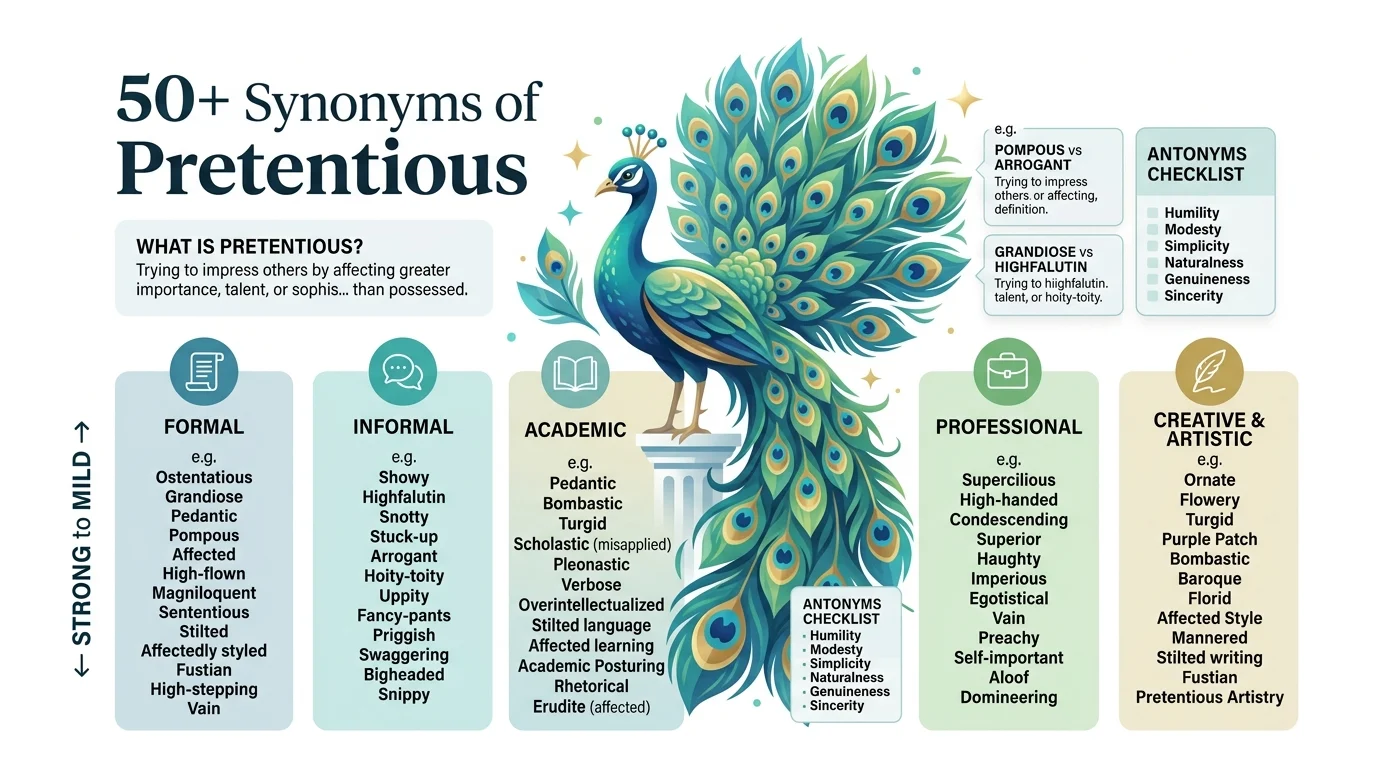
Simple Definition: Trying to appear more important, intelligent, or cultured than one really is. False show of importance.
Part of Speech: Adjective.
Overall Tone: Negative and critical. It implies insincerity and overestimation of one’s own importance.
Formality Level: Formal to neutral. The word is used in both professional and everyday contexts.
Common Uses: Native English speakers use it to criticize people, art, writing, or behavior that seems inflated or insincere. For example, “His pretentious speech bored everyone,” or “The pretentious restaurant was overpriced.”
Word Forms: Related words include the noun pretension (or pretentiousness) and the adverb pretentiously.
When and How to Use “Pretentious”
“Pretentious” is the perfect choice when you want to criticize someone or something for being falsely impressive. Here are seven realistic examples.
Professional: “The pretentious presentation used jargon to mask a lack of substance.”
Academic: “The student’s pretentious essay was filled with fancy words that added no value.”
Workplace: “His pretentious attitude alienated his colleagues and frustrated his team.”
Personal: “She stopped attending the book club because of the pretentious discussions.”
Email: “I found the proposal a bit pretentious. It promised more than it could deliver.”
Resume: “Avoid pretentious language in your resume. Focus on concrete achievements.”
Social Media: “That pretentious quote feels out of touch with reality.”
Best Synonyms of “Pretentious”
No synonym is identical in every situation. Here is your guide to the best replacement for “pretentious” based on your writing context.
Professional Writing: Ostentatious. It suggests a flashy, showy display of wealth or importance. “The ostentatious office design distracted from the work.”
Academic Writing: Affected. This is ideal when discussing artificial behavior or insincere displays. “The affected language of the poem felt inauthentic.”
Business Communication: Pompous. A practical choice for criticizing self-importance. “His pompous speech alienated the board members.”
Casual Conversation: Showy. It tones down the formality and sounds natural. “That showy display of wealth was unnecessary.”
Emotional Writing: Grandiose. This word carries weight, suggesting exaggerated importance and unreality. “His grandiose claims were met with skepticism.”
Creative Writing: Grandiloquent. It implies pompous, inflated language. “The grandiloquent speech was full of empty rhetoric.”
Resume Writing: Avoid this word entirely. Choose confident or accomplished instead, and let achievements speak for themselves.
When Not to Use “Pretentious”
Using “pretentious” can sound wrong or inappropriate in certain situations.
When It Sounds Too Harsh: “Pretentious” is a strong criticism.
Better Choice: Showy or flashy. “Her dress was a bit too flashy for the occasion.”
When You Mean Confident: Confidence is positive. Pretension is false.
Better Choice: Confident or self-assured. “He is a confident leader.”
When Describing Someone Who Is Genuinely Accomplished: Pretension implies falseness.
Better Choice: Accomplished or distinguished. “She is a distinguished scholar.”
When It Sounds Too Formal: In casual conversation, “pretentious” can sound academic.
Better Choice: Snobby or phony. “He comes across as a bit snobby.”
Words Commonly Confused With “Pretentious”
Several words are often mixed up with “pretentious.” Here is how to keep them straight.
Word: Pompous
Difference: Means self-important and arrogant. “Pretentious” implies false claims.
When to Use: Use it for people who act overly important.
Example: “The pompous manager lectured his team.”
Word: Ostentatious
Difference: Means showy and flashy. “Pretentious” is about false claims.
When to Use: Use this for displays of wealth or status.
Example: “The ostentatious mansion was built to impress.”
Word: Affected
Difference: Means artificial and insincere. “Pretentious” is about false importance.
When to Use: Use this for behavior that seems forced.
Example: “Her affected laugh irritated him.”
Word: Grandiose
Difference: Means impressive and ambitious. “Pretentious” implies false exaggeration.
When to Use: Use this for exaggerated plans or claims.
Example: “His grandiose plans were unrealistic.”
Word: Snobby
Meaning: Looks down on others. “Pretentious” is about false claims.
When to Use: Use this for people who act superior.
Example: “The snobby waiter ignored us.”
Word: Grandiloquent
Difference: Means using pompous language. “Pretentious” is broader.
When to Use: Use this for overly fancy speech or writing.
Example: “The grandiloquent speech was hard to follow.”
Best Synonyms of “Pretentious” by Context
| Context | Best Synonym | Why It Works | Example |
|---|---|---|---|
| Formal writing | Ostentatious | Suggests flashy display. | “The ostentatious building was controversial.” |
| Academic writing | Affected | Precise for insincerity. | “The affected tone of the paper weakened it.” |
| Professional communication | Pompous | Criticizes self-importance. | “His pompous attitude cost him respect.” |
| Business emails | Showy | Professional yet critical. | “The showy proposal lacked substance.” |
| Resume writing | None | Avoid entirely. | “Let your achievements speak for themselves.” |
| Workplace communication | Overbearing | Emphasizes dominance. | “His overbearing style frustrated the team.” |
| Casual conversation | Phony | Simple, natural, and critical. | “He is so phony when he talks about art.” |
| Creative writing | Grandiloquent | Evokes inflated language. | “The grandiloquent dialogue was unrealistic.” |
| Emotional writing | Grandiose | Suggests unrealistic importance. | “His grandiose claims were delusional.” |
| Strong emphasis | Highfalutin | Very strong, informal criticism. | “Her highfalutin ideas annoyed everyone.” |
| Mild tone | Showy | Simple and non-judgmental. | “The showy decorations were a bit much.” |
| Social media captions | Cringe | Modern, critical, and relatable. | “That post was so cringe and pretentious.” |
How to Choose the Best Synonym of “Pretentious”
Choosing the right word is a simple decision. Answer these questions.
What is my audience? For a professor or CEO, ostentatious or pompous is powerful. For a friend, phony or showy is more natural.
What is my purpose? Are you criticizing language, behavior, or appearance? Use grandiloquent for language, pompous for behavior, and ostentatious for appearance.
Am I describing a person or a thing? For people, pompous or snobby work well. For things, showy or flashy are better.
What is the emotional strength? Grandiose and grandiloquent are stronger. Showy and flashy are mild. Pick the one that matches your message.
Real Life Examples of “Pretentious”
To truly master the word, it helps to see how it behaves in the wild and how a stronger synonym can elevate the sentence.
School: Basic: “The student’s pretentious writing annoyed the teacher.” Improved: “The student’s affected writing annoyed the teacher with its artificial complexity.”
College: Basic: “His pretentious essay was filled with jargon.” Improved: “His grandiloquent essay was filled with jargon and empty rhetoric.”
Workplace: Basic: “His pretentious attitude alienated his team.” Improved: “His pompous attitude alienated his team and cost him their trust.”
Business: Basic: “The pretentious advertisement was ineffective.” Improved: “The ostentatious advertisement alienated its target audience.”
Email: Basic: “The pretentious proposal was unrealistic.” Improved: “The grandiose proposal was unrealistic and lacked substance.”
Conversation: Basic: “He is so pretentious about wine.” Improved: “He is so snobby about wine; he acts like he knows everything.”
Storytelling: Basic: “The pretentious speaker droned on.” Improved: “The pompous speaker droned on, full of self-importance.”
Top 10 Synonyms of “Pretentious”
| Synonym | Simple Meaning | Best Used For | Example Sentence |
|---|---|---|---|
| Ostentatious | Showy to impress | Appearance, wealth, and display contexts. | “The ostentatious mansion was meant to impress.” |
| Pompous | Self-important and arrogant | Behavior, speech, and character contexts. | “The pompous manager lectured his team.” |
| Affected | Artificial and insincere | Behavior, art, and academic contexts. | “Her affected mannerisms were off-putting.” |
| Grandiose | Exaggeratedly important | Plans, claims, and delusions of grandeur. | “His grandiose plans were completely unrealistic.” |
| Grandiloquent | Pompous and inflated language | Writing, speech, and literary contexts. | “The grandiloquent speech was full of hot air.” |
| Showy | Flashy and ostentatious | Casual conversation and appearance. | “The showy car was a waste of money.” |
| Phony | False and insincere | Casual conversation and personal criticism. | “He is so phony when he talks about art.” |
| Snobby | Looking down on others | Social situations and personal criticism. | “The snobby waiter ignored us.” |
| Highfalutin | Pompous and pretentious language | Informal, strong criticism. | “Her highfalutin ideas alienated everyone.” |
| Overblown | Exaggerated and excessive | Criticism of language, claims, and style. | “The overblown speech lacked substance.” |
Synonyms of “Pretentious” by Usage
Professional vs. Personal Synonyms
In the workplace (professional), choose pompous, ostentatious, or overbearing to criticize self-importance. These words convey precise criticism. “His pompous leadership style alienated the team” is more professional than “His phony attitude alienated the team.”
With friends (personal), phony, snobby, or showy keep the tone relaxed and relatable. These alternatives sound natural in everyday conversation.
Formal vs. Conversational Synonyms
For formal writing (reports, essays, professional emails), use ostentatious, grandiose, or pompous. These choices maintain the sophisticated tone expected in professional documents.
For casual conversations and texting, use phony, showy, or snobby. These options sound more natural and less pretentious.
Academic Synonyms
For research and essays, choose precise, authoritative words. Affected is great for insincerity, grandiloquent for language, and ostentatious for display. These words sound considered and scholarly.
Using precise academic vocabulary demonstrates expertise and careful thinking. Professors and reviewers expect this level of precision.
Professional and Business Synonyms
For maximum impact in professional writing, choose pompous for behavior, ostentatious for display, and overbearing for style. These words demonstrate confidence and professional awareness.
Business leaders respond to language that conveys precision and directness. These synonyms project authority.
Creative and Literary Synonyms
To add emotion and imagery to your writing, choose grandiloquent, grandiose, or affected. These words create atmosphere and develop character.
Literary writers use these alternatives to build personality and theme. They transform ordinary descriptions into evocative prose.
Slang or Modern Synonyms
In modern American slang, cringe, try-hard, or extra are sometimes used as informal alternatives. For example, “That post is so cringe,” or “She is so extra with her luxury posts.” These are acceptable in casual, friendly contexts. Avoid them in professional or academic writing.
Strongest to Mildest Synonyms
Mild: showy, flashy, snobby
Moderate: pompous, affected, pretentious
Strong: ostentatious, grandiose, overbearing
Very Strong: grandiloquent, highfalutin, overblown
Emotional vs. Neutral Synonyms
Emotional Synonyms: Grandiose, grandiloquent, affected. These words often hint at disdain, mockery, or criticism. Use them when you want to evoke feeling.
Neutral Synonyms: Showy, flashy, overblown. These words simply communicate factual information. Use them when you want to inform without emotional coloring.
Antonyms of “Pretentious”
Here are 15 genuine opposites of “pretentious.”
| Antonym | Meaning | Example Sentence |
|---|---|---|
| Humble | Modest and unassuming | “The humble leader did not seek attention.” |
| Modest | Not boastful or showy | “Her modest demeanor was appreciated.” |
| Authentic | Genuine and real | “The authentic performance moved everyone.” |
| Sincere | Honest and genuine | “His sincere apology was accepted.” |
| Down-to-earth | Practical and realistic | “She is a down-to-earth person.” |
| Unassuming | Not pretentious or arrogant | “The unassuming professor was brilliant.” |
| Natural | Not artificial or affected | “Her natural charisma won everyone over.” |
| Simple | Not elaborate or showy | “The simple design was elegant.” |
| Modest | Moderate and unpretentious | “The modest house was comfortable.” |
| Genuine | Real and sincere | “His genuine kindness was refreshing.” |
| Uppretentious | Not pretentious | “The unpretentious restaurant served great food.” |
| Real | Genuine and authentic | “She is a real, down-to-earth person.” |
| Honest | Truthful and straightforward | “His honest feedback was valuable.” |
| Approachable | Easy to talk to | “The approachable leader inspired loyalty.” |
| Easygoing | Relaxed and informal | “The easygoing atmosphere made everyone comfortable.” |
Comparison: “Pretentious” vs Similar Words
Pretentious vs. Pompous
Main Difference: Pretentious is about false claims. Pompous is about self-importance.
Which Is Stronger? Pompous is stronger for arrogance.
Which Is More Formal? Both are formal.
When to Use Each: Use pretentious for false claims. Use pompous for arrogant behavior.
Examples:
Pretentious: “His pretentious claim about his wealth was false.”
Pompous: “His pompous attitude alienated everyone.”
Pretentious vs. Ostentatious
Main Difference: Pretentious is about false claims. Ostentatious is about showy display.
Which Is Stronger? Ostentatious is stronger for visual display.
Which Is More Formal? Both are formal.
When to Use Each: Use pretentious for false importance. Use ostentatious for flashy display.
Examples:
Pretentious: “His pretentious lifestyle was all a facade.”
Ostentatious: “The ostentatious mansion was built to impress.”
Pretentious vs. Affected
Main Difference: Pretentious is about false importance. Affected is about artificial behavior.
Which Is Stronger? Pretentious is stronger for claims. Affected is about behavior.
Which Is More Formal? Both are formal, but affected is more academic.
When to Use Each: Use pretentious for claims. Use affected for behavior.
Examples:
Pretentious: “His pretentious speech was empty.”
Affected: “Her affected laugh was annoying.”
Pretentious vs. Grandiose
Main Difference: Pretentious is false importance. Grandiose is exaggerated importance.
Which Is Stronger? Grandiose is stronger and more unrealistic.
Which Is More Formal? Both are formal.
When to Use Each: Use pretentious for false claims. Use grandiose for exaggerated plans.
Examples:
Pretentious: “His pretentious title meant nothing.”
Grandiose: “His grandiose plans were impossible.”
Pretentious vs. Snobby
Main Difference: Pretentious is about false claims. Snobby is about looking down on others.
Which Is Stronger? Pretentious is more intellectual. Snobby is more social.
Which Is More Formal? Pretentious is formal. Snobby is informal.
When to Use Each: Use pretentious for claims. Use snobby for social behavior.
Examples:
Pretentious: “His pretentious art criticism was hollow.”
Snobby: “The snobby waiter ignored us.”
Pretentious vs. Grandiloquent
Main Difference: Pretentious is about importance. Grandiloquent is about language.
Which Is Stronger? Grandiloquent is stronger for language criticism.
Which Is More Formal? Grandiloquent is very formal.
When to Use Each: Use pretentious for general criticism. Use grandiloquent for language.
Examples:
Pretentious: “His pretentious attitude was tiresome.”
Grandiloquent: “His grandiloquent speech was all style, no substance.”
Common Phrases and Expressions with “Pretentious”
Phrase: Pretentious attitude
Meaning: A false display of importance.
Example Sentence: “His pretentious attitude annoyed everyone in the room.”
Phrase: Pretentious art
Meaning: Art that tries too hard to be deep.
Example Sentence: “The pretentious art installation was widely mocked.”
Phrase: Pretentious language
Meaning: Overly fancy or academic language used to impress.
Example Sentence: “The pretentious language of the report made it hard to read.”
Phrase: Pretentious behavior
Meaning: Actions intended to appear more important.
Example Sentence: “Her pretentious behavior alienated her friends.”
Phrase: Pretentious claim
Meaning: A claim of importance that is false.
Example Sentence: “His pretentious claim about his ancestry was proven false.”
Common Mistakes to Avoid
Mistake 1: Using “pretentious” when you mean “confident”.
Incorrect: “He is a pretentious leader.”
Better: “He is a confident leader.”
Why: Confidence is positive. Pretension is false.
Mistake 2: Using “pretentious” when you mean “showy”.
Incorrect: “The pretentious car was expensive.”
Better: “The showy car was expensive.”
Why: Showy is about appearance. Pretentious is about false claims.
Mistake 3: Overusing “pretentious” in casual conversation.
Incorrect: “That is a pretentious thing to say.”
Better: “That is a phony thing to say.”
Why: Phony sounds more natural in casual conversation.
Mistake 4: Using “pretentious” on your resume.
Incorrect: “I am pretentious about my achievements.”
Better: “I am proud of my achievements.”
Why: Pretentious is negative. Proud is positive.
Mistake 5: Confusing “grandiose” with “pretentious”.
Incorrect: “His grandiose attitude was annoying.”
Better: “His pretentious attitude was annoying.”
Why: Grandiose is about plans. Pretentious is about claims.
Frequently Asked Questions
1. What are the best synonyms of “pretentious”?
The best synonyms depend on your context. For formal writing, choose ostentatious or pompous. And for casual conversation, phony or showy are ideal choices. For language criticism, use grandiloquent.
2. What are the best formal synonyms of “pretentious”?
The best formal synonyms are ostentatious, pompous, and grandiose. These words are suitable for academic papers, professional reports, and business communications.
3. What are common informal synonyms of “pretentious”?
For informal settings, use phony, showy, or snobby. These alternatives sound more natural in everyday conversation.
4. What is another word for “pretentious” in professional writing?
In professional writing, pompous is an excellent choice. It conveys self-importance and arrogance in a precise, professional way.
5. What is the difference between “pretentious” and “ostentatious”?
While both indicate showiness, pretentious is about false claims of importance. Ostentatious is about flashy display. Use ostentatious for visual display and pretentious for false importance.
6. What is the opposite of “pretentious”?
The most direct opposites (antonyms) of pretentious are humble, modest, and unpretentious. These words describe people who do not show false importance.
Conclusion
“Pretentious” is a sharp and useful word for describing false importance and insincerity. The term is formal and widely accepted in critical contexts, yet it can sound too harsh for mild criticism or too formal for casual conversation. The best choice among the synonyms of pretentious depends entirely on your audience, tone, and purpose. Remember, no single synonym works perfectly in every situation. Your goal is to choose the word that communicates your message with the most clarity and impact. A practical tip for your vocabulary growth is to pay attention to how critics and writers describe insincerity and practice using different synonyms in your writing.
Discover More:
- 50+ Synonyms of Goal: Meanings, Uses, Examples, and Best Alternatives 2026
- 50+ Synonyms of Developed: Meanings, Uses, Examples, and Best Alternatives 2026

Alexander Cole is a professional content writer and researcher who specializes in creating informative, reader-friendly, and well-researched articles. He is committed to publishing accurate, valuable, and engaging content that helps readers stay informed and make smarter decisions.