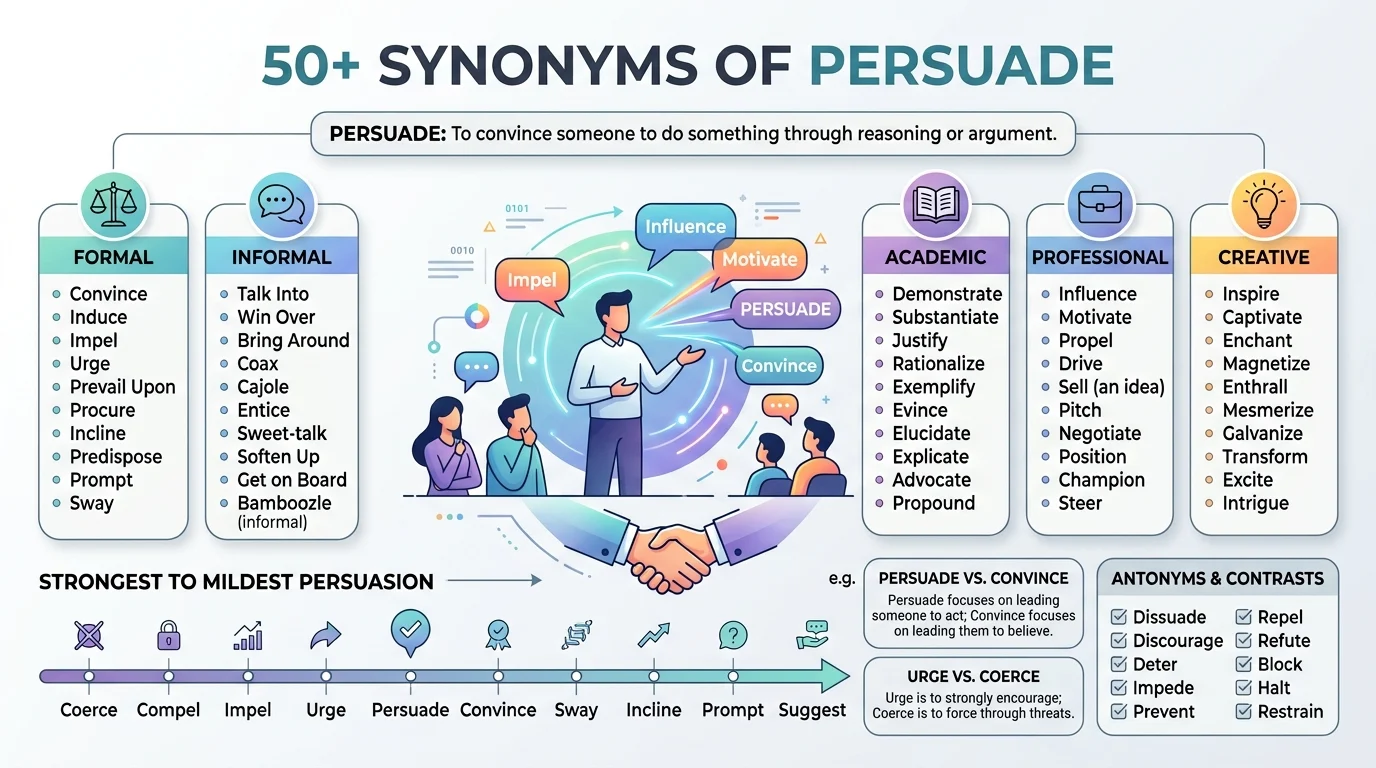
Have you ever needed to convince someone to see things your way but felt that “convince” or “influence” did not fully capture the nuance? You want to describe the act of changing minds or gaining agreement, and the word “persuade” comes to mind. But is it the best fit for your audience? Choosing the right synonym for “persuade” can transform a simple statement into a precise description of influence, negotiation, or advocacy. This guide explores the best synonyms of persuade, explaining exactly which word to use and when.
Quick Ans: “Persuade” means to cause someone to do something through reasoning, argument, or appeal. It is a neutral verb. For formal writing, choose convince or induce. For casual conversation, use talk into or win over. In academic contexts, influence and sway are strong choices. For a stronger, more dramatic impact, select compel or prevail upon.
Meaning, Tone, and Context
Understanding the core meaning of “persuade” is the first step to using it effectively.
Simple Definition: To cause someone to believe or do something through reasoning, argument, or request.
Part of Speech: Verb.
Overall Tone: Neutral. The word describes an action without positive or negative judgment.
Formality Level: Neutral to formal. The word works in most contexts.
Common Uses: Native English speakers use it in discussions of influence, marketing, and personal relationships. For example, “I persuaded him to join the team,” or “The ad persuaded many people to buy the product.”
Word Forms: Related words include the noun persuasion, the adjective persuasive, and the adverb persuasively.
When and How to Use “Persuade”
“Persuade” is the perfect choice when you want to describe the act of convincing someone. Here are seven realistic examples.
Professional: “She persuaded the board to approve the new strategy.”
Academic: “The researcher persuaded his colleagues to reconsider their hypothesis.”
Workplace: “He persuaded the team to adopt a new workflow.”
Personal: “I persuaded my friend to try the new restaurant.”
Email: “I hope I can persuade you to review the proposal before the deadline.”
Resume: “Persuaded stakeholders to invest $1 million in the project.”
Social Media: “The influencer persuaded her followers to buy the product.”
Best Synonyms of “Persuade”
No synonym is identical in every situation. Here is your guide to the best replacement for “persuade” based on your writing context.
Professional Writing: Convince. It suggests bringing someone to a belief. “She convinced the committee of her plan’s merits.”
Academic Writing: Induce. This is ideal when discussing cause and effect in research. “The experiment induced a change in behavior.”
Business Communication: Influence. A practical choice for leadership and marketing. “The campaign influenced consumer behavior.”
Casual Conversation: Talk into. It tones down the formality and sounds natural. “He talked me into going to the party.”
Emotional Writing: Inspire. This word carries weight, suggesting motivation through emotion. “Her words inspired the team to continue.”
Creative Writing: Entice. It implies drawing someone through attraction. “The aroma enticed customers into the bakery.”
Resume Writing: Negotiate. Use it to describe achieving agreement through discussion. “Negotiated a deal that satisfied all parties.”
When Not to Use “Persuade”
Using “persuade” can sound wrong or awkward in certain situations.
When You Mean Force: “Persuade” is about agreement, not force.
Better Choice: Compel or force. “The law compels citizens to pay taxes.”
When It Sounds Too Formal: In casual conversation, “persuade” sounds stiff.
Better Choice: Talk into or convince. “I convinced him to help me.”
When You Mean Offer: “Persuade” is about reasoning, not offering.
Better Choice: Tempt or entice. “The offer tempted me to apply.”
When It Is Too Manipulative: “Persuade” can sound manipulative in some contexts.
Better Choice: Encourage or support. “We encourage everyone to participate.”
Words Commonly Confused With “Persuade”
Several words are often mixed up with “persuade.” Here is how to keep them straight.
Word: Convince
Difference: Means to cause someone to believe something. “Persuade” can also mean to cause someone to act.
When to Use: Use it for changing beliefs or opinions.
Example: “She convinced me that she was right.”
Word: Influence
Difference: Means to affect someone’s thoughts or actions. “Persuade” is more direct.
When to Use: Use this for subtle or indirect effects.
Example: “The book influenced my thinking.”
Word: Induce
Difference: Means to bring about an effect. “Persuade” is about gaining agreement.
When to Use: Use this for cause-and-effect relationships.
Example: “The medication induced drowsiness.”
Word: Coerce
Difference: Means to persuade through force or threats. “Persuade” is about agreement.
When to Use: Use this for negative or forceful influence.
Example: “The threats coerced him into complying.”
Word: Entice
Difference: Means to attract through appeal. “Persuade” can involve reasoning.
When to Use: Use this for attraction through desire.
Example: “The coupon enticed customers to buy.”
Word: Prevail upon
Difference: Means to persuade someone to do something. “Persuade” is more common.
When to Use: Use this in formal or literary contexts.
Example: “She prevailed upon him to stay.”
Best Synonyms of “Persuade” by Context
| Context | Best Synonym | Why It Works | Example |
|---|---|---|---|
| Formal writing | Convince | Suggests changing a belief. | “He convinced the panel of his theory.” |
| Academic writing | Induce | Precise for cause and effect. | “The treatment induced remission.” |
| Professional communication | Influence | Emphasizes leadership and effect. | “The policy influenced the decision.” |
| Business emails | Encourage | Professional and positive. | “I encourage you to review the report.” |
| Resume writing | Negotiate | Highlights achievement through discussion. | “Negotiated a favorable agreement.” |
| Workplace communication | Advocate | Emphasizes support and recommendation. | “She advocated for the new policy.” |
| Casual conversation | Talk into | Simple, natural, and conversational. | “She talked him into going.” |
| Creative writing | Entice | Evokes attraction through desire. | “The smell enticed them inside.” |
| Emotional writing | Inspire | Suggests motivation through feeling. | “Her speech inspired the crowd.” |
| Strong emphasis | Compel | Suggests irresistible force. | “The evidence compelled them to act.” |
| Mild tone | Suggest | Simple and unassuming. | “I suggested a different approach.” |
| Social media captions | Convince | Widely understood and relatable. | “Convince me I need this product.” |
How to Choose the Best Synonym of “Persuade”
Choosing the right word is a simple decision. Answer these questions.
What is my audience? For a professor or CEO, convince or induce is powerful. For a friend, talk into or convince is more natural.
What is my purpose? Are you trying to change a belief, inspire action, or attract interest? Use convince for belief, inspire for action, and entice for attraction.
Am I describing reasoning, force, or attraction? For reasoning, persuade or convince work. And for force, compel or coerce are better. For attraction, entice or tempt are best.
What is the emotional strength? Compel is stronger. Suggest is mild. Pick the one that matches your message.
Real Life Examples of “Persuade”
To truly master the word, it helps to see how it behaves in the wild and how a stronger synonym can elevate the sentence.
School: Basic: “The teacher persuaded students to study.” Improved: “The teacher inspired students to study through engaging lessons.”
College: Basic: “She persuaded her advisor to approve the proposal.” Improved: “She convinced her advisor of the proposal’s merit.”
Workplace: Basic: “He persuaded his team to try the new method.” Improved: “He advocated for the new method and won team support.”
Business: Basic: “The campaign persuaded customers to buy.” Improved: “The campaign enticed customers with compelling offers.”
Email: Basic: “I want to persuade you to attend.” Improved: “I strongly encourage you to attend the event.”
Conversation: Basic: “I persuaded her to come with us.” Improved: “I talked her into coming with us.”
Storytelling: Basic: “The witch persuaded the villagers to leave.” Improved: “The witch compelled the villagers to leave through her dark magic.”
Top 10 Synonyms of “Persuade”
| Synonym | Simple Meaning | Best Used For | Example Sentence |
|---|---|---|---|
| Convince | To cause someone to believe | Formal, professional, and belief contexts. | “He convinced me of his sincerity.” |
| Induce | To bring about an effect | Academic, scientific, and cause contexts. | “The drug induced drowsiness.” |
| Influence | To affect thoughts or actions | Business, leadership, and subtle contexts. | “The article influenced my opinion.” |
| Encourage | To give support or confidence | Professional, personal, and positive contexts. | “I encourage you to apply.” |
| Inspire | To motivate through emotion | Emotional, creative, and leadership contexts. | “Her actions inspired the team.” |
| Compel | To force through pressure | Legal, dramatic, and strong contexts. | “The evidence compelled a change.” |
| Entice | To attract through desire | Marketing, creative, and attraction contexts. | “The offer enticed many buyers.” |
| Talk into | To convince through discussion | Casual, conversational, and personal contexts. | “She talked me into going.” |
| Prevail upon | To persuade successfully | Formal, literary, and polite contexts. | “He prevailed upon her to stay.” |
| Cajole | To persuade through flattery | Persuasive, psychological, and social contexts. | “He cajoled his parents into buying the car.” |
Synonyms of “Persuade” by Usage
Professional vs. Personal Synonyms
In the workplace (professional), choose convince, advocate, or influence to describe gaining support. These words convey seriousness and competence. “She convinced the board of the proposal’s value” is more impactful than “She persuaded the board.”
With friends (personal), talk into, convince, or encourage keep the tone relaxed and relatable. These alternatives sound natural in everyday conversation.
Formal vs. Conversational Synonyms
For formal writing (reports, essays, professional emails), use convince, induce, or compel. These choices maintain the sophisticated tone expected in professional documents.
For casual conversations and texting, use talk into, convince, or encourage. These options sound more natural and less pretentious.
Academic Synonyms
For research and essays, choose precise, authoritative words. Induce is great for cause-and-effect relationships, convince for changing beliefs, and influence for subtle effects. These words sound considered and scholarly.
Using precise academic vocabulary demonstrates expertise and careful thinking. Professors and reviewers expect this level of precision.
Professional and Business Synonyms
For maximum impact in business writing, choose convince for gaining agreement, advocate for supporting positions, and influence for leadership. These words demonstrate confidence and professional awareness.
Business leaders respond to language that conveys conviction and effectiveness. These synonyms project authority.
Creative and Literary Synonyms
To add emotion and imagery to your writing, choose entice, inspire, or cajole. These words create atmosphere and develop character.
Literary writers use these alternatives to build conflict and motivation. They transform ordinary descriptions into evocative prose.
Slang or Modern Synonyms
In modern American slang, convince is commonly used in casual contexts. Sway can also be used informally. For example, “Her argument swayed me.” These are acceptable in casual contexts. Avoid them in professional or academic writing.
Strongest to Mildest Synonyms
Mild: suggest, encourage, mention
Moderate: persuade, convince, influence
Strong: induce, sway, prevail upon
Very Strong: compel, coerce, oblige
Emotional vs. Neutral Synonyms
Emotional Synonyms: Inspire, entice, cajole. These words often hint at passion, desire, or personal appeal. Use them when you want to evoke feeling.
Neutral Synonyms: Persuade, convince, influence. These words simply communicate factual information. Use them when you want to inform without emotional coloring.
Antonyms of “Persuade”
Here are 15 genuine opposites of “persuade.”
| Antonym | Meaning | Example Sentence |
|---|---|---|
| Deter | To discourage from acting | “The warning deterred him from going.” |
| Discourage | To make less confident | “The failure discouraged her from trying again.” |
| Dissuade | To persuade against doing | “He dissuaded her from quitting her job.” |
| Hinder | To make difficult | “The obstacle hindered progress.” |
| Prevent | To keep from happening | “The new rule prevented the change.” |
| Disincline | To make unwilling | “His rudeness disinclined me to help.” |
| Repel | To drive away | “The bad smell repelled customers.” |
| Deter | To stop through fear | “The threat deterred the criminal.” |
| Dissuade | To talk out of something | “She dissuaded him from investing.” |
| Obstruct | To block or impede | “The law obstructed the plan.” |
| Forbid | To prohibit | “The rules forbid that action.” |
| Prohibit | To officially forbid | “The policy prohibits smoking.” |
| Inhibit | To hold back | “His shyness inhibited his progress.” |
| Restrain | To hold back from action | “The restraints prevented the prisoner from escaping.” |
| Impede | To slow or block progress | “The storm impeded the rescue.” |
Comparison: “Persuade” vs Similar Words
Persuade vs. Convince
Main Difference: Persuade causes action. Convince changes belief.
Which Is Stronger? They are similar. Convince is stronger for beliefs.
Which Is More Formal? Both are formal.
When to Use Each: Use persuade when someone acts. Use convince when someone believes.
Examples:
Persuade: “I persuaded him to go.”
Convince: “I convinced him that I was right.”
Persuade vs. Influence
Main Difference: Persuade is direct. Influence is indirect.
Which Is Stronger? Persuade is more direct and active.
Which Is More Formal? Both are formal.
When to Use Each: Use persuade for active efforts. Use influence for subtle effects.
Examples:
Persuade: “She persuaded the committee.”
Influence: “The data influenced his decision.”
Persuade vs. Induce
Main Difference: Persuade is about agreement. Induce is about causing an effect.
Which Is Stronger? Induce is more scientific.
Which Is More Formal? Induce is more formal.
When to Use Each: Use persuade for people. Use induce for effects or results.
Examples:
Persuade: “She persuaded him to attend.”
Induce: “The drug induced sleep.”
Persuade vs. Compel
Main Difference: Persuade is about agreement. Compel is about force.
Which Is Stronger? Compel is much stronger.
Which Is More Formal? Both are formal.
When to Use Each: Use persuade for voluntary agreement. Use compel for forced action.
Examples:
Persuade: “He persuaded me to help.”
Compel: “The law compels citizens to pay.”
Persuade vs. Entice
Main Difference: Persuade uses reason. Entice uses attraction.
Which Is Stronger? They are similar. Entice is more about desire.
Which Is More Formal? Both are formal.
When to Use Each: Use persuade for logical arguments. Use entice for offers and rewards.
Examples:
Persuade: “She persuaded him with statistics.”
Entice: “The offer enticed him to switch jobs.”
Persuade vs. Cajole
Main Difference: Persuade is neutral. Cajole uses flattery.
Which Is Stronger? Cajole is more specific.
Which Is More Formal? Cajole is somewhat formal.
When to Use Each: Use persuade for general influence. Use cajole for flattery-based persuasion.
Examples:
Persuade: “He persuaded her with logic.”
Cajole: “He cajoled her with compliments.”
Common Phrases and Expressions with “Persuade”
Phrase: Persuade someone to
Meaning: To convince someone to do something.
Example Sentence: “I persuaded him to join the team.”
Phrase: Persuade someone of
Meaning: To convince someone of a fact or idea.
Example Sentence: “She persuaded me of the plan’s value.”
Phrase: Try to persuade
Meaning: To make an effort to convince.
Example Sentence: “I tried to persuade her to stay.”
Phrase: Persuasive argument
Meaning: An argument that convinces.
Example Sentence: “He presented a persuasive argument.”
Phrase: Easily persuaded
Meaning: Someone who is easy to convince.
Example Sentence: “She is easily persuaded by others.”
Phrase: Art of persuasion
Meaning: The skill of convincing people.
Example Sentence: “He mastered the art of persuasion.”
Common Mistakes to Avoid
Mistake 1: Using “persuade” when you mean “convince”.
Incorrect: “I persuaded him that I was right.”
Better: “I convinced him that I was right.”
Why: Convince is for beliefs. Persuade is for actions.
Mistake 2: Using “persuade” when you mean “force”.
Incorrect: “The law persuaded citizens to pay taxes.”
Better: “The law compels citizens to pay taxes.”
Why: Persuade is about agreement. Compel is about force.
Mistake 3: Using “persuade” for subtle effects.
Incorrect: “The ad persuaded my opinion.”
Better: “The ad influenced my opinion.”
Why: Influence is better for subtle effects.
Mistake 4: Overusing “persuade” in casual conversation.
Incorrect: “I persuaded him to come with us.”
Better: “I talked him into coming with us.”
Why: Talk into sounds more natural casually.
Mistake 5: Using “entice” when you mean “persuade”.
Incorrect: “I enticed her with logic.”
Better: “I persuaded her with logic.”
Why: Entice is about attraction, not logic.
Frequently Asked Questions
1. What are the best synonyms of “persuade”?
The best synonyms depend on your context. For formal writing, choose convince or induce.And for casual conversation, talk into or convince are ideal choices. For business contexts, use influence or advocate.
2. What are the best formal synonyms of “persuade”?
The best formal synonyms are convince, induce, and compel. These words are suitable for academic papers, professional reports, and business communications.
3. What are common informal synonyms of “persuade”?
For informal settings, use talk into, convince, or encourage. These alternatives sound more natural in everyday conversation.
4. What is another word for “persuade” in professional writing?
In professional writing, convince is an excellent choice. It conveys changing a belief. Advocate is also strong for supporting positions.
5. What is the difference between “persuade” and “convince”?
While both indicate influence, persuade means to cause someone to act. Convince means to cause someone to believe. Use persuade for action and convince for belief.
6. What is the opposite of “persuade”?
The most direct opposites (antonyms) of persuade are deter, dissuade, and discourage. These words describe preventing someone from acting.
Conclusion
“Persuade” is a versatile and powerful word for describing the act of changing minds or gaining agreement. The term is neutral and widely accepted in most contexts, yet it can sound too formal in casual conversation or too weak when force is involved. The best choice among the synonyms of persuade depends entirely on your audience, tone, and purpose. Remember, no single synonym works perfectly in every situation. Your goal is to choose the word that communicates your message with the most clarity and impact. A practical tip for your vocabulary growth is to practice using different synonyms in your daily conversations and notice how they affect responses.
Discover More:
- 50+ Synonyms of Cool: Meanings, Uses, Examples, and Best Alternatives 2026
- 50+ Synonyms of Peculiar: Meanings, Uses, Examples, and Best Alternatives 2026

Alexander Cole is a professional content writer and researcher who specializes in creating informative, reader-friendly, and well-researched articles. He is committed to publishing accurate, valuable, and engaging content that helps readers stay informed and make smarter decisions.

1 thought on “50+ Synonyms of Persuade: Meanings, Uses, Examples, and Best Alternatives 2026”