Have you ever needed to describe someone who is modest and not arrogant, or perhaps a person of low social rank, but felt that “modest” or “poor” did not fully capture the nuance? You want to highlight a lack of pride or a simple station in life, and the word “humble” comes to mind. But is it the best fit for your audience? Choosing the right synonym for “humble” can transform a simple description into a precise characterization of modesty, lowliness, or even a sense of being brought low. This guide explores the best synonyms of humble, explaining exactly which word to use and when.
Quick Ans: “Humble” means having or showing a modest estimate of one’s own importance, or of low social, administrative, or political rank. It is an adjective with a generally positive or neutral tone. For describing a modest person, choose modest or unassuming. For a person of low social rank, use lowly or common. For someone who is overly submissive, synonyms like servile or obsequious fit, though they carry a negative connotation. As a verb, meaning to humiliate, synonyms include humble, humiliate, and mortify.
Meaning, Tone, and Context
Understanding the core meaning of “humble” is the first step to using it effectively.
Simple Definition: Not proud or arrogant; having a modest opinion of oneself. It can also mean low in rank, importance, or quality.
Part of Speech: Adjective and Verb.
Overall Tone: Positive to Neutral. When describing a person, it is a compliment. And when describing a background or object, it is neutral. When describing a forced action, it can be negative.
Formality Level: Neutral to Formal. It works well in most contexts.
Common Uses: Native English speakers use it to describe a modest person (“She remained humble despite her success”), a lowly background (“He came from humble origins”), or an ordinary object (“They lived in a humble cottage”). As a verb, it is used to describe the act of being defeated or humiliated (“The champion was humbled by his opponent”).
Word Forms: Related words include the noun humbleness, the adverb humbly, and the verb humble.
When and How to Use “Humble”
“Humble” is a versatile word. Here are seven realistic examples showing its different uses.
Professional: “Despite leading the company to record profits, the CEO remained remarkably humble.”
Academic: “The study highlights the contrast between his public persona and his humble origins.”
Workplace: “A truly humble leader is willing to admit their mistakes.”
Personal: “I come from a humble background, but my family taught me strong values.”
Email: “In my humble opinion, we should consider a different approach to this problem.”
Resume: (Use with caution) “A humble beginning did not prevent me from building a successful team.” (Better to use “determined” or “driven”).
Social Media: “Humble beginnings lead to great stories. Never forget where you came from.”
Best Synonyms of “Humble”
No synonym is identical in every situation. Here is your guide to the best replacement for “humble” based on your writing context.
For a Modest Person: Modest is the most direct and common synonym. Unassuming suggests a lack of pretension. Unpretentious implies a lack of showiness.
For Low Social Rank: Lowly is a classic synonym meaning low in status. Common (often British English) implies ordinary or lower-class origins. Menial is used for unskilled work.
For Overly Submissive: Servile describes having or showing an excessive willingness to serve or please others. Obsequious describes being overly attentive and flattering. Deferential means showing respectful submission.
For the Verb (to humble): Humiliate is a strong direct synonym. Humbling is the participle form describing a situation that lowers pride.
When Not to Use “Humble”
Using “humble” can sound wrong or awkward in certain situations.
When It Sounds Self-Promoting: Calling yourself “humble” often seems ironic. It is better to let others describe you this way.
When You Mean “Poor”: “Humble” often implies simplicity, not poverty. “Poor” is about a lack of money, while “humble” is about a lack of showiness or status.
When It Sounds Too Formal: In casual conversation, “I’m just a simple guy” sounds more natural than “I am a humble man.”
When You Mean “Shy”: “Humble” is about a lack of pride, whereas “shy” is about being nervous in social situations.
Words Commonly Confused With “Humble”
Several words are often mixed up with “humble.” Here is how to keep them straight.
Word: Modest
Difference: Very similar. Modest often refers to a moderate estimate of one’s abilities. Humble often suggests a deeper sense of lowliness.
When to Use: Use it when someone is not boastful.
Example: “She is very modest about her achievements.”
Word: Meek
Difference: Meek implies a lack of spirit and being easily imposed upon. Humble can mean having a low opinion of oneself, but a humble person can be strong-willed.
When to Use: Use this for someone who is quiet and docile.
Example: “The meek child never spoke out of turn.”
Word: Servile
Difference: Servile is negative, implying groveling or an excessive desire to please. Humble is often positive, implying a lack of arrogance.
When to Use: Use this for someone who is fawning or subservient.
Example: “The servant’s servile behavior was embarrassing.”
Word: Lowly
Difference: Primarily used to describe rank or status, not personality. A “lowly” person is not necessarily a “humble” person.
When to Use: Use it to describe low social status.
Example: “He started as a lowly intern.”
Best Synonyms of “Humble” by Context
| Context | Best Synonym | Why It Works | Example |
|---|---|---|---|
| For a modest person | Modest | Direct and neutral. | “She is modest about her accomplishments.” |
| For a modest person | Unassuming | Suggests a lack of pretension. | “The famous actor was surprisingly unassuming.” |
| For low social rank | Lowly | Classic term for low status. | “He rose from a lowly position to become CEO.” |
| For overly submissive | Deferential | Shows respectful submission. | “They gave a deferential bow to the king.” |
| For the verb | Humbling | Describes a situation that reduces pride. | “The experience of failure was very humbling.” |
How to Choose the Best Synonym of “Humble”
Choosing the right word is a simple decision. Answer these questions.
What is my audience? Are they looking for a compliment or a description? Use modest for a compliment and lowly for a neutral description of status.
What is my purpose? Are you describing personality or background? For personality, use modest or unassuming. For background, use lowly or simple.
What is the emotional strength? Servile and obsequious are strong and negative. Modest and unpretentious are mild and positive. Pick the one that matches your message.
Real Life Examples of “Humble”
To truly master the word, it helps to see how it behaves in the wild and how a stronger synonym can elevate the sentence.
Personality: Basic: “He is a humble person.” Improved: “He is a remarkably modest person, never speaking of his success.”
Background: Basic: “She had a humble upbringing.” Improved: “She had a lowly upbringing but never let it hold her back.”
Workplace: Basic: “The humble leader was respected.” Improved: “The unassuming leader was respected for her quiet competence.”
A Place: Basic: “They lived in a humble cottage.” Improved: “They lived in a simple cottage surrounded by gardens.”
Emotion: Basic: “He felt humbled.” Improved: “He felt humbled by the overwhelming support of the community.”
Top 10 Synonyms of “Humble”
| Synonym | Simple Meaning | Best Used For | Example Sentence |
|---|---|---|---|
| Modest | Not boasting about achievements | Describing a person or opinion | “She is very modest about her accomplishments.” |
| Unassuming | Quiet, not pretentious | Describing personality | “He was a quiet, unassuming man.” |
| Lowly | Low in rank or status | Describing station or job | “He started as a lowly assistant.” |
| Unpretentious | Simple, not showy | Describing a place or lifestyle | “They lived in an unpretentious home.” |
| Meek | Quiet, gentle, submissive | Describing a person who doesn’t assert themselves | “She was too meek to complain.” |
| Servile | Overly submissive | Describing a negative fawning personality | “The servant’s servile attitude was expected.” |
| Deferential | Showing respect to others | Describing polite submission to authority | “He always gave a deferential nod to his boss.” |
| Self-effacing | Keeping oneself in the background | Describing someone who does not seek attention | “She is self-effacing and rarely takes credit.” |
| Simple | Ordinary, not grand | Describing a lifestyle or things | “It was a simple life in the countryside.” |
| Common | Ordinary, unremarkable | Describing something of low rank or quality | “She was a commoner by birth.” |
Synonyms of “Humble” by Usage
Personality vs. Social Standing
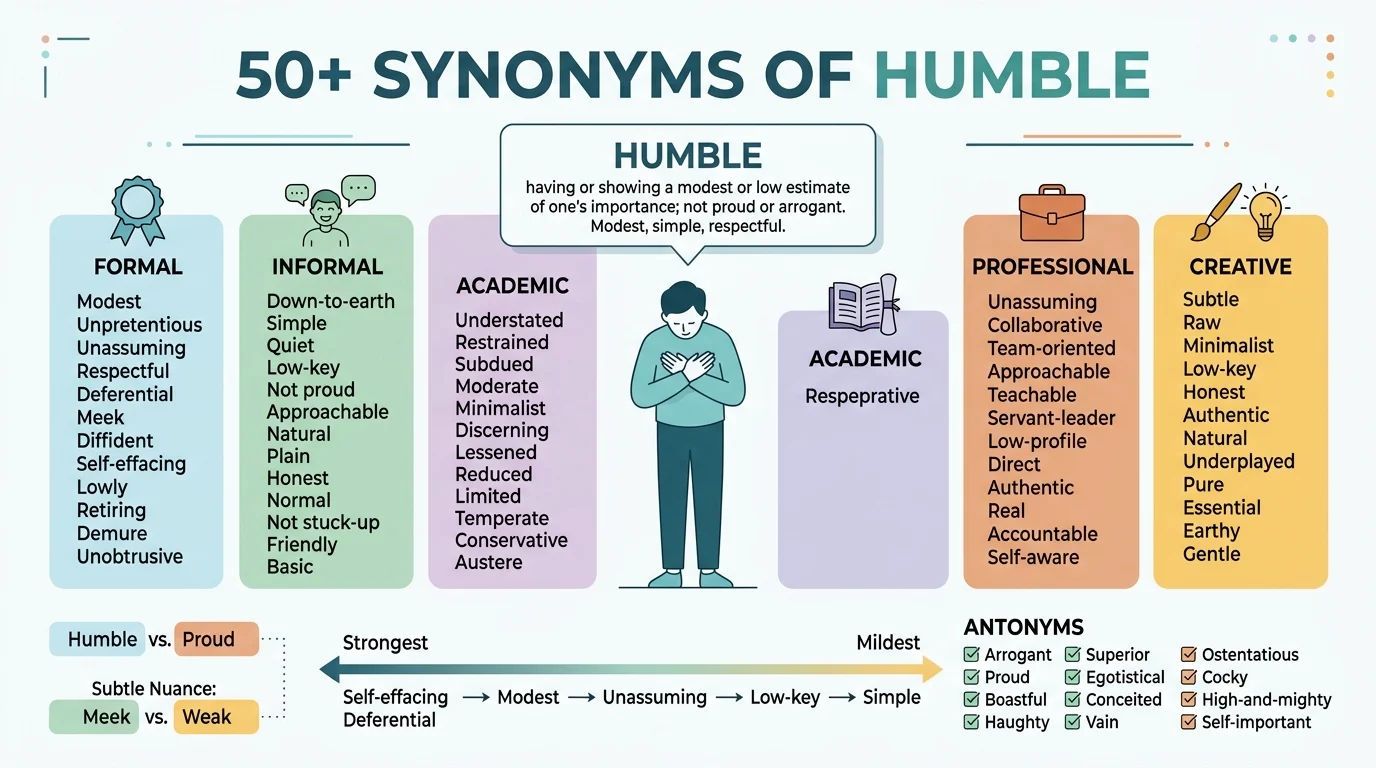
When describing a personality trait (someone who is not arrogant), use modest, unassuming, or self-effacing. When describing a person’s social rank or job (someone low in station), use lowly, common, or menial.
Formal vs. Conversational Synonyms
For formal writing (reports, professional emails), use unpretentious or deferential. For casual conversations, use modest or simple.
The Verb Forms
When using “humble” as a verb, synonyms include humiliate, degrade, and mortify. Humiliate is the most common direct synonym for causing someone to feel shame.
Creative and Literary Synonyms
To add a touch of old-fashioned charm to your writing, use humble itself or lowly. In classic literature, “a humble cottage” evokes a sense of peace and simplicity.
Slang or Modern Synonyms
In modern slang, calling someone “down-to-earth” is a very common and positive way to say they are humble and practical. “Humblebrag” is a modern portmanteau describing someone who is pretending to be humble.
Strongest to Mildest Synonyms
Mild (Personality): modest, simple, unpretentious
Moderate (Personality/Status): lowly, common, unassuming
Strong (Negative Submission): deferential, meek
Very Strong (Negative Submission): servile, obsequious
Verb: humiliate (strong), humble (moderate)
Emotional vs. Neutral Synonyms
Emotional/Submissive Synonyms: Meek, servile, obsequious. These carry strong emotional connotations, often negative.
Neutral/Descriptive Synonyms: Modest, lowly, unassuming. These simply describe a state of being without negative judgment.
Antonyms of “Humble”
Here are 15 genuine opposites of “humble.”
| Antonym | Meaning | Example Sentence |
|---|---|---|
| Proud | Having a high opinion of oneself | “He was too proud to ask for help.” |
| Arrogant | Unpleasantly proud and self-important | “The arrogant manager treated everyone poorly.” |
| Conceited | Excessively proud of oneself | “His conceited nature lost him friends.” |
| Pretentious | Attempting to impress by affecting greater importance | “She lived in a pretentious mansion.” |
| Noble | Belonging to the aristocracy (opposite of lowly) | “A man of noble birth.” |
| Grand | Magnificent and impressive (opposite of humble cottage) | “A grand palace.” |
| Haughty | Arrogantly superior and disdainful | “He had a haughty manner.” |
| Superior | Higher in rank, status, or quality | “She had a superior attitude.” |
| Exalted | Placed at a high level | “The exalted position of CEO.” |
| Pompous | Affectedly grand, solemn, or self-important | “His pompous speech was boring.” |
| Egotistical | Excessively conceited or absorbed in oneself | “His egotistical actions cost him the team.” |
| Snooty | Showing disapproval by being rude or unfriendly | “The snooty receptionist ignored me.” |
| Lofty | Of imposing height or a noble nature | “The lofty ideals were admirable.” |
| Condescending | Acting as if you are better than others | “His condescending tone was insulting.” |
| Immodest | Lacking humility | “Her immodest boasting turned people away.” |
Comparison: “Humble” vs Similar Words
Humble vs. Modest
Main Difference: These are very close synonyms. Modest often refers to a moderate estimate of one’s own abilities or importance. Humble often suggests a deeper sense of lowliness or a lack of pride at a fundamental level.
Which Is Stronger? Humble can be seen as a deeper virtue than modest.
Which Is More Formal? Both are neutral.
When to Use Each: Use modest for general descriptions of a person not boasting. Use humble for a more profound sense of self-awareness and lowliness.
Examples:
Humble: “Despite his fame, he was a humble man.”
Modest: “She was modest about her artistic talents.”
Humble vs. Lowly
Main Difference: Humble can describe personality or status. Lowly almost exclusively describes low social rank, position, or status.
Which Is Stronger? Lowly is stronger in describing lower social status.
Which Is More Formal? Both are neutral, but lowly is more literary.
When to Use Each: Use humble for personality. Use lowly for rank.
Examples:
Humble: “He has a humble spirit.”
Lowly: “He is a lowly worker in the factory.”
Humble vs. Servile
Main Difference: Humble (when applied to a person) is generally a positive trait. Servile is a negative trait implying a cringing, excessive willingness to obey or serve others, which stems from a lack of self-respect.
Which Is Stronger? Servile carries a much stronger negative emotional weight.
Which Is More Formal? Both are formal.
When to Use Each: Use humble for a compliment. Use servile to criticize someone for being a sycophant.
Examples:
Humble: “The respectful employee was humble.”
Servile: “The assistant’s fawning, servile behavior was embarrassing.”
Humble vs. Humbling (Verb/Adjective)
Main Difference: As a verb, humble is the act of making someone modest. Humbling is the adjective or participle describing the experience that causes that feeling. The experience is humbling.
Which Is Stronger? Humbling is a descriptor. Humbled is the state of being brought low.
Which Is More Formal? Both are neutral.
When to Use Each: Use humbled to describe your own feeling. Use humbling to describe the event.
Examples:
Humble: “The defeat will humble him.”
Humbling: “The support of my peers is humbling.”
Common Phrases and Expressions with “Humble”
Phrase: Humble beginnings
Meaning: Starting life in a low social or financial position.
Example Sentence: “He rose from humble beginnings to become a successful entrepreneur.”
Phrase: Eat humble pie
Meaning: To admit that you were wrong or to apologize.
Example Sentence: “After his mistake, he had to eat humble pie in front of the board.”
Phrase: In my humble opinion
Meaning: A polite way to introduce an opinion, often used ironically.
Example Sentence: “In my humble opinion, we need a better strategy.”
Phrase: Humble home
Meaning: A small or simple house.
Example Sentence: “They live in a humble home, but it’s filled with love.”
Common Mistakes to Avoid
Mistake 1: Using “humble” to describe oneself.
Incorrect: “I am a very humble person.”
Better: “I try to stay grounded.”
Why: Calling yourself humble often makes you sound boastful.
Mistake 2: Using “humble” when you mean “poor”.
Incorrect: “They were a very humble family, struggling to survive.”
Better: “They were a very poor family, struggling to survive.”
Why: Humble describes a modesty of spirit or style, not a lack of money.
Mistake 3: Using “servile” as a compliment.
Incorrect: “He is so servile; he’s a great employee.”
Better: “He is so conscientious; he’s a great employee.”
Why: Servile implies groveling, which is negative.
Mistake 4: Confusing “humbling” with “humiliating”.
Incorrect: “Losing the game was a humiliating experience that taught me to be humble.”
Better: “Losing the game was a humbling experience that taught me to be modest.”
Why: Humiliating is a painful experience. Humbling is a humbling lesson.
Frequently Asked Questions
1. What are the best synonyms of “humble”?
The best synonyms depend on your context. For describing a modest personality, modest or unassuming is ideal. And for low social rank, use lowly. For a negative form of submission, use servile or obsequious.
2. What are the best formal synonyms of “humble”?
The best formal synonyms are unpretentious and modest for personality, or lowly for status. Deferential is formal for showing respect.
3. What are common informal synonyms of “humble”?
For informal settings, use down-to-earth or simple. For background, ordinary works well.
4. What is another word for “humble” in a professional setting?
In professional writing, unassuming is a strong choice to describe a leader who is not arrogant. Modest is also excellent.
5. What is the difference between “humble” and “humbling”?
Humble is a character trait (adjective) or a verb meaning to bring down. Humbling is an adjective or participle describing an experience that makes you feel humble. The experience is humbling.
6. What is the opposite of “humble”?
The most direct opposites (antonyms) of humble are proud, arrogant, and conceited.
Conclusion
“Humble” is a rich word with two primary meanings: a modest lack of pride and a low social rank. The term is versatile and widely accepted in various contexts, yet it can sound ironic when used to describe oneself. The best choice among the synonyms of humble depends entirely on your audience, tone, and purpose. For a positive, formal effect, use modest or unassuming. To describe social standing, lowly works perfectly. For negative submission, choose servile. Remember, no single synonym works perfectly in every situation. Your goal is to choose the word that communicates your message with the most clarity and impact. A practical tip for your vocabulary growth is to practice using modest and unassuming in your professional writing to describe others with respect and precision.
Discover More:
- 50+ Synonyms of Terms: Meanings, Uses, Examples, and Best Alternatives 2026
- 50+ Synonyms of Propaganda: Meanings, Uses, Examples, and Best Alternatives 2026

Amelia Brooks is a professional content writer and digital publishing specialist with a passion for creating clear, engaging, and informative content. She has extensive experience writing about technology, business, lifestyle, and online services.