Have you ever needed to describe how someone behaves, how a business is run, or how energy travels but felt that common words did not capture the full meaning? You want to convey management, behavior, or transmission, and the word “conduct” comes to mind. But is it the best fit for your audience? Choosing the right synonym for “conduct” can transform a simple statement into a precise description of behavior, management, or direction. This guide explores the best synonyms of conduct, explaining exactly which word to use and when.
Quick Ans: “Conduct” means the manner in which a person behaves (noun) or to direct, manage, or carry out an activity (verb). It is a neutral, formal word. For professional writing, choose manage or direct (verb) or behavior (noun). For casual conversation, use run (verb) or ways (noun). In academic contexts, administer and demeanor are strong choices. For a stronger, more dramatic impact, select supervise or govern.
Meaning, Tone, and Context
Understanding the core meaning of “conduct” is the first step to using it effectively.
Simple Definition: (Noun) The way a person behaves. (Verb) To organize, direct, or carry out an activity. Also, to transmit energy.
Part of Speech: Noun and Verb .
Overall Tone: Neutral to formal. It describes actions, behavior, or processes without strong emotional coloring.
Formality Level: Formal. The word is appropriate in professional, academic, and official contexts.
Common Uses: Native English speakers use it to describe behavior (“good conduct”), management (“conduct business”), transmission (“metals conduct electricity”), and guidance (“conduct a tour”) .
Word Forms: Related words include the noun conduction, the adjective conductive, the noun conductor, and the noun conductivity.
When and How to Use “Conduct”
“Conduct” is a versatile word with several distinct meanings. Here are seven realistic examples.
Professional: “The manager will conduct the meeting according to the agenda.”
Academic: “The researcher conducted a study on sleep patterns.”
Workplace: “Employees are expected to conduct themselves professionally.”
Personal: “Her conduct at the dinner party was impeccable.”
Scientific: “Copper and silver conduct electricity efficiently.”
Email: “I will conduct a review of the project timeline.”
Social Media: “Conduct yourself with kindness online.”
Best Synonyms of “Conduct”
No synonym is identical in every situation. Here is your guide to the best replacement for “conduct” based on your writing context.
Professional Writing (Verb): Manage. It suggests control and organization. “She manages the daily operations” .
Professional Writing (Noun): Behavior. A direct and widely understood alternative. “His behavior was professional” .
Academic Writing (Verb): Administer. This is ideal for formal processes and tests. “The team administered the questionnaire” .
Business Communication: Direct. It implies guiding and overseeing. “He directs the marketing strategy” .
Casual Conversation (Verb): Run. It tones down the formality. “She runs the department efficiently” .
Casual Conversation (Noun): Ways. A natural, informal word for behavior. “She has funny ways” .
Describing Guidance: Lead. It suggests taking someone somewhere. “He led us through the museum” .
Describing Transmission: Carry. A simpler word for conducting energy. “Copper carries electricity” .
Resume Writing: Supervise. Use it to show leadership and oversight. “Supervised a team of ten employees” .
When Not to Use “Conduct”
Using “conduct” can sound wrong or awkward in certain situations.
When It Sounds Too Formal: In casual conversation, “conduct” sounds stiff.
Better Choice (Verb): Run. “She runs the store” instead of “She conducts the store.”
Better Choice (Noun): Behavior. “His behavior is odd” instead of “His conduct is odd” (though this is acceptable).
When Describing a Simple Action: “Conduct” is for organized activities, not simple actions.
Better Choice: Do. “I will do the laundry” instead of “I will conduct the laundry.”
When You Mean “Lead” a Person: “Conduct” can mean guide, but “lead” or “take” is simpler.
Better Choice: Lead. “He led us to the restaurant” instead of “He conducted us to the restaurant.”
When It Sounds Too Vague: “Conduct” can be vague for behavior.
Better Choice: Demeanor or manner. “Her calm demeanor was appreciated” .
Words Commonly Confused With “Conduct”
Several words are often mixed up with “conduct.” Here is how to keep them straight.
Word: Behavior
Difference: A direct synonym for the noun form. “Conduct” is more formal.
When to Use: Use it in most everyday situations.
Example: “His behavior was unacceptable” .
Word: Manage
Difference: Means to control or handle. “Conduct” as a verb means to direct or carry out.
When to Use: Use this for running operations.
Example: “She manages the entire project” .
Word: Lead
Difference: Means to guide or show the way. “Conduct” can also mean guide.
When to Use: Use this for physically guiding someone.
Example: “He led us to the exit” .
Word: Run
Difference: An informal synonym for managing. “Conduct” is more formal.
When to Use: Use this in casual contexts.
Example: “He runs the family business” .
Word: Demeanor
Difference: Refers to outward appearance and behavior. “Conduct” is broader.
When to Use: Use this for describing how someone comes across .
Word: Transmit
Difference: A technical synonym for energy transfer. “Conduct” is more general.
When to Use: Use this for signals or information.
Example: “The tower transmits signals” .
Best Synonyms of “Conduct” by Context
| Context | Best Synonym | Why It Works | Example |
|---|---|---|---|
| Formal writing (Verb) | Administer | Precise for official processes. | “The official administered the oath.” |
| Formal writing (Noun) | Demeanor | Suggests outward bearing. | “Her calm demeanor was noted” . |
| Academic writing | Carry out | Clear and scholarly. | “The team carried out the experiment.” |
| Professional communication | Direct | Conveys authority and oversight. | “He directs the project team” . |
| Business emails | Handle | Practical and clear. | “I will handle the customer inquiry” . |
| Resume writing | Supervise | Highlights leadership skills. | “Supervised daily operations” . |
| Workplace communication | Run | Casual and efficient. | “She runs the office smoothly” . |
| Casual conversation | Ways | Natural and informal for behavior. | “He has his own ways” . |
| Creative writing | Comport | Evokes dignity and formality. | “She comported herself with grace” . |
| Scientific writing | Transmit | Precise for energy transfer. | “The material transmits heat” . |
| Describing behavior | Manner | Simple and direct. | “His manner was pleasant” . |
| Social media captions | Act | Widely understood and relatable. | “Act with kindness.” |
How to Choose the Best Synonym of “Conduct”
Choosing the right word is a simple decision. Answer these questions.
What is my audience? For a professor or CEO, administer, direct, or demeanor is powerful. For a friend, run, act, or ways is more natural .
What is my purpose? Are you describing behavior, management, energy transfer, or guidance? Use behavior for conduct (noun), manage for running operations, transmit for energy, and lead for guiding.
Am I using it as a noun or a verb? For behavior, use conduct or behavior. For action, use conduct, manage, or carry out.
What is the emotional strength? Comport and demeanor are more elegant. Manage and run are more practical. Pick the one that matches your message.
Real Life Examples of “Conduct”
To truly master the word, it helps to see how it behaves in the wild and how a stronger synonym can elevate the sentence.
School: Basic: “The student’s conduct was excellent.” Improved: “The student’s behavior was excellent.”
College: Basic: “They conducted the research.” Improved: “They carried out the research according to protocol.”
Workplace: Basic: “He conducts the team meetings.” Improved: “He facilitates the team meetings effectively.”
Business: Basic: “The CEO conducts the company.” Improved: “The CEO directs the company with a clear vision” .
Email: Basic: “I will conduct the review.” Improved: “I will perform the review and share my findings.”
Conversation: Basic: “How should I conduct myself?” Improved: “How should I behave at the party?” .
Storytelling: Basic: “Her conduct was admirable.” Improved: “Her deportment was admirable, every movement graceful and poised” .
Top 10 Synonyms of “Conduct”
| Synonym | Simple Meaning | Best Used For | Example Sentence |
|---|---|---|---|
| Manage | To control and handle operations | Professional, business, and action contexts. | “She manages the office efficiently” . |
| Direct | To guide and oversee | Leadership, business, and strategic contexts. | “He directs the marketing department” . |
| Behavior | The way a person acts | General, everyday, and neutral contexts. | “His behavior was praised” . |
| Administer | To manage official processes | Academic, legal, and official contexts. | “The team administered the survey” . |
| Supervise | To oversee and guide | Workplace, leadership, and operational contexts. | “She supervises the production line” . |
| Run | To manage informally | Casual, everyday, and business contexts. | “He runs the family business” . |
| Lead | To guide or show the way | Personal, guidance, and leadership contexts. | “The guide led us through the museum” . |
| Handle | To deal with or manage | Practical, business, and task contexts. | “I will handle the customer complaint” . |
| Transmit | To send or carry energy | Scientific, technical, and medical contexts. | “The cables transmit electricity” . |
| Demeanor | Outward behavior and bearing | Professional, personal, and character contexts. | “Her calm demeanor was reassuring” . |
Synonyms of “Conduct” by Usage
Professional vs. Personal Synonyms
In the workplace (professional), choose manage, direct, supervise, or behavior to describe operations and actions. These words convey professionalism and authority. “He manages the department” is more precise than “He conducts the department” .
With friends (personal), run, ways, or act keep the tone relaxed and relatable. These alternatives sound natural in everyday conversation .
Formal vs. Conversational Synonyms
For formal writing (reports, essays, professional emails), use administer, supervise, direct, or deportment. These choices maintain the sophisticated tone expected in professional documents .
For casual conversations and texting, use run, ways, act, or carry out. These options sound more natural and less pretentious.
Academic Synonyms
For research and essays, choose precise, authoritative words. Administer is great for surveys and tests, carry out for experiments, and behavior for sociological observations. These words sound considered and scholarly.
Using precise academic vocabulary demonstrates expertise and careful thinking.
Professional and Business Synonyms
For maximum impact in professional writing, choose supervise for leadership, manage for operations, and direct for strategy. These words demonstrate confidence and professional awareness .
Business leaders respond to language that conveys clarity and authority.
Creative and Literary Synonyms
To add emotion and imagery to your writing, choose comport, deportment, or mien. These words create atmosphere and character depth .
Literary writers use these alternatives to build personality and dignity. They transform ordinary descriptions into evocative prose.
Slang or Modern Synonyms
There is no direct slang synonym for “conduct” in mainstream American English. In modern texting, people use run, act, or behave. This straightforward approach works best for casual digital communication.
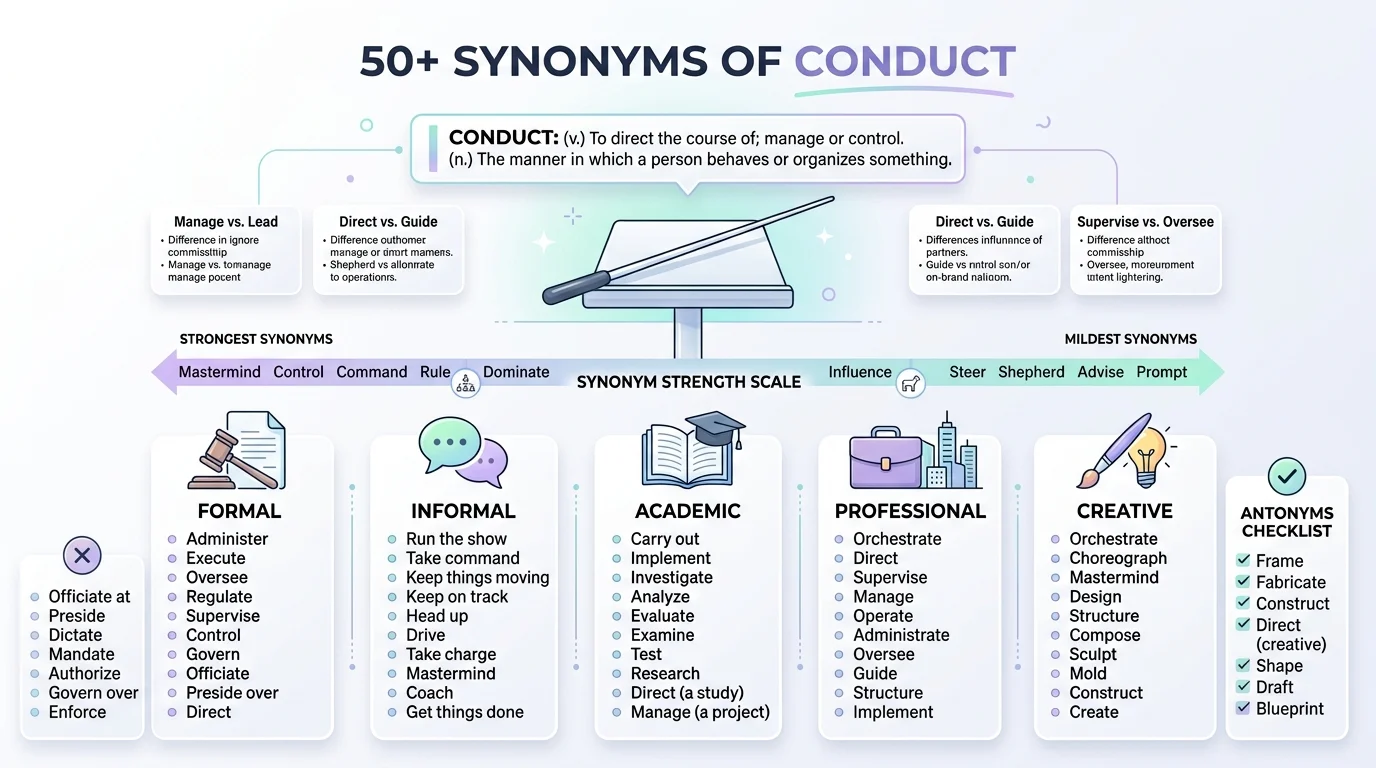
Strongest to Mildest Synonyms
Mild: ways, act, do
Moderate: handle, carry out, run
Strong: manage, supervise, lead
Very Strong: direct, govern, administer, comport
Emotional vs. Neutral Synonyms
Emotional Synonyms: Comport, deportment, mien. These words often hint at dignity, grace, or elegance. Use them when you want to evoke feeling.
Neutral Synonyms: Manage, run, behavior, handle. These words simply communicate factual information. Use them when you want to inform without emotional coloring.
Antonyms of “Conduct”
Here are 15 genuine opposites of “conduct.”
| Antonym | Meaning | Example Sentence |
|---|---|---|
| Mismanage | To handle badly | “He mismanaged the company” . |
| Neglect | To fail to care for | “She neglected her duties” . |
| Misconduct | Improper behavior | “His misconduct led to dismissal.” |
| Abandon | To give up entirely | “He abandoned the project.” |
| Disorder | A lack of order | “The disorder in the room was obvious.” |
| Chaos | Complete confusion | “The chaos disrupted the event.” |
| Disorganize | To throw into disorder | “The changes disorganized the team.” |
| Ignore | To pay no attention | “She ignored the instructions.” |
| Misdirect | To direct wrongly | “The manager misdirected the team.” |
| Mishandle | To handle incorrectly | “He mishandled the situation.” |
| Fail | To not succeed | “The plan failed completely.” |
| Bungle | To do poorly | “She bungled the presentation.” |
| Botch | To ruin by poor work | “He botched the repair.” |
| Disobey | To refuse to follow | “The student disobeyed the rules.” |
| Insubordination | Defiance of authority | “His insubordination led to termination.” |
Comparison: “Conduct” vs Similar Words
Conduct vs. Manage
Main Difference: Conduct can mean to lead or carry out. Manage specifically means to handle or control .
Which Is Stronger? Manage is stronger for control.
Which Is More Formal? Both are formal.
When to Use Each: Use conduct for organized activities. Use manage for operations.
Examples:
Conduct: “We conducted a survey.”
Manage: “We manage the daily operations” .
Conduct vs. Behavior
Main Difference: Conduct is more formal. Behavior is the direct synonym .
Which Is Stronger? They are equal in meaning.
Which Is More Formal? Conduct is more formal.
When to Use Each: Use conduct in formal contexts. Use behavior in everyday situations.
Examples:
Conduct: “His conduct was professional.”
Behavior: “His behavior was odd.”
Conduct vs. Direct
Main Difference: Direct means to guide. Conduct can mean to guide or carry out .
Which Is Stronger? Direct is stronger for leadership.
Which Is More Formal? Both are formal.
When to Use Each: Use direct for guidance and leadership. Use conduct for carrying out.
Examples:
Conduct: “We conducted the experiment.”
Direct: “He directs the team” .
Conduct vs. Run
Main Difference: Run is informal. Conduct is formal .
Which Is Stronger? They are equal.
Which Is More Formal? Conduct is formal.
When to Use Each: Use run in casual contexts. Use conduct in formal writing.
Examples:
Conduct: “The organization conducts classes.”
Run: “She runs the program.”
Conduct vs. Demeanor
Main Difference: Demeanor refers to outward appearance and behavior. Conduct is broader .
Which Is Stronger? Demeanor is more specific.
Which Is More Formal? Both are formal.
When to Use Each: Use demeanor for how someone appears. Use conduct for general behavior.
Examples:
Conduct: “His conduct was praised.”
Demeanor: “Her calm demeanor was reassuring” .
Conduct vs. Transmit
Main Difference: Conduct can mean energy transfer. Transmit is the technical synonym .
Which Is Stronger? Transmit is more technical.
Which Is More Formal? Both are formal.
When to Use Each: Use conduct for heat and electricity. Use transmit for signals and information.
Examples:
Conduct: “Copper conducts electricity” .
Transmit: “The tower transmits signals” .
Common Phrases and Expressions with “Conduct”
Phrase: Conduct an experiment
Meaning: To perform a scientific test.
Example Sentence: “The scientist conducted an experiment” .
Phrase: Conduct oneself
Meaning: To behave in a particular way.
Example Sentence: “He conducted himself with dignity” .
Phrase: Code of conduct
Meaning: A set of rules governing behavior.
Example Sentence: “The company has a strict code of conduct.”
Phrase: Conduct business
Meaning: To do business.
Example Sentence: “We conduct business globally.”
Phrase: Conduct a survey
Meaning: To carry out a survey.
Example Sentence: “The agency conducted a survey.”
Phrase: Good conduct
Meaning: Positive behavior.
Example Sentence: “The student received an award for good conduct.”
Common Mistakes to Avoid
Mistake 1: Using “conduct” when you mean “manage”.
Incorrect: “She conducts the department.”
Better: “She manages the department” .
Why: Manage implies control and oversight.
Mistake 2: Using “conduct” for simple actions.
Incorrect: “I will conduct the laundry.”
Better: “I will do the laundry.”
Why: Conduct is for organized activities.
Mistake 3: Overusing “conduct” in casual conversation.
Incorrect: “How should I conduct myself?”
Better: “How should I behave?” .
Why: Behave sounds more natural in casual conversation.
Mistake 4: Using “conduct” when you mean “transmit”.
Incorrect: “The wire conducts signals.”
Better: “The wire transmits signals” .
Why: Transmit is for signals.
Mistake 5: Confusing “behavior” and “conduct”.
Incorrect: “His conduct at the party was loud.”
Better: “His behavior at the party was loud.”
Why: Behavior is the more common word.
Frequently Asked Questions
1. What are the best synonyms of “conduct”?
The best synonyms depend on your context. For formal writing, choose manage, direct, or administer. For casual conversation, run, behavior, or ways are ideal choices .
2. What are the best formal synonyms of “conduct”?
The best formal synonyms are administer, supervise, and direct. These words are suitable for academic papers, professional reports, and business communications .
3. What are common informal synonyms of “conduct”?
For informal settings, use run, behavior, act, or carry out. These alternatives sound more natural in everyday conversation .
4. What is another word for “conduct” in professional writing?
In professional writing, manage or supervise are excellent choices. They convey control and leadership authority .
5. What is the difference between “conduct” and “behavior”?
While both refer to actions, conduct is more formal. Behavior is the direct synonym and more common in everyday situations .
6. What is the opposite of “conduct”?
The most direct opposites (antonyms) of conduct are mismanage, neglect, and misconduct .
Conclusion
“Conduct” is a versatile word with multiple meanings, covering behavior, management, energy transmission, and guidance. The term is formal and widely accepted in professional contexts, yet it can sound overly formal in everyday conversation. The best choice among the synonyms of conduct depends entirely on your audience, tone, and purpose. Remember, no single synonym works perfectly in every situation. Your goal is to choose the word that communicates your message with the most clarity and impact. A practical tip for your vocabulary growth is to pay attention to how different contexts call for different synonyms and practice using them in your daily writing.
Discover More:
- 50+ Synonyms of Ethereal: Meanings, Uses, Examples, and Best Alternatives 2026
- 50+ Synonyms of Developed: Meanings, Uses, Examples, and Best Alternatives 2026

Alexander Cole is a professional content writer and researcher who specializes in creating informative, reader-friendly, and well-researched articles. He is committed to publishing accurate, valuable, and engaging content that helps readers stay informed and make smarter decisions.