Have you ever been writing an essay, a professional email, or a speech and realized you are overusing the word “we”? You want to refer to yourself and others, but the repetition feels monotonous and informal. Choosing the right synonym for “we” can transform a repetitive text into a nuanced, engaging, and precise piece of communication. This guide explores the best synonyms of we, explaining exactly which alternative to use and when.
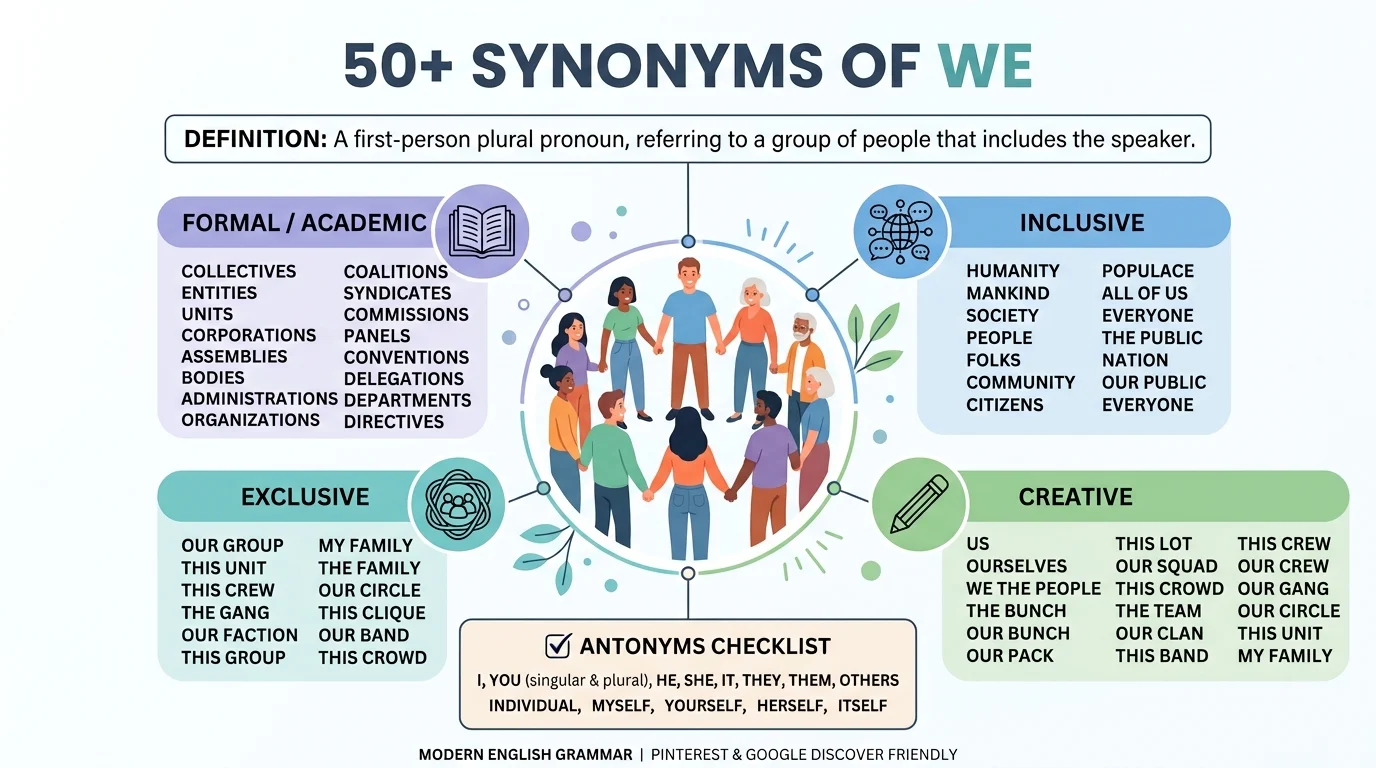
Quick Ans: “We” is a first-person plural pronoun used by a speaker to refer to themselves and at least one other person. It does not have direct one-word synonyms in the traditional sense . However, depending on the context and your goal, you can replace it with phrases like “all of us,” “the group,” “our team,” “you and I,” or even switch to a third-person pronoun like “they” for formal writing . The best choice depends on whether you want to include or exclude your audience and the level of formality required.
Meaning, Tone, and Context
Understanding the core meaning of “we” is the first step to using it effectively.
Simple Definition: Used by a speaker to refer to themselves and one or more other people considered together .
Part of Speech: Pronoun .
Overall Tone: Neutral. The tone is dictated by how it is used. It can be inclusive and warm, or exclusive and impersonal.
Formality Level: Neutral to informal. In formal academic writing, the use of “we” can be problematic and is often replaced.
Common Uses: Native English speakers use “we” constantly to refer to a group that includes themselves. For example, “We are going to the store,” or “We need to finish this project.”
Clusivity: English does not distinguish between “inclusive we” (including the listener) and “exclusive we” (excluding the listener) . For example, saying “We are going to the party” to a friend could mean “You and I” (inclusive) or “My spouse and I” (exclusive). This distinction is critical for clarity.
When and How to Use “We”
“We” is the go-to word for speaking as a collective. Here are seven realistic examples.
Inclusive (You and I): “We should all work together to solve this problem.”
Exclusive (My team and I): “I am sorry, but we already have plans for tonight.”
Professional: “We have decided to move forward with the new policy.” (Editorial we)
Academic: “We can see from the data that the trend is clear.” (Author’s we)
Personal: “We (my family and I) are going on vacation next week.”
Email: “We will be in touch soon regarding your application.”
Social Media: “We made it! Thanks for all the support.”
Best Alternatives to “We”
Since “we” lacks direct synonyms, the best replacement depends entirely on your context .
Professional & Academic Writing (Removing “We”)
In formal essays and reports, first-person pronouns like “we” are often discouraged. Here are the best ways to avoid them .
Alternative: The Group / The Team. This is a standard way to refer to your research team or organization in the third person. “The group was able to conclude the following findings.”
Alternative: They. By using a third-person pronoun, you remove yourself from the narrative to sound more objective. Original: “We have so much creativity.” Alternative: “They have so much creativity.”
Alternative: The Organization. Use this for formal institutions. “The organization will push through with the planned fundraising project.”
Emphasizing Inclusion & Specificity
When you need to be clear about who “we” includes.
Alternative: All of us. Emphasizes the entire group. “All of us wanted to be here to say goodbye.”
Alternative: You and I. Specifies that “we” includes the person you are speaking to. “You and I can handle this.”
Alternative: _ and I. Naming individuals for absolute clarity. “Emily, Dave, and I walked home together.”
Alternative: We ourselves. Used for emphasis to stress that your group, and no one else, did something. “We ourselves cast the deciding votes.”
Emphasizing the Group
Alternatives to highlight the collective.
Alternative: Ourselves. A reflexive pronoun used to talk about “us.” “We should think for ourselves.”
Alternative: The Body. Used for large groups like an audience. “The body didn’t find the presentation interesting.”
When Not to Use “We”
Using “we” can be confusing or sound arrogant in certain situations.
When It Is Confusing: If it is unclear if “we” includes the listener, use a more specific phrase.
Better Choice: You and I or My team and I. “You and I should work on this together.”
When You Mean “I”: The “royal we” or “nosism” (using “we” to refer to oneself) can sound pompous.
Better Choice: I or Me. “I think this is a good idea.”
When Writing Formally: In formal essays, first-person pronouns are often banned.
Better Choice: The researchers, The group, or passive voice. “The experiment was conducted.”
When It Sounds Condescending: The “second-party we” is used in place of “you” and sounds patronizing.
Better Choice: You. “How are you this evening?”
Words Commonly Confused With “We”
While not synonyms, these concepts are closely related.
Word: Us
Difference: Us is the object form of we. “We” is for the subject. “We (subject) are going.” vs. “They told us (object).”
Word: Our/Ours
Difference: This is the possessive form of we. “We” is the pronoun for the group. “We have our tickets.”
Best Alternatives to “We” by Context
| Context | Best Alternative | Why It Works | Example |
|---|---|---|---|
| Formal Academic | The Group | Creates objectivity by referring to the research team in the third person. | “The group was unable to replicate the results.” |
| Formal Business | The Organization | Professionalizes the entity making the decision. | “The organization will not tolerate that behavior.” |
| Inclusive (You & I) | You and I | Provides absolute clarity that the listener is included. | “You and I need to leave now.” |
| Exclusive (My team) | My team and I | Clarifies that the listener is not included. | “My team and I have plans tonight.” |
| Emphasizing All | All of us | Highlights the totality of the group. | “All of us wanted to be here.” |
| Removing “We” | They | Removes the author from the narrative for objectivity. | “They have implemented new policies.” |
| Emphasis | We ourselves | Stresses personal involvement. | “We ourselves created the solution.” |
| Creative Writing | The crowd, The masses | Creates a specific, evocative image of the group. | “The masses were restless.” |
How to Choose the Best Alternative
Choosing the right word is a simple decision. Answer these questions.
What is my audience? For an academic paper, use “the group” or “they.” For a friend, “you and I” or “all of us” sounds natural.
What is my purpose? Are you trying to be formal, objective, or inclusive? Use “the team” for objectivity, “you and I” for inclusivity, and “they” for formality.
Does “we” include the listener? If yes, use “You and I.” If no, use “My team and I.”
Real Life Examples
To truly master the alternatives, it helps to see them in the wild.
School: Basic: “We have a test tomorrow.” Improved: “The class has a test tomorrow.”
College: Basic: “We will now analyze the poem.” Improved: “The analysis will now focus on the poem.”
Workplace: Basic: “We need to improve sales.” Improved: “The sales team needs to improve numbers.”
Business: Basic: “We will release the new product.” Improved: “The company will release the new product.”
Email: Basic: “We are looking forward to hearing from you.” Improved: “The committee looks forward to hearing from you.”
Conversation: Basic: “We should go.” Improved: “You and I should go.”
Storytelling: Basic: “We were lost in the woods.” Improved: “The group was lost in the woods.”
Top 10 Synonyms & Alternatives for “We”
| Alternative | Simple Meaning | Best Used For | Example Sentence |
|---|---|---|---|
| You and I | The speaker and the listener only | Clarifying inclusive “we.” | “You and I will handle this.” |
| The Group | The team or collective | Formal academic writing. | “The group concluded the findings.” |
| All of us | The entire group | Emphasizing the whole group. | “All of us wanted to help.” |
| Our team | The specific team | Professional, collaborative contexts. | “Our team is ready to present.” |
| They | Third-person group | Removing “we” for objectivity. | “They have already completed it.” |
| Ourselves | Reflexive pronoun | When “we” is the object of an action. | “We should prepare ourselves.” |
| We ourselves | Emphatic version | Emphasizing personal involvement. | “We ourselves built this.” |
| My colleagues | Fellow workers | Professional, formal introductions. | “My colleagues and I…” |
| The body | Large group | Referring to a large, diverse group. | “The body listened carefully.” |
| The public | General population | Formal and general contexts. | “The public is not concerned.” |
Formal vs. Informal Alternatives
For formal writing (reports, essays), use The group, The organization, or They to avoid the first person. For informal writing and conversation, use You and I, All of us, or Ourselves.
Creative & Literary Alternatives
To add emotion and imagery, use The crowd, The masses, or The world. These alternatives create atmosphere and evoke a sense of scale.
Strongest Emphasis vs. Mildest Alternatives
Mild: us, our
Moderate: ourselves, you and I
Strong: we ourselves, all of us
Very Strong: the masses, the entire world
Antonyms of “We”
Here are 7 opposites of “we.”
| Antonym | Meaning | Example Sentence |
|---|---|---|
| They | Refers to others, excluding the speaker. | “They went to the store.” |
| You | Refers to the listener. | “You should go.” |
| I | Refers only to the speaker. | “I will do it.” |
| Them | Object form of “they.” | “We gave it to them.” |
| Other people | Explicitly excludes the speaker. | “Other people feel differently.” |
| Everyone else | Everyone except the speaker. | “Everyone else agreed.” |
| The public | A group that does not include the speaker. | “The public is unaware.” |
Comparison: “We” vs Similar Concepts
We vs. I
Main Difference: We refers to a group. I refers to one person.
When to Use Each: Use I when speaking only for yourself. Use We when representing a group.
We vs. They
Main Difference: We includes the speaker. They excludes the speaker.
When to Use Each: Use We when you are part of the group. Use They when you are outside it.
Inclusive We vs. Exclusive We
Main Difference: Inclusive we means “you and I.” Exclusive we means “I and others, but not you.”
When to Use Each: Use context and phrasing to avoid confusion. Say “You and I” for inclusive and “My team and I” for exclusive.
Common Phrases and Expressions with “We”
Phrase: We are
Meaning: The present tense of “we.”
Example: “We are happy.”
Phrase: We have
Meaning: The present perfect tense of “we.”
Example: “We have arrived.”
Phrase: We should
Meaning: Expressing advice.
Example: “We should go.”
Phrase: Editorial we
Meaning: Used by a single author to state an opinion as if the organization agrees.
Example: “We will not tolerate this.”
Phrase: Royal we
Meaning: Used by royalty to refer to themselves.
Example: “We are not amused.”
Phrase: Nosism
Meaning: Using “we” to refer to oneself.
Example: “We think this is a great idea.” (Avoid it.)
Common Mistakes to Avoid
Mistake 1: Using “we” when you mean “I”.
Incorrect: “We think this is a great idea.” (When speaking alone.)
Better: “I think this is a great idea.”
Why: The “royal we” sounds pompous.
Mistake 2: Using “we” in formal academic writing.
Incorrect: “We conducted the experiment.”
Better: “The researchers conducted the experiment.”
Why: Formal essays often require third-person objectivity.
Mistake 3: Being vague about who “we” is.
Incorrect: “We are going.” (Is the listener invited?)
Better: “You and I are going.” (Inclusive) or “My team and I are going.” (Exclusive)
Why: English lacks separate words for inclusive and exclusive “we.”
Mistake 4: Using the condescending “we”.
Incorrect: “Did we brush our teeth today?”
Better: “Did you brush your teeth today?”
Why: The “second-party we” sounds patronizing.
Frequently Asked Questions
1. What is the best synonym for “we”?
Because “we” is a pronoun, there are no true one-word synonyms . The best alternative depends on context. For formal writing, use “the group.” For clarity, use “you and I.”
2. How can I replace “we” in a formal essay?
Use third-person alternatives like “the group,” “the team,” “the researchers,” or “they” to maintain objectivity and avoid the first person .
3. What are common formal alternatives to “we”?
The best formal alternatives are “the group,” “the team,” “the organization,” and “they” .
4. What is another word for “we” in professional writing?
In professional writing, use “our team,” “the company,” or “the group” to refer to your organization .
5. What is the difference between inclusive and exclusive “we”?
Inclusive “we” includes the person being addressed (“you and I”). Exclusive “we” does not include the listener (“my team and I”) .
6. What is the opposite of “we”?
The direct opposite is they, which refers to a group that excludes the speaker. Other antonyms include you and I .
Conclusion
“We” is a powerful and essential word for referring to a group that includes the speaker. Since it lacks direct synonyms, the best “replacement” depends on whether you need to be formal, inclusive, or clear. For a dramatic, formal effect, use “the group” or “the organization.” For practical clarity, use “you and I” (inclusive) or “my team and I” (exclusive). To avoid the first person, use “they.” Remember, no single alternative works perfectly in every situation. Your goal is to choose the word or phrase that communicates your message with the most clarity and impact. A practical tip for your vocabulary growth is to pay attention to how others introduce groups and practice using different alternatives in your writing and speech.
Discover More:
- 50+ Synonyms of Cool: Meanings, Uses, Examples, and Best Alternatives 2026
- 50+ Synonyms of Terms: Meanings, Uses, Examples, and Best Alternatives 2026

Alexander Cole is a professional content writer and researcher who specializes in creating informative, reader-friendly, and well-researched articles. He is committed to publishing accurate, valuable, and engaging content that helps readers stay informed and make smarter decisions.